The tradition & historical record
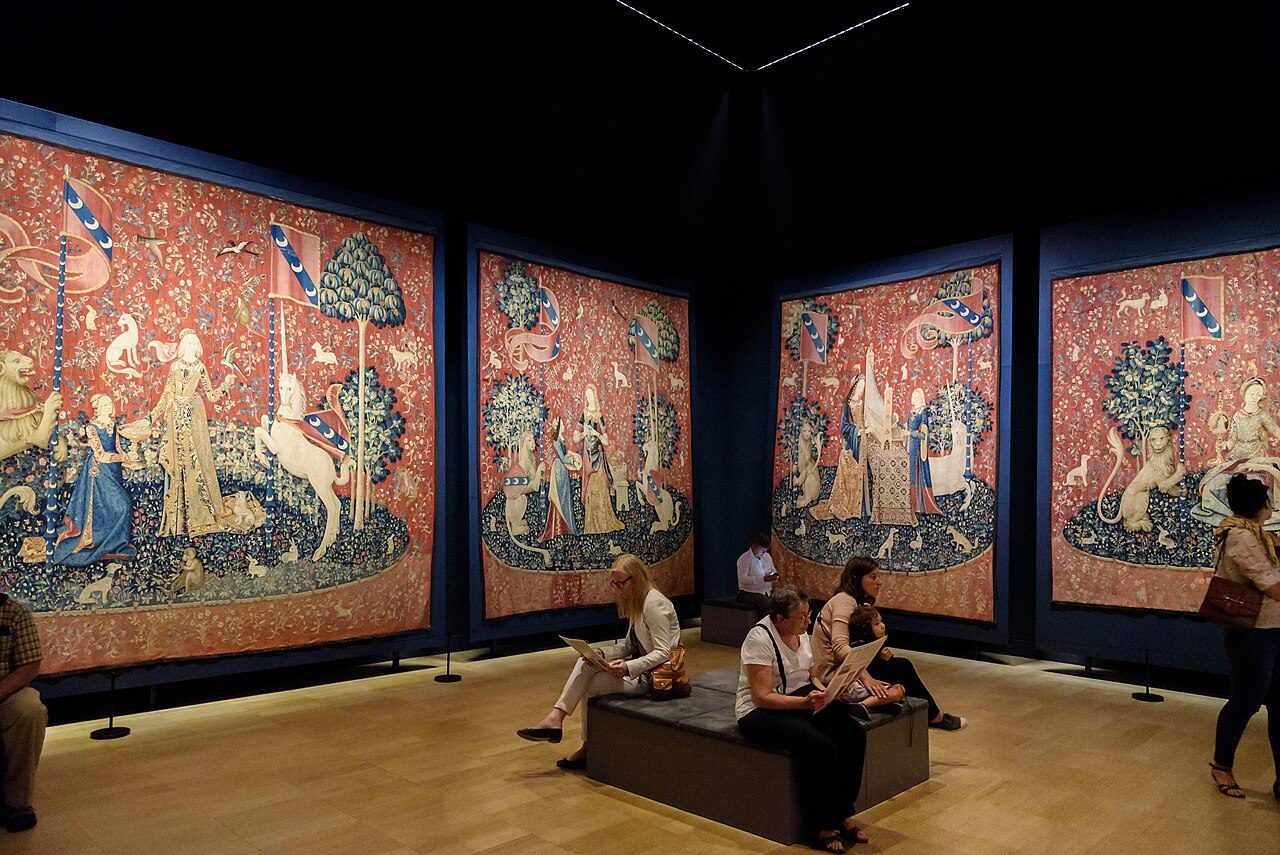
4 min read · 2 sourcesThe Lady and the Unicorn (French: La Dame à la licorne) is the modern title given to a series of six tapestries created in the style of mille-fleurs ("thousand flowers") and woven in Flanders from wool and silk, from designs ("cartoons") drawn in Paris around 1500. The set is on display in the Musée de Cluny in Paris. Five of the tapestries are commonly interpreted as depicting the five senses – taste, hearing, sight, smell, and touch. The sixth displays the words "À mon seul désir". The tapestry's intended meaning is obscure, but has been interpreted as representing love or understanding. Each of the six tapestries depicts a noble lady with a unicorn on her left and a lion on her right; some include a monkey in the scene. 1
History
The famous tapestries were rediscovered in 1841 by Prosper Mérimée at Boussac Castle, then owned by the subprefect of the Creuse. At the time, the tapestries were in poor condition due to improper storage, suffering from dampness and mould. In 1844, the novelist George Sand encountered the tapestries and brought them to public attention, notably through her novel Jeanne, in which she accurately dated them to the late 15th century by analyzing the ladies' costumes. Despite growing interest, the tapestries remained at risk until 1882, when Edmond Du Sommerard, curator of the Musée de Cluny in Paris, purchased them. Since then, they have undergone meticulous conservation efforts, restoring them nearly to their original splendor. Today, the tapestries are housed at the Musée de Cluny, where they remain on display. 1
Content and themes
The subject of the tapestries is complex, and scholars "now (generally) agree that they present a meditation on earthly pleasures and courtly culture, offered through an allegory of the senses." The pennants, as well as the armor of the unicorn and lion in the tapestry appear to bear the arms of Antoine II or Jean IV Le Viste, Baron of Montreuil, a powerful nobleman in the court of Charles VII of France and presumably its sponsor. The arms, however, appear to break the rules of French heraldry with an incorrect superposition of colors. A very recent study of the heraldry appears to lend credence to another hypothesis (previously dismissed) that the real sponsor of the tapestry was Antoine II Le Viste (1470–1534), a descendant of the younger branch of the Le Viste family and an important figure at the court of Charles VIII, Louis XII, and François I. 1
Touch
The 'Touch' tapestry displays a noble lady standing with one hand touching the horn of a unicorn, and the other holding up a pennant. A lion sits to the side and looks on. 1
Taste
In the 'Taste' tapestry, the lady takes sweets from a dish held by a maidservant. Her eyes are on a parakeet on her upheld left hand. The lion and the unicorn are both standing on their hind legs, reaching up to pennants that frame the lady on either side. The monkey is at her feet, eating one of the sweetmeats. The animals within the background create an illusive environment. 1
Smell
In the 'Smell' tapestry, the lady stands, making a wreath of flowers. Her maidservant holds a basket of flowers within her easy reach. Again, the lion and unicorn frame the lady while holding on to the pennants. The monkey has stolen a flower which he is smelling, providing the key to the allegory. 1
The text above is adapted from the Wikipedia article “The Lady and the Unicorn”, available under the Creative Commons Attribution-ShareAlike 4.0 licence. 1
The Lady and the Unicorn is collection of medieval tapestries, Musée national du Moyen Âge, Paris, according to the structured record cited below. This entry was generated automatically from that record and has not yet been reviewed by a person familiar with the tradition. 2
The source record links this tradition to 14 external registers, which can be verified through the citation. 2