The tradition & historical record
4 min read · 2 sources"The Peasant's Wise Daughter", "The Peasant's Clever Daughter" or "The Clever Lass" is a German fairy tale collected by the Brothers Grimm in Grimm's Fairy Tales as tale number 94. It has also spread into Bohemia and Božena Němcová included it into her collection of Czech national folk tales in 1846. It is Aarne-Thompson type 875 ("The Clever Farmgirl"). This type of tale is the commonest European tale dealing with witty exchanges. 1
Origin
The Brothers Grimm published this tale in the second volume of the first edition of Kinder- und Hausmärchen in 1815. Their informant was Dorothea Viehmann. 1
Synopsis
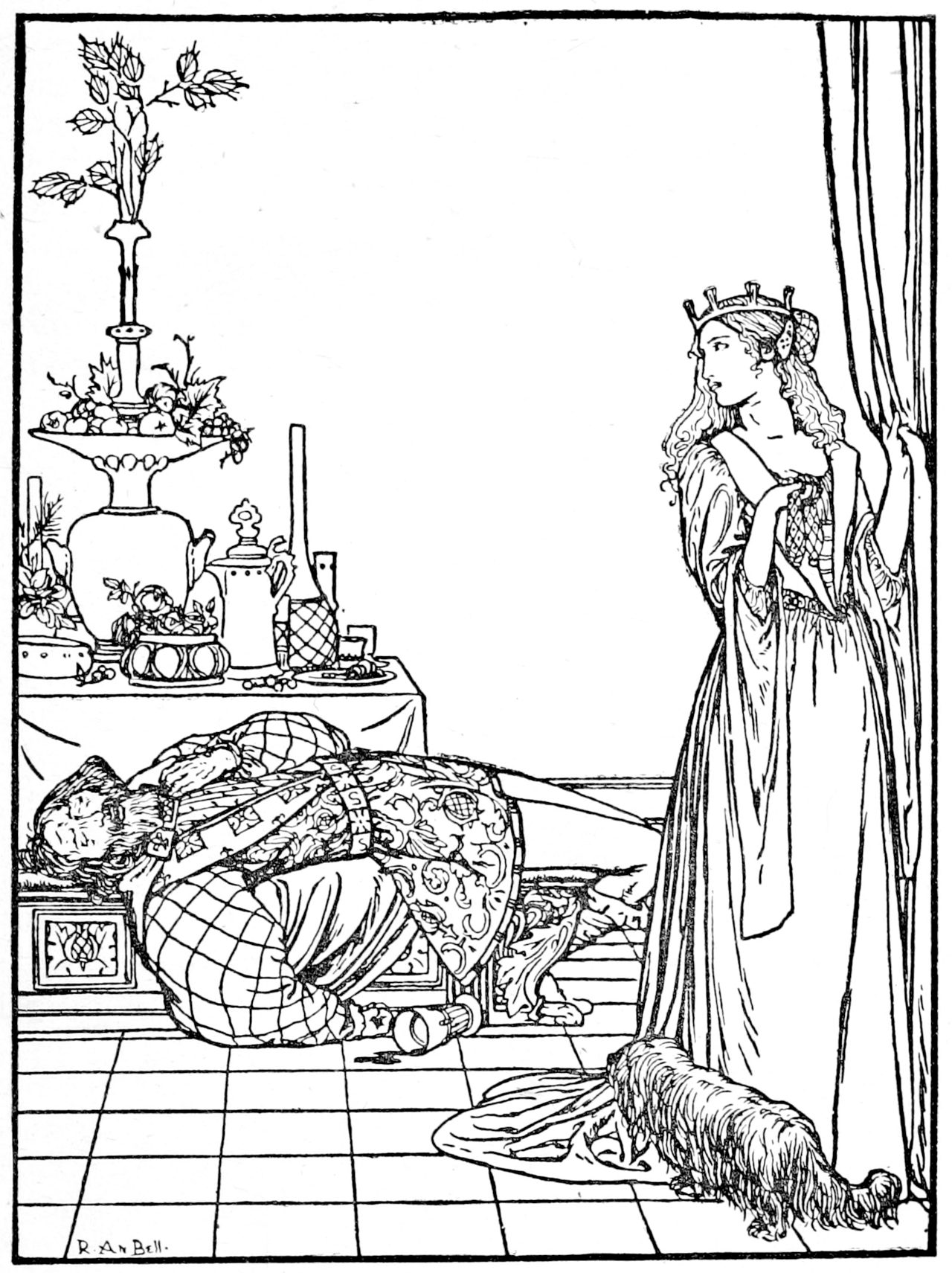
A peasant begged some land from the king. When he and his daughter dug the field, they found a mortar made of gold. The daughter warned that if they gave it to the king for his kindness, he would ask for the pestle as well; the father gave it nonetheless, and the king asked for the pestle and put him in prison until he got it. The peasant lamented his folly in not listening to his daughter. The king had him brought before him again, and asked what he meant. The peasant explained. The king summoned the daughter and set her riddle: to come to him neither naked nor clothed, neither walking nor riding, neither on the road nor off it. If she guessed it, she had proved her cleverness and would marry him. She wrapped herself in fish net, and tied it to a donkey's tail so that it had to drag her along, and she kept only one toe touching the ground. The king agreed that she had guessed the riddle; he freed her father and married her. Some years later, a mare gave birth to a foal that ran off and lay down under an ox. Both the peasant who owned the mare and the one who owned the ox claimed it; the king said it belonged where it was found. The peasant who owned the mare went to the queen for help. She told him to take a fishing net and pretend to fish on dry land where the king would see; when the king said it was impossible, he was to say it was no more impossible than oxen giving birth to foals. The peasant did so, and the king gave him the foal but got from him that the queen had given him the advice. He sent the queen back to her father, saying she could take only one thing, what she valued most, from the castle. The queen gave him a sleeping draught and took him back to her father's house. 1
Antiquity and distribution
Joseph Jacobs points out in Europa's Fairy Book that the tale has many parallels across both Europe and Asia. Ulrich Marzolph and Richard van Leewen comment that the motif of the clever maiden who answers the prince's riddles is ancient enough to be present in the Mahabharata and in narratives of the Jatakas. The story of a poor maiden's cleverness can be found in Norse mythology and Viking legend of Aslaug and Ragnar Lodbrok, specially the riddle of coming "not dressed, yet not undressed". Folklorist Stith Thompson argued for a Central European source for the ATU 875 type. 1
Continental variants
Scholars Johannes Bolte and Jiří Polívka listed several variants from across the globe in their seminal work on the Brothers Grimm fairy tale collection. 1
Italy
Variants have been registered in Italian scholarship, as noted by Jack Zipes; for instance, by Laura Gonzenbach. A version from Abruzzi (The Clever Girl) begins with an old lady blessing the newborn peasant girl with "beauty and wit", but otherwise remains a realistic tale. A scholarly inquiry by Italian Istituto centrale per i beni sonori ed audiovisivi ("Central Institute of Sound and Audiovisual Heritage"), produced in the late 1960s and early 1970s, found thirty variants of the tale across Italian sources. 1
The text above is adapted from the Wikipedia article “The Peasant's Wise Daughter”, available under the Creative Commons Attribution-ShareAlike 4.0 licence. 1
The Peasant's Wise Daughter is folk tale version by the Brothers Grimm, according to the structured record cited below. This entry was generated automatically from that record and has not yet been reviewed by a person familiar with the tradition. 2
The source record links this tradition to 2 external registers, which can be verified through the citation. 2