The tradition & historical record
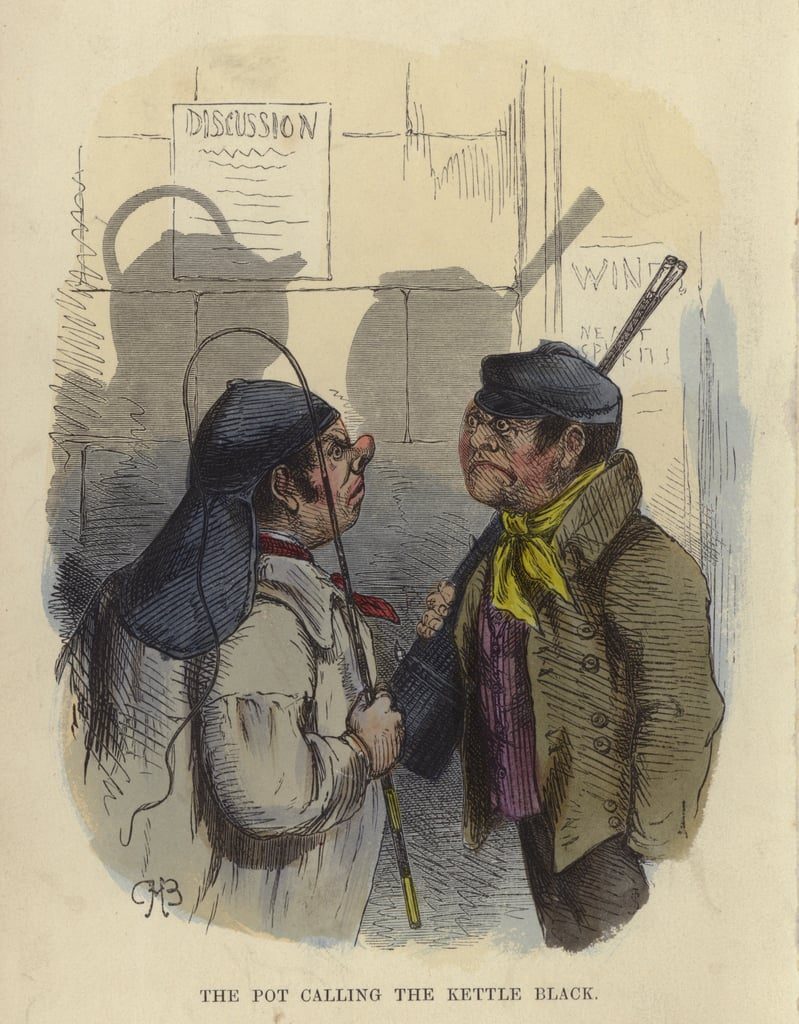
3 min read · 2 sources"The pot calling the kettle black" is a proverbial idiom that may be of Spanish (or ultimately Italian) origin, of which English versions began to appear in the first half of the 17th century. It means a situation in which somebody accuses someone else of a fault which the accuser shares, and therefore is an example of psychological projection, or hypocrisy. Use of the expression to discredit or deflect a claim of wrongdoing by attacking the originator of the claim for their own similar behaviour (rather than acknowledging the guilt of both) is the tu quoque logical fallacy. 1
Origin
The earliest appearance of the idiom is in Thomas Shelton's 1620 translation of the Spanish novel Don Quixote. The protagonist is growing increasingly restive under the criticisms of his servant Sancho Panza, one of which is that "You are like what is said that the frying-pan said to the kettle, 'Avant, black-browes'." The Spanish text at this point reads: Dijo la sartén a la caldera, Quítate allá ojinegra (Said the pan to the pot, get out of there black-eyes). It is identified as a proverb (refrán) in the text, functioning as a retort to the person who criticises another of the same defect that he plainly has. Among several variations, the one where the pan addresses the pot as culinegra (black-arse) makes clear that they are dirtied in common by contact with the cooking fire. This translation was also recorded in England soon afterwards as "The pot calls the pan burnt-arse" in John Clarke's collection of proverbs, Paroemiologia Anglo-Latina (1639). A nearer approach to the present wording is provided by William Penn in his collection Some Fruits of Solitude in Reflections and Maxims (1682): 1
"If thou hast not conquer'd thy self in that which is thy own particular Weakness, thou hast no Title to Virtue, tho' thou art free of other Men's. 1
Similar themes in antiquity
In ancient Greece, mention of 'the Snake and the Crab' signified much the same, where the critic censures its own behaviour in another. The first instance of this is in a drinking song (skolion) dating from the late 6th or early 5th century BCE. The fable ascribed to Aesop concerns a mother crab and its young, where the mother tells the child to walk straight and is asked in return to demonstrate how that is done. The same theme differently expressed occurs in the Aramaic version of the story of Ahiqar, dating from about 500 BCE. 'The bramble sent to the pomegranate tree saying, "Wherefore the multitude of thy thorns to him that toucheth thy fruit?" The pomegranate tree answered and said to the bramble, "Thou art all thorns to him that toucheth thee". Talmud: "Do not ascribe to your fellow your own blemish" (BM 59b) ... "a person stigmatizes another with his own blemish" (Kid. 70b). The Mote and the Beam – In Matthew 7:3-5, the target is criticism of a less significant failing by those who are worse: "Why do you look at the speck of sawdust in your brother's eye and pay no attention to the plank in your own eye?" 1
The text above is adapted from the Wikipedia article “The pot calling the kettle black”, available under the Creative Commons Attribution-ShareAlike 4.0 licence. 1
the pot calling the kettle black is proverb, according to the structured record cited below. This entry was generated automatically from that record and has not yet been reviewed by a person familiar with the tradition. 2
The source record links this tradition to 2 external registers, which can be verified through the citation. 2