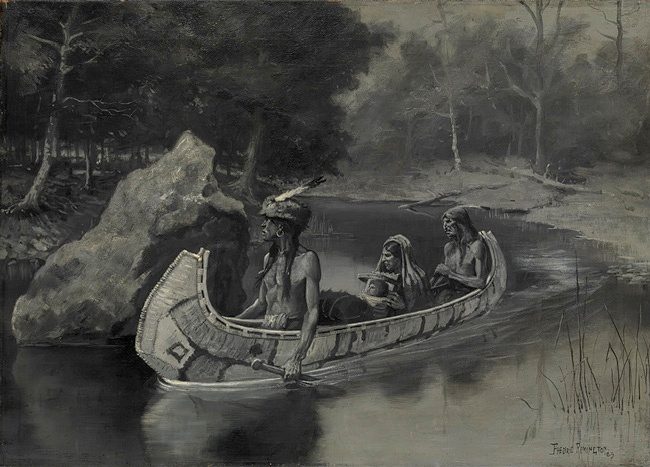
The tradition & historical record
6 min read · 2 sourcesThe Song of Hiawatha is an 1855 epic poem in trochaic tetrameter by Henry Wadsworth Longfellow which features Native American characters. The epic relates the fictional adventures of an Ojibwe warrior named Hiawatha and the tragedy of his love for Minnehaha, a Dakota woman. Events in the story are set in the Pictured Rocks area of Michigan on the south shore of Lake Superior. Longfellow's poem is based on oral traditions surrounding the Ojibwe folk hero Manabozho, but also contains Longfellow's own innovations. Longfellow drew some of his material from his friendship with Ojibwe chief Kahge-ga-gah-bowh (George Copway), who would visit Longfellow's home. He also had frequent encounters with Black Hawk and other Sauk people on Boston Common, and he drew from Algic Researches (1839) and other writings by Henry Rowe Schoolcraft, an ethnographer and United States Indian agent, and from Heckewelder's Narratives. In sentiment, scope, overall conception, and many particulars, Longfellow insisted, "I can give chapter and verse for these legends. Their chief value is that they are Indian legends." Longfellow had originally planned on following Schoolcraft in calling his hero Manabozho, the name in use at the time among the Ojibwe of the south shore of Lake Superior for a figure of their folklore who was a trickster and transformer. 1
Publication and plot
The poem was published on November 10, 1855, by Ticknor and Fields and was an immediate success. In 1857, Longfellow calculated that it had sold 50,000 copies. Longfellow chose to set The Song of Hiawatha at Pictured Rocks, one of the locations along the south shore of Lake Superior favored by narrators of the Manabozho stories. The Song presents a legend of Hiawatha and his lover Minnehaha in 22 chapters (and an introduction). Hiawatha is not introduced until Chapter III. In Chapter I, Hiawatha's arrival is prophesied by a "mighty" peace-bringing leader named Gitche Manito. Chapter II tells a legend of how the warrior Mudjekeewis became Father of the Four Winds by slaying the Great Bear of the mountains, Mishe-Mokwa. His son Wabun, the East Wind, falls in love with a maiden whom he turns into the Morning Star, Wabun-Annung. Wabun's brother, Kabibonokka, the North Wind, bringer of autumn and winter, attacks Shingebis, "the diver". Shingebis repels him by burning firewood, and then in a wrestling match. A third brother, Shawondasee, the South Wind, falls in love with a dandelion, mistaking it for a golden-haired maiden. In Chapter III, in "unremembered ages", a woman named Nokomis falls from the Moon. Nokomis gives birth to Wenonah, who grows to be a beautiful young woman. Nokomis warns her not to be seduced by the West Wind (Mudjekeewis) but she does not heed her mother, becomes pregnant and bears Hiawatha. In the ensuing chapters, Hiawatha has childhood adventures, falls in love with Minnehaha, slays the evil magician Pearl-Feather, invents written language, discovers corn, and other episodes. 1
Folkloric and ethnographic critiques
Longfellow used Henry Rowe Schoolcraft as a source of Native American legend. Schoolcraft seems to have been inconsistent in his pursuit of authenticity, as he rewrote and censored sources. The folklorist Stith Thompson, although crediting Schoolcraft's research with being a "landmark," is quite critical of him: "Unfortunately, the scientific value of his work is marred by the manner in which he has reshaped the stories to fit his own literary taste." In addition to Longfellow's own annotations, Stellanova Osborn (and previously F. Broilo in German) tracked down "chapter and verse" for every detail Longfellow took from Schoolcraft. Others have identified words from native languages included in the poem. Intentionally epic in scope, The Song of Hiawatha is described by its author as "this Indian Edda". But Thompson judges that despite Longfellow's claimed "chapter and verse" citations, the work "produce[s] a unity the original will not warrant," i.e., it is non-Indian in its totality. Thompson finds close parallels in plot between the poem and its sources, with the major exception that Longfellow took legends told about multiple characters and substituted the character Hiawatha as the protagonist of them all. Resemblances between the original stories, as "reshaped by Schoolcraft," and the episodes in the poem are but superficial, and Longfellow omits important details essential to Ojibwe narrative construction, characterization, and theme. This is the case even with "Hiawatha's Fishing," the episode closest to its source. Some important parts of the poem were more or less Longfellow's invention from fragments or his imagination. 1
Historical Iroquois Hiawatha
Apparently, no connection, apart from name, exists between Longfellow's hero and the legendary Iroquois chief Hiawatha who co-founded the Iroquois League. Longfellow took the name from works by Schoolcraft, whom he acknowledged as his main source. In his notes to the poem, Longfellow cites Schoolcraft: 1
a tradition prevalent among the North American Indians, of a personage of miraculous birth, who was sent among them to clear their rivers, forests, and fishing-grounds, and to teach them the arts of peace. He was known among different tribes by the several names of Michabou, Chiabo, Manabozo, Tarenyawagon, and Hiawatha.Longfellow's notes make no reference to the Iroquois or the Iroquois League or to any historical personage. However, according to 19th century ethnographer Horatio Hale, there was a longstanding confusion between the Iroquois leader Hiawatha and the Iroquois deity Aronhiawagon because of "an accidental similarity in the Onondaga dialect between [their names]." The deity, he says, was variously known as Aronhiawagon, Tearonhiaonagon, Taonhiawagi, or Tahiawagi; the historical Iroquois leader, as Hiawatha, Tayonwatha or Thannawege. Schoolcraft "made confusion worse ... by transferring the hero to a distant region and identifying him with Manabozho, a fantastic divinity of the Ojibways. [Schoolcraft's book] has not in it a single fact or fiction relating either to Hiawatha himself or to the Iroquois deity Aronhiawagon." In 1856, Schoolcraft published The Myth of Hiawatha and Other Oral Legends Mythologic and Allegoric of the North American Indians, reprinting (with a few changes) stories previously published in his Algic Researches and other works. Schoolcraft dedicated the book to Longfellow, whose work he praised highly. 1
Indian words used
Longfellow cites the Indian words he used as from the works by Schoolcraft. The majority of the words were Ojibwa, with a few from the Dakota, Cree and Onondaga languages. Though the majority of the Native American words included in the text accurately reflect pronunciation and definitions, some words appear incomplete. For example, the Ojibway words for "blueberry" are miin (plural: miinan) for the berries and miinagaawanzh (plural: miinagaawanzhiig) for the bush upon which the berries grow. Longfellow uses Meenah'ga, which appears to be a partial form for the bush, but he uses the word to mean the berry. 1
Inspiration from Kalevala
The Song… 1
The text above is adapted from the Wikipedia article “The Song of Hiawatha”, available under the Creative Commons Attribution-ShareAlike 4.0 licence. 1
The Song of Hiawatha is epic poem by Henry Wadsworth Longfellow, according to the structured record cited below. This entry was generated automatically from that record and has not yet been reviewed by a person familiar with the tradition. 2
The source record links this tradition to 16 external registers, which can be verified through the citation. 2