The tradition & historical record
6 min read · 2 sourcesThe Song of Roland (French: La Chanson de Roland) is an 11th-century chanson de geste based on the deeds of the Frankish military leader Roland at the Battle of Roncevaux Pass in AD 778, during the reign of Charlemagne. It is the oldest surviving major work of French literature. It exists in various manuscript versions, which testify to its enormous and enduring popularity in Medieval and Renaissance literature from the 12th to the 16th centuries. It is an epic poem written in Old French and is the first example of the chanson de geste, a literary form that flourished between the 11th and 16th centuries in Medieval Europe and celebrated legendary deeds. An early version was composed around 1040, with additions and alterations made up to about 1115. The final poem contains about 4,000 lines. 1
Manuscripts and dating
Although set in the Carolingian era, the Song of Roland was written centuries later. There is a single extant manuscript of the Song of Roland. It is held at the Bodleian Library at the University of Oxford. It dates between 1129 and 1165 and was written in Anglo-Norman. There are eight additional manuscripts and three fragments of other poems on the subject of Roland. Scholars estimate that the poem was written between approximately 1040 and 1115 — possibly by a poet named Turold (Turoldus in the manuscript itself) — and that most of the alterations were completed by about 1098. Some favor the earlier dating, which allows that the narrative was inspired by the Castilian campaigns of the 1030s and that the poem was established early enough to be a major influence in the First Crusade (1096–1099). Others favor a later dating based on brief passages which are interpreted as alluding to events of the First Crusade. Relevant to the question of dating the poem, the term d'oltre mer (or l'oltremarin) occurs three times in the text in reference to named Muslims who came to fight in Spain and France. The Old French oltre mer (oversea, modern French outremer) was commonly used during and after the First Crusade to refer to the Latin Levant, which supports a date of composition after the Crusade. Those favoring an earlier dating argue that the term is used generically to refer to "a Muslim land." It is possible that the bulk of the poem dates from before the Crusades, with a few additions from the time of the First Crusade. After two manuscripts were found in 1832 and 1835 and published in 1837, the Song of Roland became recognized as France's national epic. 1
Oral performance compared to manuscript versions
Scholarly consensus has long accepted that the Song of Roland was at first performed orally in many different versions with varying material and episodes, which were fixed and harmonized in the textual form. Early 19th century editors of the Song of Roland, informed in part by patriotic desires to elevate a distinctly French epic, could thus overstate the textual cohesiveness of the Roland tradition as they presented it to the public. Andrew Taylor notes, "[T]he Roland song was, if not invented, at the very least constructed. By supplying it with an appropriate epic title, isolating it from its original codicological context, and providing a general history of minstrel performance in which its pure origin could be located, the early editors presented a 4,002 line poem as sung French epic". 1
AOI
Certain lines of the Oxford manuscript end with the letters "AOI". The meaning of this word or annotation is unclear. Many scholars have hypothesized that the marking may have played a role in public performances of the text, such as indicating a place where a jongleur would change the tempo. Contrarily, Nathan Love believes that "AOI" marks locations where the scribe or copyist is signaling that he has deviated from the primary manuscript: ergo, the mark indicates the source is a non-performance manuscript. 1
Plot
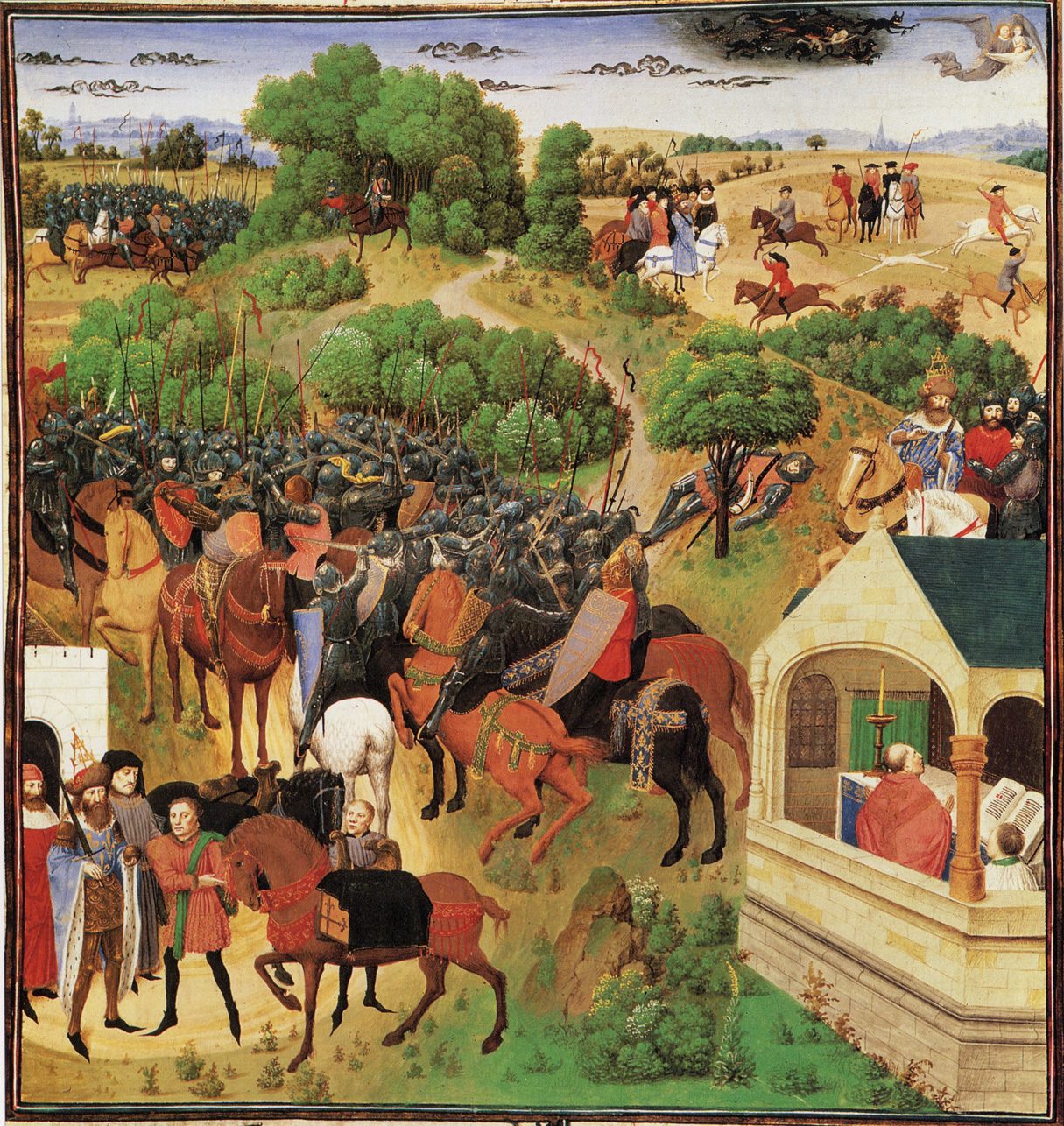
The Song of Roland's account of the Battle of Roncesvalles is not supported by history. According to Einhard's Vita Karoli Magni from the late eighth century, the attackers were Basques seeking revenge against Charlemagne's army for the looting of Pamplona. The following is the depiction in the poem itself, not a historical account. Charlemagne's army is fighting the Arab Muslims in Spain. They have campaigned for seven years, and the last city standing is Zaragoza, held by King Marsile, who is pictured not as a Muslim, but a follower of Mahumet and Apollin. Threatened by the might of Charlemagne's Franks, Marsile seeks advice from his wise man, Blancandrin, who counsels him to conciliate the Emperor, offering to surrender and giving hostages. Accordingly, Marsile sends out messengers to Charlemagne, promising treasure and Marsile's conversion to Christianity if the Franks will go back to Francia. Charlemagne and his men, tired of fighting, accept his peace offer and select a messenger to Marsile's court. The protagonist, Roland, Charlemagne's nephew, nominates his stepfather, Ganelon, as messenger. Ganelon, who fears being murdered by the enemy and accuses Roland of intending this, takes revenge by informing the Saracens of a way to ambush the rear guard of Charlemagne's army, led by Roland, as the Franks re-enter Francia through the mountain passes. As Ganelon predicted, Roland leads the rear guard, with the wise and moderate Oliver and the fierce Archbishop Turpin. The Muslims ambush them at Roncesvalles and the Christians are overwhelmed. Oliver pleads with Roland to blow his horn to call for help, but Roland tells him that blowing his horn in the middle of the battle would be an act of cowardice. 1
Form
The song is written in stanzas of irregular length known as laisses. The lines are decasyllabic (containing ten syllables), and each is divided by a strong caesura which generally falls after the fourth syllable. The last stressed syllable of each line in a laisse has the same vowel sound as every other end-syllable in that laisse. The laisse is therefore an assonal, not a rhyming stanza. On a narrative level, the Song of Roland features extensive use of repetition, parallelism, and thesis-antithesis pairs. Roland proposes Ganelon for the dangerous mission to Sarrogossa; Ganelon designates Roland to man the rearguard. Charlemagne is contrasted with Baligant. Unlike later Renaissance and Romantic literature, the poem focuses on action rather than introspection. The characters are presented through what they do, not through what they think or feel. The narrator gives few explanations for characters' behaviour. The warriors are stereotypes defined by a few salient traits; for example, Roland is loyal and trusting while Ganelon, though brave, is traitorous and vindictive. The story moves at a fast pace, occasionally slowing down and recounting the same scene up to three times but focusing on different details or taking a different perspective each time. The effect is similar to a film sequence shot at different angles so that new and more important details come to light with each shot. 1
The text above is adapted from the Wikipedia article “Song of Roland”, available under the Creative Commons Attribution-ShareAlike 4.0 licence. 1
The Song of Roland is medieval epic work, according to the structured record cited below. This entry was generated automatically from that record and has not yet been reviewed by a person familiar with the tradition. 2
The source record links this tradition to 32 external registers, which can be verified through the citation. 2