The tradition & historical record
7 min read · 2 sourcesThe Tale of Kiều is an epic poem in Vietnamese written by Nguyễn Du (1765–1820), well known in Vietnamese literature. The original title in Vietnamese is Đoạn Trường Tân Thanh (斷腸新聲, "A New Cry From a Broken Heart"), but it is better known as Truyện Kiều (傳翹, IPA: [t͡ɕwiən˧˨ʔ kiəw˨˩] , lit. "Tale of Kiều"). In 3,254 verses, written in lục bát ("six–eight") meter, the poem recounts the life, trials and tribulations of Thúy Kiều, a beautiful and talented young woman, who has to sacrifice herself to save her family. To save her father and younger brother from prison, she sells herself into marriage with a middle-aged man, not knowing that he is a pimp, and is forced into prostitution. While modern interpretations vary, some post-colonial writers have interpreted it as a critical, allegorical reflection on the rise of the Nguyễn dynasty. The work is famous for its humane meaning and was translated into 20 languages, such as English, French, Japanese, and Korean. 1
Background
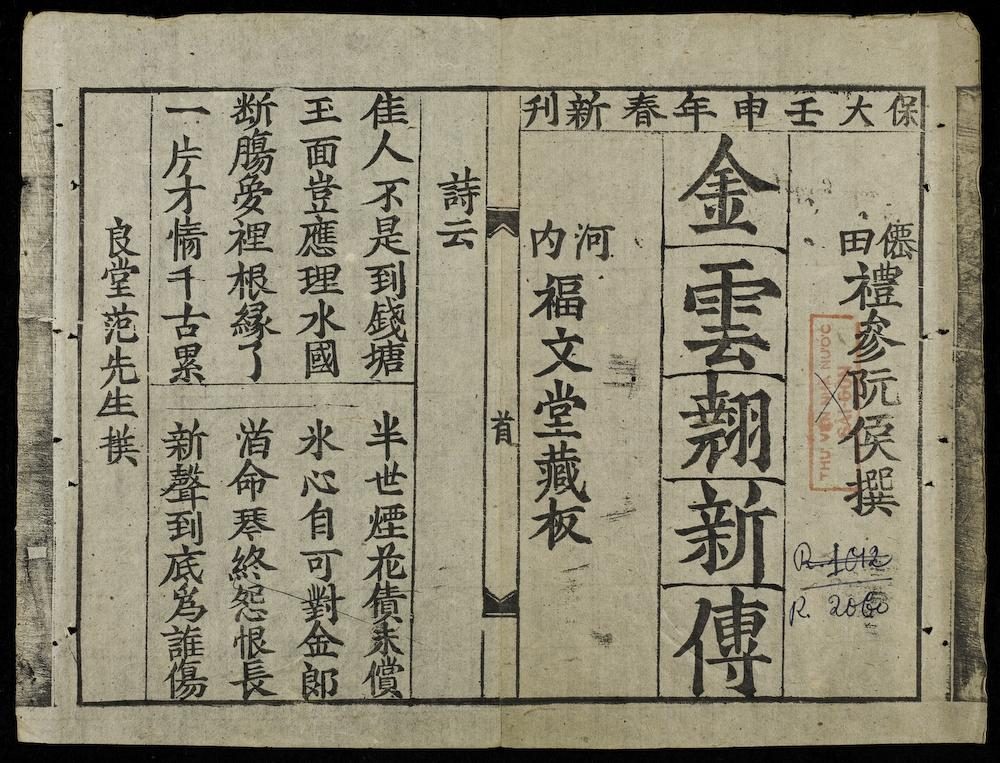
Nguyễn Du made use of the plot of a seventeenth-century Chinese novel, Jīn Yún Qiào (Chinese: 金雲翹), known in Vietnamese pronunciation of Chinese characters as Kim Vân Kiều. The original, written by an unknown writer under the pseudonym Qīngxīn Cáirén (Chinese: 青心才人 "Pure-Hearted Man of Talent"), was a straightforward romance, but Nguyễn Du chose it to convey the social and political upheavals at the end of the 18th century in Vietnam. Vietnam at that time was ruled nominally by the 300-year-old Lê dynasty, but real power rested in the Trịnh lords in the north and the Nguyễn lords in the south. While the Trịnh and the Nguyễn were fighting against each other, the Tây Sơn rebels overthrew both the Nguyễn and then the Trịnh over the span of a decade. Nguyễn Du was loyal to the Lê Dynasty and hoped for the return of the Lê emperor. In 1802 the Nguyễn lord Nguyễn Ánh conquered all of Vietnam forming the new Nguyễn dynasty. Nguyễn Ánh, now Emperor Gia Long, summoned Nguyễn Du to join the new government and, with some reluctance, he did so. Nguyễn Du's situation in terms of conflicting loyalties between the previous Lê king and the current Nguyễn emperor is partially analogous to the situation of the main character in The Tale of Kiều who submitted to circumstances but her heart longed for her first love. 1
Depiction of sex work
It is believed that The Tale of Kiều contains the earliest depiction or mention of sex work in Vietnam. The poem depicts a form of sex work that resembles Chinese courtesan culture. Although the poem is fictional, it reveals a view of sex work in 19th century Vietnam as a kind of performative and affective, not simply sexual, labor. 1
Plot
The story takes place during the reign of the Jiajing Emperor in Ming China. The entire plot in the Tale of Kiều spans over fifteen years. At the beginning of the story, set in Peking, Vương Thuý Kiều—a beautiful and educated girl—visits her ancestors' graves with her younger sister Thuý Vân (王翠雲) and brother Vương Quan (王觀). On the way, she identifies with the grave of a dead performer—Đạm Tiên (淡仙), who was said to be as beautiful and talented as she is but lived a life full of grief. There, she meets and later promises to marry Kim Trọng (金重), a young and promising scholar, but their marriage is delayed because Trọng has to go back home to mourn his uncle for half a year. During that time misfortune begins to befall Kiều. Her family is framed by a silk dealer and has all their wealth taken away by the government: her father and brother are facing imprisonment. Kiều decides to sell herself to Scholar Mã (Mã giám sinh; 馬監生) to free her family, while asking Thúy Vân to fulfil the marital promise with Trọng. Mã turns out to be a pimp who is in charge of finding girls for a brothel run by Madam Tú (Tú Bà; 秀婆). He rapes Kiều and takes her back to the brothel in Lin-Tzu (modern day Xindian in Shandong), but she refuses to serve any guests and attempts to commit suicide when she is forced to do so. Madam Tú concocts a plan to crush Kiều's dignity by hiring Sở Khanh, a playboy and con artist, to meet Kiều and coerce her into eloping with him, and then lead her to Tú. With nothing left to hold on to, Kiều finally submits and becomes a prostitute. 1
English translations
There have been at least five English translations of the work in the last half century. Kim Van Kieu by Lê Xuân Thuy, presenting the work in the form of a novelette, was widely available in Vietnam in the 1960s. The Tale of Kiều, a scholarly annotated blank verse version by Huỳnh Sanh Thông (1926–2008), was first published in the US in 1983. In 2008, a translation by Arno Abbey, based on the French translation by Nguyễn Khắc Viện (1913–1997), was published in the US. There have also been two verse translations in recent years. One of these, another bilingual edition called simply Kiều published by Thế Giới Publishers, Hanoi, in 1994, with a verse translation by Michael Counsell (born 1935), is currently the English version most widely available in Vietnam itself, and the English version alone, called Kieu, The Tale of a Beautiful and Talented Girl, by Nguyễn Du, is now available worldwide. A second verse translation, The Kim Vân Kiều of Nguyễn Du (1765–1820), by Vladislav Zhukov (born 1941), was published by Pandanus books in 2004. A new translation by Timothy Allen of the opening section of the poem was awarded one of The Times Stephen Spender prizes for Poetry Translation in 2008; further extracts from Allen's translation have appeared in Cosmopolis, (the Summer 2009 edition of Poetry Review.) and in Transplants, the Spring 2010 edition of Modern Poetry in Translation. Allen's translation was published in its entirety in 2019 as The Song of Kieu. An English translation by Dương Tường, which took more than two years, was published in 2020 by Nhã Nam. In 2021, a translation by twenty-year-old Nguyễn Bình from the Vietnamese into heroic couplets was published by the Vietnamese Writers' Association Publishing House. 1
Comparison with Jin Yun Qiao
The Tale of Kiều adapted the Chinese novel Jin Yun Qiao into Vietnamese lục bát verses. Thus, there has been many works that compare the two in both Vietnamese and Chinese. The first person to do the work is Đào Duy Anh, who wrote in his book: "Nguyễn Du preserved the Chinese story without cutting or adding anything. But the original is redundant, detailed, presented in a simple way, while Nguyễn Du calculated and rearranged [the story] to be more organized and coherent." Researcher Phạm Đan Quế said: "...Nguyễn Du's story, characters, order of events, morality, philosophy and even details are mostly from the original by Qingxin-caizi. However, he selected main events and cut redundant parts, and sometime summarized long paragraphs into a few sentences. The main different is that: the events in Jin Yun Qiao are analytical, while [the events] in Tale of Kiều are organic [...] Through comparisons, we can see that Nguyễn Du preserved the order of events from the original story. 1
The text above is adapted from the Wikipedia article “The Tale of Kieu”, available under the Creative Commons Attribution-ShareAlike 4.0 licence. 1
The Tale of Kieu is epic poem in Vietnamese written by Nguyễn Du (1766–1820), according to the structured record cited below. This entry was generated automatically from that record and has not yet been reviewed by a person familiar with the tradition. 2
The source record links this tradition to 7 external registers, which can be verified through the citation. 2