The tradition & historical record
7 min read · 2 sources"The Three Little Pigs" is a fable about three pigs who build their houses of different materials. A Big Bad Wolf blows down the first two pigs' houses which are made of straw and sticks respectively, but is unable to destroy the third pig's house that is made of bricks. The printed versions of this fable date back to the 1840s, but the story is thought to be much older. The earliest version takes place in Dartmoor with three pixies and a fox before its best known version appears in English Fairy Tales by Joseph Jacobs in 1890, with Jacobs crediting James Halliwell-Phillipps as the source. In 1886, Halliwell-Phillipps had published his version of the story, in the fifth edition of his Nursery Rhymes of England, and it included, for the first time in print, the now-standard phrases "not by the hair of my chiny chin chin" and "I'll huff, and I'll puff, and I'll blow your house in". The phrases used in the story, and the various morals drawn from it, have become embedded in Western culture. Many versions of The Three Little Pigs have been recreated and modified over the years, sometimes making the wolf a kind character. It is a type B124 folktale in the Thompson Motif Index. 1
Traditional versions
"The Three Little Pigs" was included in The Nursery Rhymes of England (London and New York, c.1886), by James Halliwell-Phillipps. The story in its arguably best-known form appeared in English Fairy Tales by Joseph Jacobs, first published on June 19, 1890, and crediting Halliwell as his source. The earliest published version of the story is from Dartmoor, Devon, England in 1853, and has three little pixies and a fox in place of the three pigs and a wolf. The first pixy had a wooden house: 1
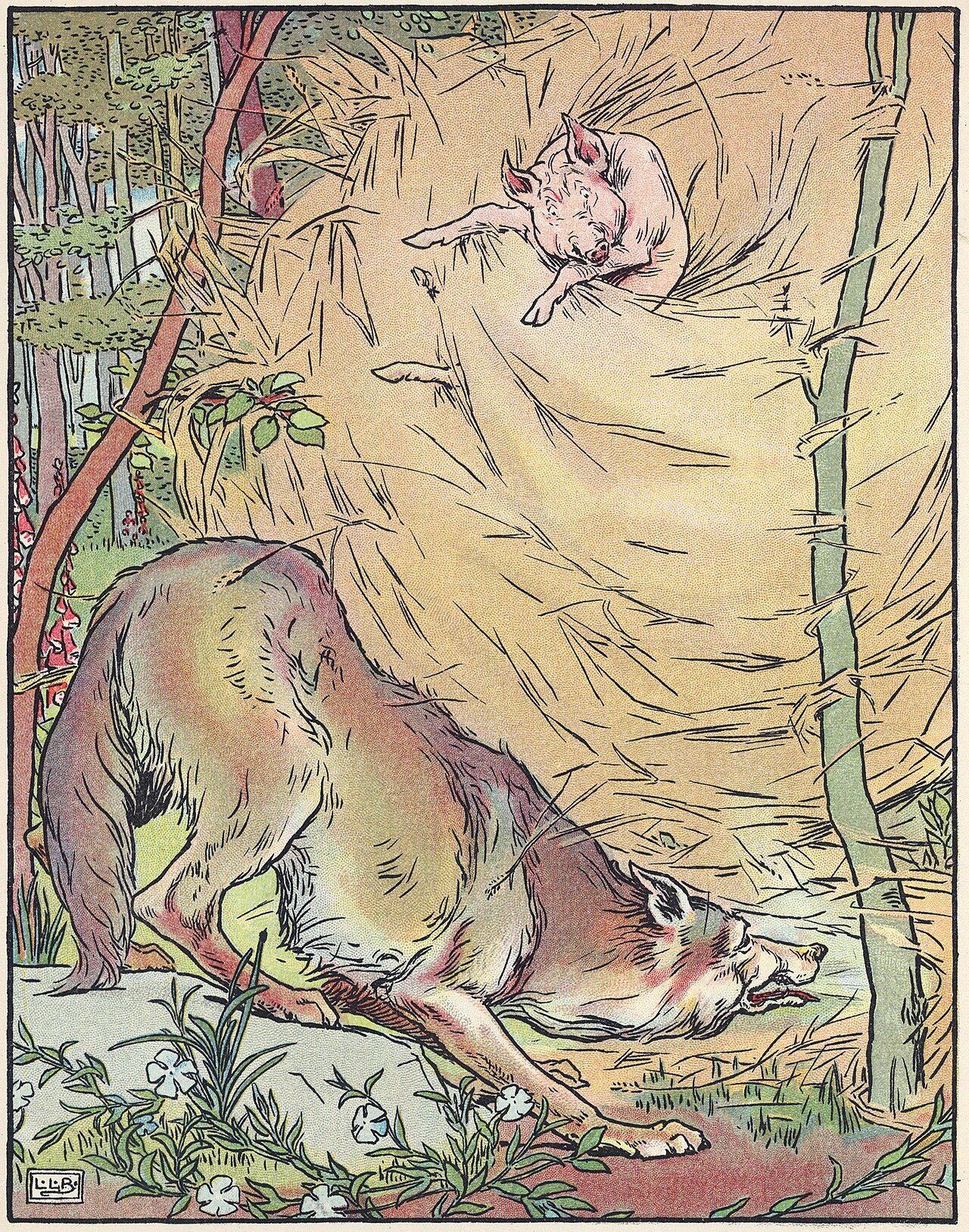
The story begins with the title characters being sent out into the world by their mother, to "seek out their fortune". The first little pig builds a house out of straw, but the wolf blows it down and devours him. The second little pig builds a house out of sticks, but the result is the same. Each exchange between wolf and pig features ringing proverbial phrases, namely: 1
The third little pig builds a house out of bricks, which the wolf fails to blow down. The wolf then attempts to meet the pig at a turnip field, an apple orchard, and a fair, but the pig always arrives early and avoids the wolf. Finally, the infuriated wolf resolves to come down the chimney, whereupon the pig lights a fire under a pot of water on the fireplace. The wolf falls in and is fatally boiled, avenging the death of his brothers. After cooking the wolf, the pig proceeds to eat him for dinner. 1
Other versions
In many versions, the first two pigs escape to their brother's (or sister's in some versions) brick house. Most such versions omit any attempts by the wolf to meet the third pig after his failed attempt to blow the house in. Sometimes, the wolf simply burns his tail and runs away. The story uses the literary rule of three, expressed in this case as a "contrasting three", as the third pig's brick house turns out to be the only one which is adequate to withstand the wolf. Variations of the tale appeared in Uncle Remus: His Songs and His Sayings in 1881, in which the pigs were replaced by Br'er Rabbit. The story also made an appearance in Nights with Uncle Remus in 1883, both by Joel Chandler Harris. Andrew Lang included it in The Green Fairy Book, published in 1892, but did not cite his source. In contrast to Jacobs's version, which left the pigs nameless, Lang's retelling cast the pigs as Browny, Whitey, and Blacky. It also set itself apart by exploring each pig's character and detailing the interaction between them. The antagonist of this version is a fox, not a wolf. The pigs' houses are made either of mud, cabbage, or brick. Blacky, the third pig, rescues his brother and sister from the fox's den after the fox has been defeated. 1
Analysis
Writer Bruno Bettelheim, in his book The Uses of Enchantment, interprets the tale as a showcase of the capacity for anticipation and courage in the face of adversity, symbolized by the wolf. According to him, the individual who is content to prepare themself as the first two pigs will be destroyed by the vicissitudes of life, and only a person who builds a solid base can face such hazards. He viewed the tale as a means of telling children that one cannot always act according to the pleasure principle, and must submit to the reality principle when life demands it. He exemplified this point by observing that the first two pigs valued gratification rather than planning and foresight as the third pig had. 1
Animated shorts
Three Little Pigs, a 1933 Silly Symphony cartoon, was produced by Walt Disney. The production cast the title characters as Fifer Pig, Fiddler Pig, and Practical Pig. The first two are depicted as both frivolous and arrogant. The story has been somewhat softened. The first two pigs still get their houses blown down, but escape from the wolf. Also, the wolf is not boiled to death but simply burns his own behind and runs away. Three sequels soon followed respectively as a result of the short film's popularity: The first of them was The Big Bad Wolf, also directed by Burt Gillett and first released on April 14, 1934. In 1936, a second cartoon starring the Three Little Pigs and the Big Bad Wolf followed, with a story based on The Boy Who Cried Wolf. This short was entitled Three Little Wolves and introduced the Big Bad Wolf's three pup sons, all of whom just as eager for a taste of the pigs as their father. A third cartoon The Practical Pig, was released in 1939, right at the end of the Silly Symphonies' run. With its own series banner In this, Fifer and Piper, again despite Practical's warning, go swimming but are captured by the Wolf, who then goes after Practical only to be caught in Practical's newly built Lie Detector machine. In 1941, a fourth cartoon much of the film was edited into The Thrifty Pig, which was distributed by the National Film Board of Canada. Here, Practical Pig builds his house out of Canadian war bonds, and the Big Bad Wolf representing Nazi Germany is unable to blow his house down. Fiddler Pig, Fifer Pig, and Big Bad Wolf appeared in the film Who Framed Roger Rabbit. In 1942, there was a Walter Lantz musical version, The Hams That Couldn't Be Cured. 1
Animated features
3 Pigs and a Baby is the first animated film in the Unstable Fables film series. The direct-to-DVD film was released on March 4, 2008, and stars Jon Cryer, Brad Garrett, Steve Zahn and Jesse McCartney. The three pigs and the wolf appear in the four Shrek films. 1
The text above is adapted from the Wikipedia article “The Three Little Pigs”, available under the Creative Commons Attribution-ShareAlike 4.0 licence. 1
The Three Little Pigs is fairy tale, according to the structured record cited below. This entry was generated automatically from that record and has not yet been reviewed by a person familiar with the tradition. 2
The source record links this tradition to 8 external registers, which can be verified through the citation. 2