The tradition & historical record
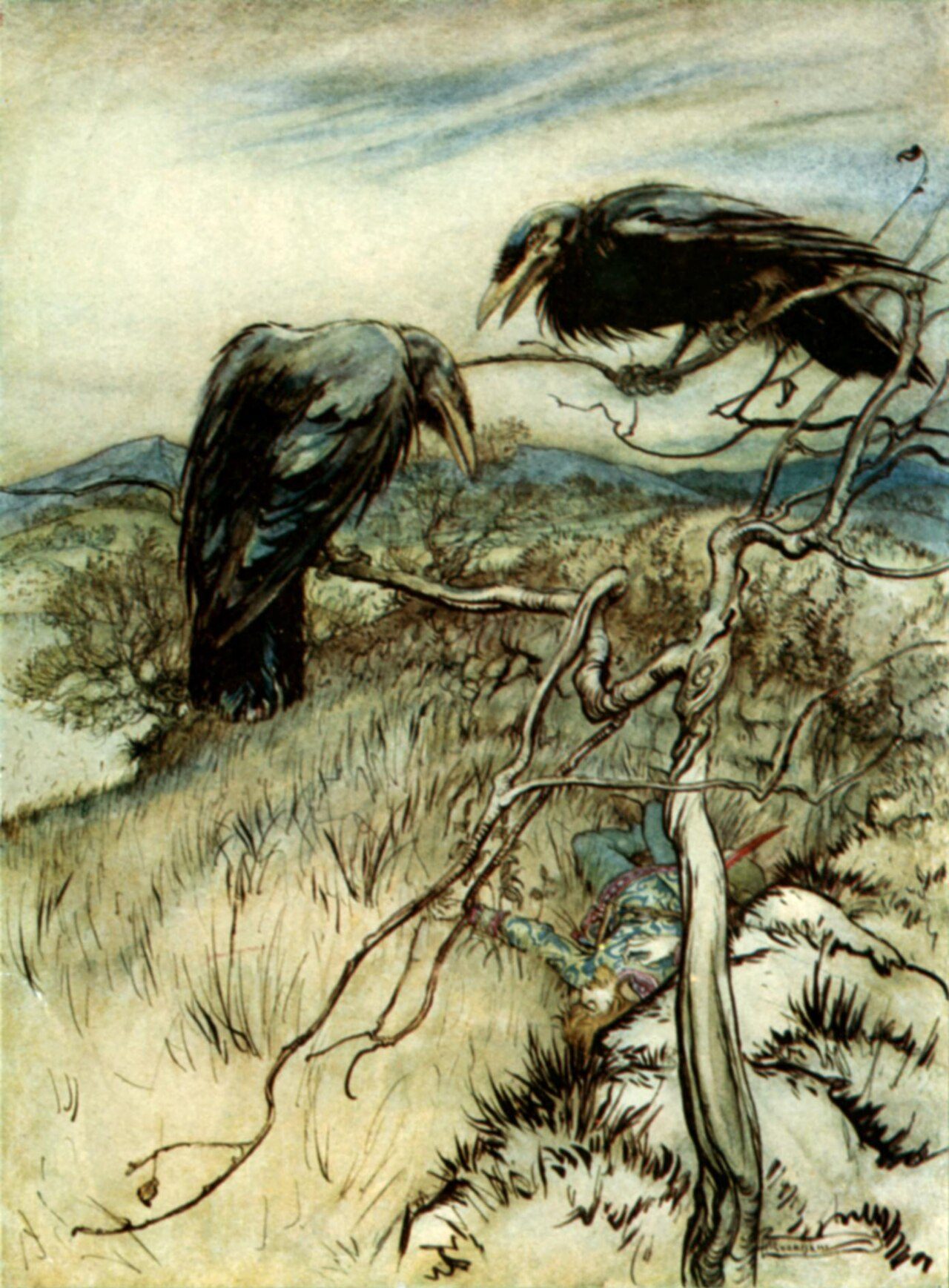
7 min read · 2 sources"The Three Ravens" (Roud 5, Child 26) is an English folk ballad, printed in the songbook Melismata compiled by Thomas Ravenscroft and published in 1611, but the song is possibly older than that. Newer versions (with different music) were recorded up through the 19th century. Francis James Child recorded several versions in his Child Ballads (catalogued as number 26). The ballad centers three scavenger birds conversing about where and what they should eat. One tells the others of a newly slain knight, but they find he is guarded by his loyal hawks and hounds. Furthermore, a "fallow doe", a metaphor for the knight's pregnant ("as great with young as she might go") lover or mistress (see "leman") comes to his body, kisses his wounds, bears him away, and buries him, leaving the ravens without a meal. The narrative ends with "God send euery gentleman / Such haukes, such hounds, and such a Leman". 1
Text of the ballad
These lyrics to "The Three Ravens" are transcribed using 1611 orthography. They can be sung either straight through in stanzas of four lines each, or in stanzas of two lines each repeating the first line three times, depending on how long the performer would like the ballad to last. The second method appears to be more canonical, so it is what is illustrated below. The refrains are sung in all stanzas, but they are only shown here for the first. 1
There were three rauens sat on a tree, downe a downe, hay downe, hay downe, There were three rauens sat on a tree, with a downe, There were three rauens sat on a tree, They were as blacke as they might be. With a downe, derrie, derrie, derrie, downe, downe. The one of them said to his mate, Where shall we our breakfast take? Downe in yonder greene field, There lies a Knight slain under his shield, His hounds they lie downe at his feete, So well they can their Master keepe, His Hawkes they flie so eagerly, There's no fowle dare him come nie Downe there comes a fallow Doe, As great with yong as she might goe, She lift up his bloudy head, And kist his wounds that were so red, She got him up upon her backe, And carried him to earthen lake, She buried him before the prime, She was dead her self ere euen-song time. God send euery gentleman, Such haukes, such hounds, and such a Leman. 1
The Twa Corbies
It is written in the Scots language, and there is no record of how early "The Twa Corbies" was first performed. Child (I, 253) quotes a letter from Charles Kirkpatrick Sharpe to Walter Scott (August 8, 1802): "The song of 'The Twa Corbies' was given to me by Miss Erskine of Alva (now Mrs Kerr), who, I think, said that she had written it down from the recitation of an old woman at Alva." This indicates that it was already known in Scotland at that date. It was first published in Walter Scott's Minstrelsy of the Scottish Border in 1803. It has a more dark and cynical tone than the Three Ravens, from which its lyrics were clearly derived. There are only two scavengers in “The Twa Corbies”, but they begin the same way. Rather than commenting on the loyalty of the knight's beasts, the corbies see that the hawk and the hound have forsaken their master, and are off chasing other game, while his mistress has already taken another lover. The ravens are therefore given an undisturbed meal, as nobody else knows where the man lies, or even that he is dead. They talk in gruesome detail about the meal they will make of him, plucking out his eyes and using his hair for their nests. It contains themes of the fragility of life, life going on after death, and a more pessimistic viewpoint on life. The loneliness and despair of the song are summed up in the final couplets; 1
O'er his banes [bones], when they are bare, The wind sall [shall] blaw for evermair There are a few different versions of this anonymously authored poem. 1
In popular culture
The popular American rock band The Horrible Crowes takes its name from "Twa Corbies”. The song is featured in The Adventure Company's game Jack the Ripper and plays a major role in the gameplay. The song is mentioned in Diana Gabaldon's novel The Fiery Cross, when Roger MacKenzie encounters some crows in the woods. Oli Steadman included it on his song collection "365 Days Of Folk". (2026). The song appears in the 1922 fantasy novel The Worm Ouroboros by E. R. Eddison, sung by the Lady Mevrian in mourning for her lost brother. Dorothy L. Sayers quotes the last two lines of the ballad in her mystery novel Clouds of Witness. There is a story, "The Three Ravens", in Jim Henson's HBO special The StoryTeller which, despite its title, is based on the German fairy tale The Six Swans, not this ballad. The ballad was selected for use in the 2017 period film My Cousin Rachel, following a commission for a dark English folk tune to be sung in the film at a Christmas feast for an early-1800s farmstead. A recording of the song features in the credits for the 2014 Channel 4 period drama New Worlds, which is set in England during the 1680s. A version of the song by John Harle features in Simon Schama's A History of Britain, particularly in the episodes "The Body of the Queen", "The British Wars" and "The Two Winstons". The song is sung by Henry VIII in the 2023 film Firebrand, which is about his marriage to Katherine Parr. The Australian depressive rock band Expurgatory used the words of "Twa Corbies" in their song "Twa" from their compilation album A lustrum in 2018. 1
Translations
Both "The Three Ravens" and "Twa Corbies" have been translated to other languages, typically sung to the same melody as Twa Corbies or that of the Breton song "An Alarc'h" ("The Swan"). Known versions include: 1
Danish: Ravnene (The Ravens), a translation of Twa Corbies by Danish folklorist Svend Grundtvig (1824–1883). The band Svartsot plays a version named "De to Ravne" (2022) Hebrew: שלושה בני עורב (Three sons of a raven), translated by Nathan Alterman, and a more popular translation שלושה עורבים (Three ravens) by Yaakov Shabtai. Finnish: Kaksi korppia, a translation of "Twa Corbies" by Finnish band Tarujen Saari. Frisian: De twa roeken, translated by Klaes Bruinsma, sung by Doede Veeman on his LP Frustraasjebloes. German: Die drei Raben, a translation of The Three Ravens, by Theodor Fontane (1819–1898). Die zwei Raben by the same author is the best known German version. The German medieval/rock crossover group Schelmish wrote a German version of The Three Ravens lyrics, also titled Rabenballade (Raven's Ballad). The German group Subway to Sally wrote the song Krähenfraß (Food for the Crows), also based on the Twa Corbies version and using a very similar melody, but with even more sinister lyrics. This version places the story in present day, replaces the knight with a soldier, and adds a new stanza in the end, loosely translating to "the bare bones will be clean / and preserved for a long time / and announce shining from the dirt / what a soldier's purpose is". The German neo-medieval group Die Streuner has their own version titled Rabenballade. In the lyrics. 1
Media
(German) – a parody of “The Three Ravens”. 1
The text above is adapted from the Wikipedia article “The Three Ravens”, available under the Creative Commons Attribution-ShareAlike 4.0 licence. 1
The Three Ravens is traditional song, according to the structured record cited below. This entry was generated automatically from that record and has not yet been reviewed by a person familiar with the tradition. 2
The source record links this tradition to 7 external registers, which can be verified through the citation. 2