The tradition & historical record
6 min read · 2 sourcesThe Tortoise and the Birds is a fable of probable folk origin, early versions of which are found in both India and Greece. There are also African variants. The moral lessons to be learned from these differ and depend on the context in which they are told. 1
Early Indian versions
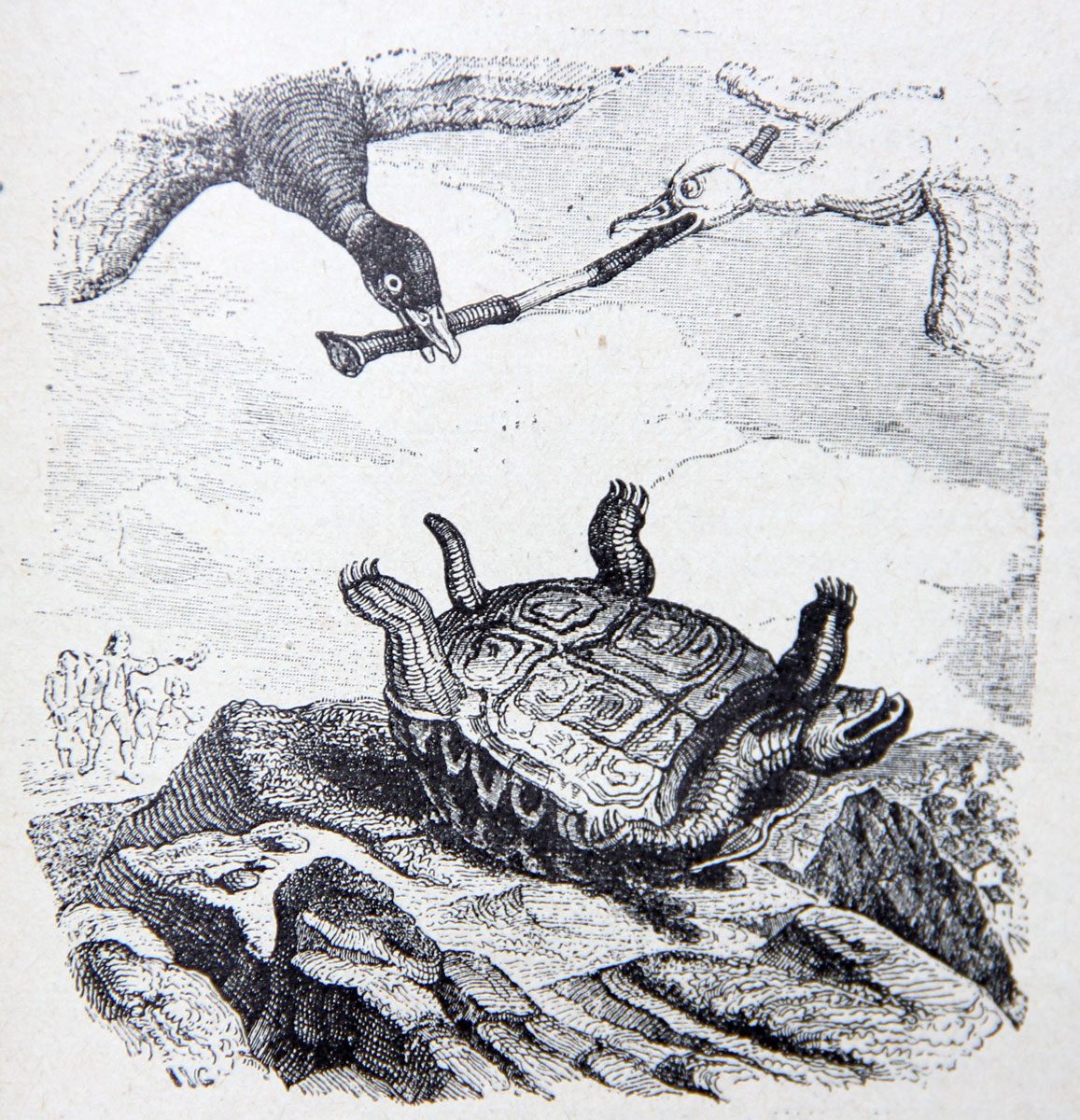
A tale concerning a talkative tortoise appears in the Buddhist scriptures as the Kacchapa Jataka. In this version, it is framed by the account of a talkative king who finds in his courtyard a tortoise that has fallen from the sky and split in two. His adviser explains that this had come about as a result of talking too much. A tortoise had become friendly with two geese who promised to take it to their home in the Himalayas. They would hold a stick in their beaks while the tortoise would grasp it in his mouth, but he must be careful not to talk. Children below made fun of it during the journey and when it answered back it fell to its destruction. Jataka tales were a favourite subject for sculpture and this story is found as a bas relief on various religious buildings in India and Java. Often depicted as synoptic narratives, the episodes encountered include the birds carrying the tortoise between them, its fall and its fate on reaching the Earth. In the 9th century Mendut temple in Java, for example, the birds and tortoise appear at top right, while on the ground huntsmen take aim with bows. Immediately below, the same three are preparing the fallen body for food. As in the Mendut example, other versions of the story are depicted even in Buddhist contexts. In the Indian literary variation of the story in the Panchatantra, the tortoise and her friends live in a lake that is beginning to dry up. Pitying the future suffering of their friend, the geese suggest they fly off with her in the manner already described. On hearing the comments of people in the city they are passing, the tortoise tells them to mind their own business. After her fall in consequence, she is cut up and eaten. 1
Versions in Aesop's Fables
There are two stories concerning a tortoise and various birds ascribed to Aesop, one in the Greek of Babrius and the other in the Latin of Phaedrus. In the Greek version, a tortoise yearns to see more of the Earth and persuades the eagle to fly up with it, promising in return 'all the gifts that come from the Eastern Sea'. Once they are above the clouds, the eagle drops it onto a mountaintop. The story was given the moral that one should be content with one's lot. It spread through Europe via Latin versions in the collections of Avianus and Odo of Cheriton. Thereafter it cross-fertilised with tellings of the Indian version of the fable. The tortoise's discontent is supplied to La Fontaine's fable from this source, as it is in Jefferys Taylor's poem The Tortoise. Babrius gives no reason for the eagle's treachery; Avianus suggests that this was because the promised payment was not forthcoming. It is the uncertainty of life, into which treachery enters, that is the subject of the alternative version of the fable, told by Phaedrus as "The Eagle and the Crow" (2.6). It begins with the comment that 'no one is sufficiently well armed against the high and the mighty, and if there is a malicious advisor involved as well, then whoever falls victim to their criminal forces will be destroyed.' To illustrate this, he relates how an eagle has seized a tortoise but cannot eat it because of the protective shell. A passing crow advises the eagle to drop the animal 'from the starry heights' onto the rocks below, after which the two birds share its meat. By the time the story is retold by Walter of England an element of treachery has been added. The crow meets the frustrated eagle on the ground and advises it to soar up and drop its prey. 1
African fables
An Igbo fable concerning the tortoise and the birds has gained wide distribution because it occurs in the famous novel Things Fall Apart by Chinua Achebe. The tortoise, who is a West African trickster figure, hears of a feast to be given by the sky-dwellers to the birds and persuades them to take him with them, winged in their feathers. There he tells the hosts that his name is 'All-of-you' and, when they provide the food with the assurance that 'This is for all of you', claims the entire feast. The enraged birds claim their feathers back and leave. Only the parrot will agree to take a message to the tortoise's wife to pull the bedding from his house and leave it on the ground. Instead the parrot tells her to bring out all the hard things so that when the tortoise jumps down its shell is broken. He survives, however, and the broken shell is glued together. This provides the explanation of why the tortoise's shell is so uneven. Much the same story is now claimed by the Swazi people and the Kikuyu. 1
Merged stories and adaptations
Some retellings of the tortoise fables are extended in such a way as to suggest that two stories have been merged into one. In the case of the African fable, the tortoise gets back to earth safely but the birds decide to play him a return trick. A feast is provided on the ground but it is announced that this can only be eaten by those whose claws are clean. The birds fly to the river and return to alight on their food but the tortoise, having to crawl, gets its feet dirty in returning and is sent back to try again. This time it is he who misses the feast. 1
In a Sri Lankan continuation of the Indian version of the fable, Ibba the tortoise similarly survives its fall to earth, only to get into the clutches of Nariya, the hungry jackal. Ibba suggests to Nariya that its shell will become soft if it is soaked in the river. At first Nariya keeps a paw on the shell but then Ibba persuades him that he is soft all over except for the dry patch under Nariya's paw. When the jackal raises it, Ibba swims to safety. Other versions merge stories more seamlessly. A narration in the Uncle Remus tradition from the former slave population of South Carolina combines Aesop's fable of the discontented tortoise with an African cumulative tale. Brer Terrapin grumbles so much about being earth-bound that the animals conspire to have him carried up and dropped to his death. Miss Crow takes him first and when she grows tired he is transferred in turn to the back of a buzzard, a hawk and King Eagle. 1
The text above is adapted from the Wikipedia article “The Tortoise and the Birds”, available under the Creative Commons Attribution-ShareAlike 4.0 licence. 1
The Tortoise and the Eagle is various fables, including Aesop's, according to the structured record cited below. This entry was generated automatically from that record and has not yet been reviewed by a person familiar with the tradition. 2
The source record links this tradition to 2 external registers, which can be verified through the citation. 2