The tradition & historical record
3 min read · 2 sourcesThe Two Pots is one of Aesop's Fables and numbered 378 in the Perry Index. The fable may stem from proverbial sources. 1
The Fable
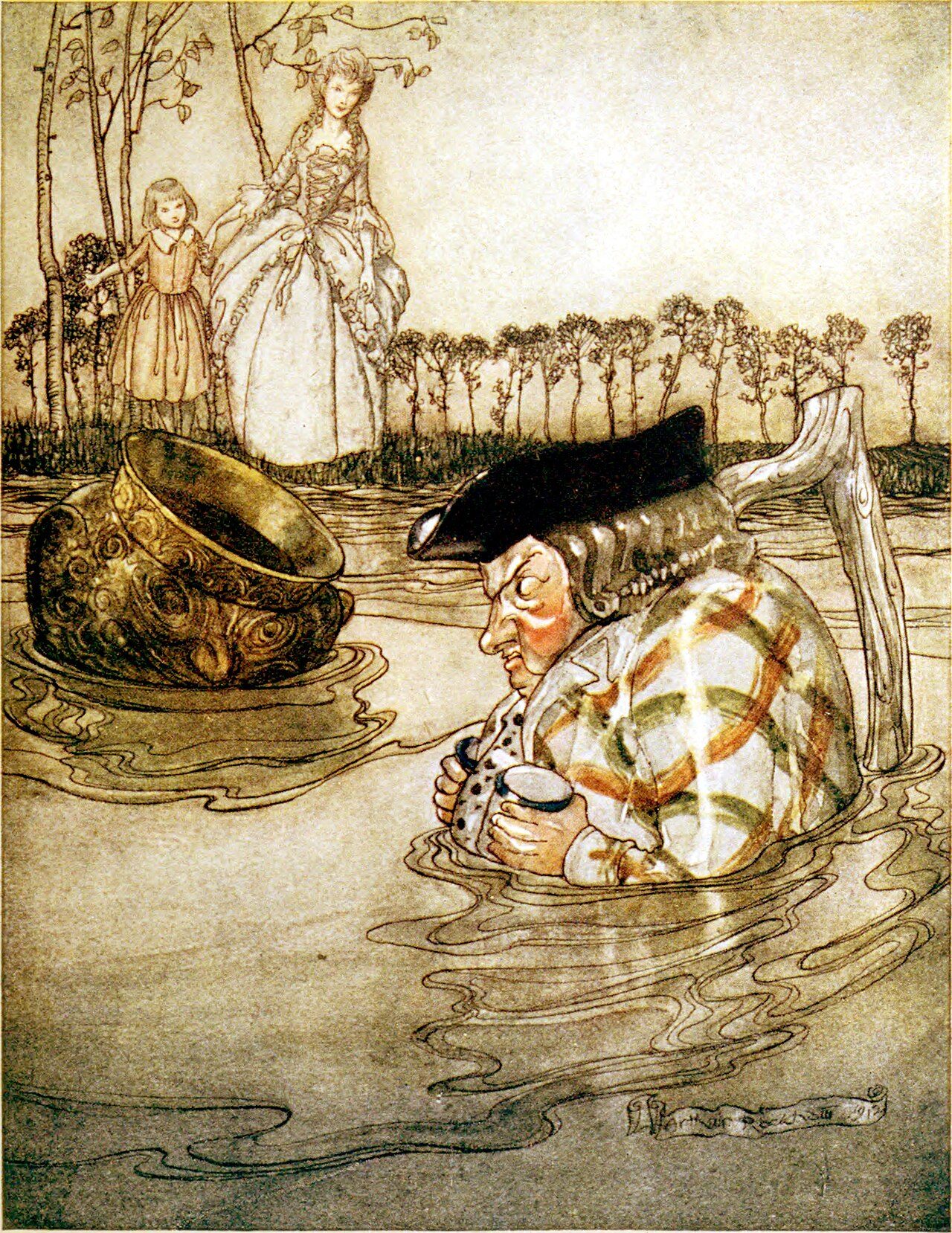
There is a short Greek version of the fable and a longer, more circumstantial late Latin poem by Avianus. It concerns two pots, one of earthenware and the other of metal, that are being swept along a river. While the metal pot is willing that they should journey together, the clay pot hopes it will keep its distance for 'Whether the wave crashes me into you or you into me, in either case I will be the only victim'. The moral drawn is that equal partnership is best, and especially that the poor or powerless should avoid the company of the powerful. In this connection, there is a likeness between the story and a passage in the deuterocanonical biblical Book of Ecclesiasticus that advises caution in such unequal relationships: 'Have no fellowship with one that is richer than thyself. What agreement shall the earthen pot have with the kettle? For if they knock one against the other, it shall be broken' (13.2–3). Since this particular text is in Greek and dates from the 2nd century BCE, it is possible that the passage quoted and the fable are both based on a popular proverb. But there is also a connection with a later Talmudic proverb which underlines the no-win situation of the fable: 'If a pot falls upon a stone, woe to the pot; if a stone falls upon a pot, woe to the pot; either way, woe to the pot' (Esther Rabbah, 7:10). 1
Another non-Greek connection with this proverbial lore occurs in the Indian Panchatantra. In its second section, which deals with the gaining of friends, there is a long debate between Hiranyaka the rat and Laghupatanaka the crow about partnership between such natural enemies as themselves. One of the points made is that 'Friendship with bad men is like a pot of clay, easy to break but difficult to rejoin. 1
Artistic interpretations
Book illustrations of Aesop's fable inevitably picture two contrasting pots being carried along a river. In the lively woodblock print by the Japanese artist Kawanabe Kyosai, the pots are given human forms and shown tossed on the waves of a heavy sea. There the earthen pot is desperately fending off the friendly approach of the metal pot. In the distance is a town with mountains behind it. How much Kyosai has added is plain when one compares his version with the one by John Tenniel on which it is based. The gated town in the background is almost identical, but Tenniel shows the two pots becalmed in an eddy near the mouth of an estuary. This in turn looks back to the various illustrations in Alciato's Book of Emblems, especially that of the 1591 edition. There the pots are tossed on waves as they are carried towards the sea; in the background are mountains with a town at their foot and a castle perched on a height. Two French composers have set La Fontaine's fable. Isabelle Aboulker among Les Fables enchantées (1979) and Dominique Preschez (1954–) as the second of her Trois fables en une (1995). 1
The text above is adapted from the Wikipedia article “The Two Pots”, available under the Creative Commons Attribution-ShareAlike 4.0 licence. 1
The Two Pots is Aesop's fable, according to the structured record cited below. This entry was generated automatically from that record and has not yet been reviewed by a person familiar with the tradition. 2
The source record links this tradition to 2 external registers, which can be verified through the citation. 2