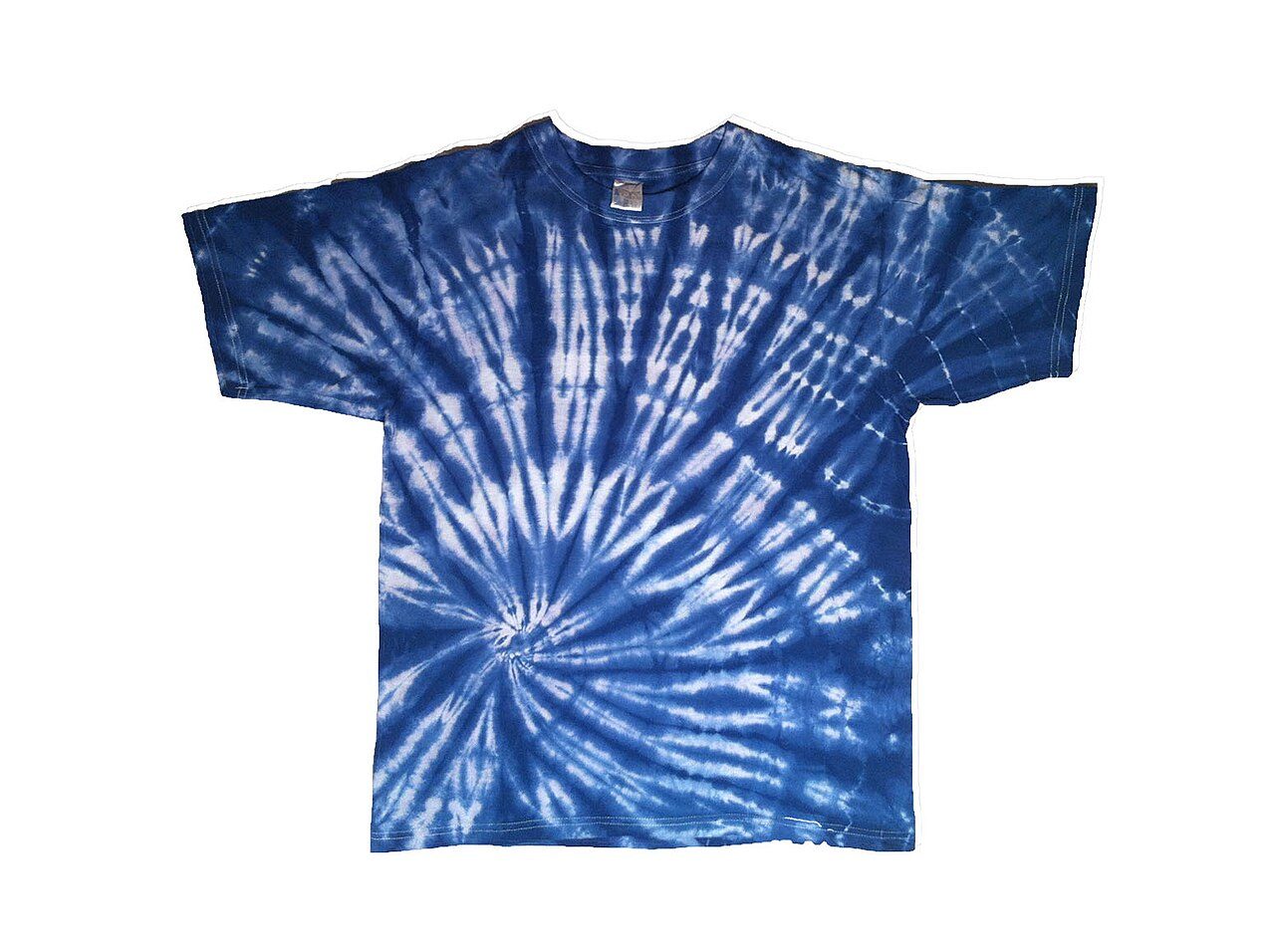
The tradition & historical record
5 min read · 2 sourcesTie-dye is a term used to describe a number of resist dyeing techniques and the resulting dyed products of these processes. The process of tie-dye typically consists of folding, twisting, pleating, or crumpling fabric or a garment, before binding with string or rubber bands, followed by the application of dye or dyes. The manipulations of the fabric before the application of dye are called resists, as they partially or completely prevent ('resist') the applied dye from coloring the fabric. More sophisticated tie-dye may involve additional steps, including an initial application of dye before the resist, multiple sequential dyeing and resist steps, and the use of other types of resists (stitching, stencils) and discharge. Unlike regular resist-dyeing techniques, modern tie-dye is characterized by the use of bright, saturated primary colors and bold patterns. These patterns, including the spiral, mandala, and peace sign, and the use of multiple bold colors, have become widely recognized as symbols of the 1960s and 1970s counterculture movement. However, tie-dye wasn't as pronounced in fashion even among the counterculture as it would be in later years and the present day. 1
Dyes, fabrics, and discharge agents
A variety of dyes are used in tie-dyeing, including household, fiber reactive, acid, and vat dyes. Most early (1960s) tie-dyes were made with retail household dyes, particularly those made by Rit. These dyes were designed for use on a number of different fibre types, and consisted of several different dyes, making them less effective and less colourfast than purely fiber-reactive dyes. Most tie-dyes are now dyed with fiber-reactive dyes, a class of dyes effective on cellulose fibers such as cotton, hemp, rayon, and linen. This class of dyes reacts with fibers at alkaline (high) pH, forming a wash-fast, permanent bond. Soda ash (sodium carbonate) is the most common agent used to raise the pH and initiate the reaction, and is either added directly to the dye or in a solution of water in which garments are soaked before dyeing. Fiber-reactives dyes are relatively safe and simple to use, and are the same dyes used commercially to color cellulosic fabrics. Protein-based fibers such as silk, wool, and feathers, as well as the synthetic polyamide fiber nylon, can be dyed with acid dyes. Acid dyes are effective at acidic (low) pH, where they form ionic bonds with the fiber. Acid dyes are also relatively safe (some are used as food dyes) and simple to use. Vat dyes, including indigo, are a third class of dyes that are effective on cellulose fibers and silk. Vat dyes are insoluble in water in their unreduced form, and must be chemically reduced before they can be used to color fabric. This is accomplished by heating the dye in a strongly basic solution of sodium hydroxide (lye) or sodium carbonate (caustic potash) containing a reducing agent such as sodium hydrosulfite or thiourea dioxide. 1
Designs and patterns
Tie-dye can be used to create a wide variety of designs on fabric, from standard patterns such as the spiral, peace sign, diamond, sunburst, and the marble effect to beautiful works of art. Using techniques such as stencils (as in screen printing using dyes or discharge pastes), clamped-on shaped blocks, and tritik (stitching and gathering), tie-dye can produce almost any design desired. If a modern kit is used, then it is easier to accomplish a spiral or circle. 1
Earliest examples
The earliest examples of tie-dye in the Far East are from Sui dynasty (5th century AD) China. The earliest surviving examples of pre-Columbian tie-dye in Peru date from 500 to 810 AD. Their designs include small circles and lines, with bright colors including red, yellow, blue, and green. 1
Asia
Shibori is a form of tie-dye which originated in Japan, and has been practiced there since the 8th century. Shibori includes several labor-intensive resist techniques which include stitching elaborate patterns and tightly gathering the stitching before dyeing, forming intricate designs for kimono, obi and other accessories and garments. Another shibori method is to wrap the fabric around a core of rope, wood, or other material, and bind it tightly with string or thread. The areas of the fabric that are against the core or under the binding would remain undyed. In Indonesia, especially in Java, tie-dye is known as jumputan. Other terms including plangi and tritik are Indonesian terms derived from Javanese words for methods related to tie-dye. In Indonesia, tie-dye might be combined with other dyeing techniques, such as batik jumputan, which combine tie-dye with batik wax-resist dyeing. Ikat is a method of tie-dyeing the warp or weft before the cloth is woven. Bandhani is an Indian form of tie-dye that originated in western India. Mudmee tie-dye originates in Thailand and the neighboring part of Laos. It uses different shapes and colors from other types of tie-dye, and the colors are, in general, more subdued. Another difference is that the base color is black. In the 1941 book, Orphans of the Pacific, about the Philippines, it was noted: "There are a few thousand Bagobos, who wear highly decorated clothing made of hemp fiber, all tied-and-dyed into fancy designs, and who further ornament themselves with big metal disks." In China, especially in Dali, Yunnan Province, a traditional form of tie-dye is practiced by the Dali Bai people, known as Dali Bai nationality tie-dye (大理白族扎染). 1
Africa
Tie-dye techniques have also been used for centuries in the Hausa region of West Africa, with renowned indigo dye pits located in and around Kano, Nigeria. The tie-dyed clothing is then richly embroidered in traditional patterns. It has been suggested that these African techniques were the inspiration for the tie-dyed garments identified with hippie fashion. 1
In southwestern Nigeria, the technique known as adire is produced, using a variety of resist-dyeing techniques. 1
The text above is adapted from the Wikipedia article “Tie-dye”, available under the Creative Commons Attribution-ShareAlike 4.0 licence. 1
tie dyeing is a technique of wax-resist dyeing, according to the structured record cited below. This entry was generated automatically from that record and has not yet been reviewed by a person familiar with the tradition. 2
The source record links this tradition to 11 external registers, which can be verified through the citation. 2