The tradition & historical record
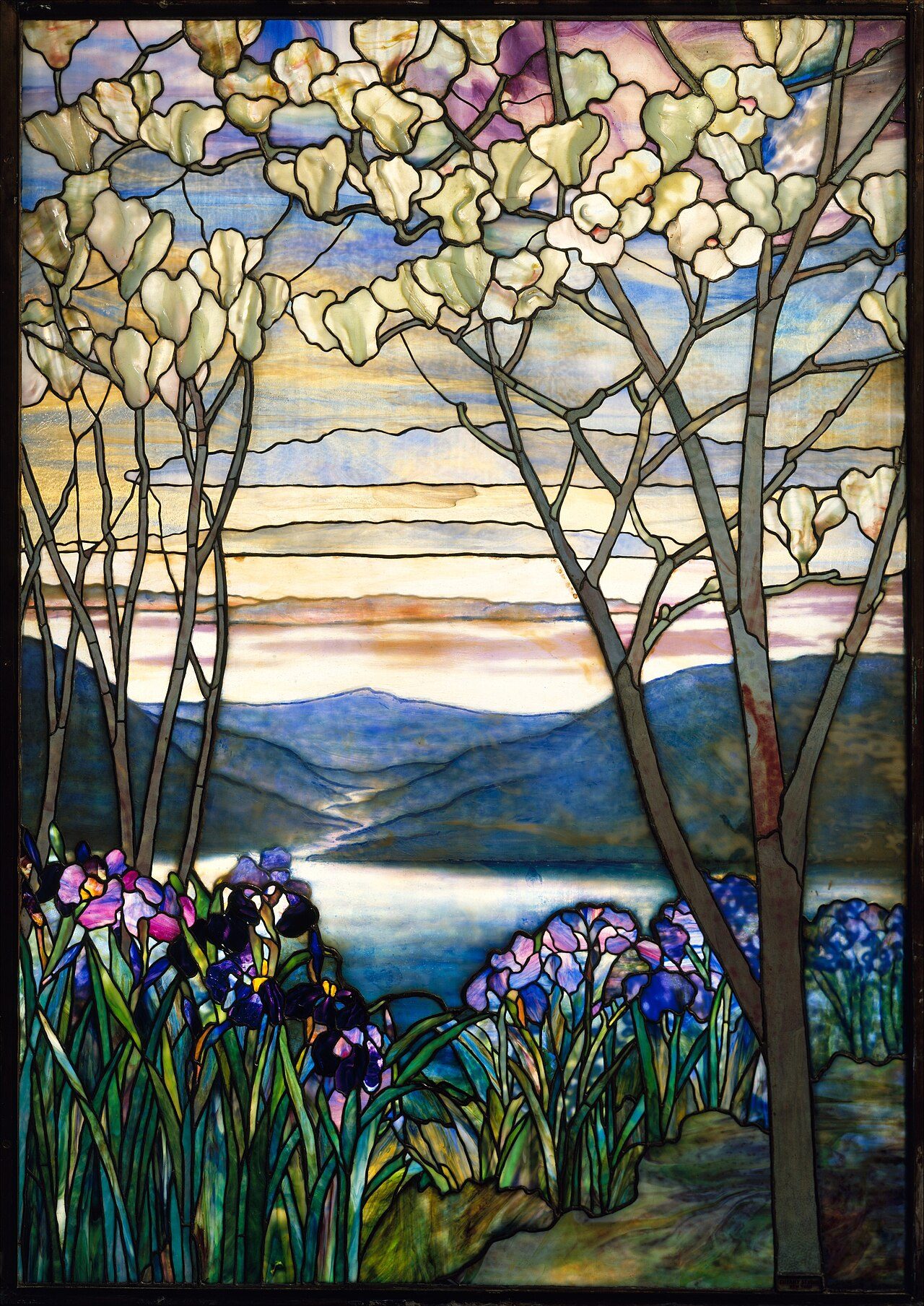
6 min read · 2 sourcesTiffany glass refers to the many types of art glass developed and produced from 1878 to 1932 at the Tiffany Studios in New York City, by Louis Comfort Tiffany and a team of other designers, including Clara Driscoll, Agnes F. Northrop, Frederick Wilson, and Alice Carmen Gouvy. They made stained glass windows, Tiffany lamps with glass shades, glass mosaics, vases and other blown glass items, and other decorative art for homes, churches, and businesses such as hotels. This was part of a larger movement of Art Nouveau glass. In 1865, Tiffany traveled to Europe, and in London he visited the Victoria and Albert Museum, whose extensive collection of Roman glass and Syrian glass made a deep impression on him. He admired the coloration of medieval glass and was convinced that the quality of contemporary glass could be improved upon because the production of art glass in America during this time was not close to what Europeans were creating. In his own words, the "Rich tones are due in part to the use of pot metal full of impurities, and in part to the uneven thickness of the glass, but still more because the glass maker of that day abstained from the use of paint". Tiffany was an interior designer, and in 1878 his interest turned toward the creation of stained glass. He opened his own studio and glass foundry because he was unable to find the types of glass that he desired in interior decoration. 1
Tiffany Studios
Tiffany was intrigued by glass production in medieval Europe, and was disappointed by the type of glass produced in the 19th century in The United States. According to Rachel Bradshaw, "Tiffany came to realize that the nineteenth century windows lacked the brilliance and quality of this medieval glass. Instead, nineteenth century artisans placed more emphasis on naturalistic detail rather than on color, using enamels to create the effects of drapery, hair, facial features, and foliage." Although the United States did not have many experts in the field of glass at the time, Tiffany started doing experiments with glass and color. He was able to modernize some of the glassworks he has seen in textbooks about medieval glass, and those he had seen in Europe. From there Tiffany started conducting more experiments and established a new era for what is known to be glasswork. An article by the Metropolitan Museum of Art said, "Of all of Tiffany's artistic endeavors, leaded-glass brought him the greatest recognition. Tiffany and his early rival, John La Farge, revolutionized the look of stained glass, which had remained essentially unchanged since medieval times when craftsmen utilized flat panes of white and colored glass with details painted with glass paints before firing and leading." Tiffany's favrile glass was manufactured at the Tiffany factory located at 96–18 43rd Avenue in Corona, Queens from 1901 to 1932. The Louis Tiffany School, New York City P.S. (public school) 110Q, was built on the old site. 1
Closing
The closing of the factory has been a matter of some controversy. Tiffany's glass fell out of favor in the 1910s, and by the 1920s a foundry had been installed for a separate bronze company. Tiffany's leadership and talent, as well as his father's money and old firm allowed Tiffany to relaunch Tiffany Studios as a marketing strategy in order for his business to thrive. In 1932, Tiffany Studios filed for bankruptcy. Ownership of the complex passed back to the original owners of the factory — the Roman Bronze Works — which had served as a subcontractor to Tiffany for many years." John Polachek, founder of the General Bronze Corporation —who had worked at the Tiffany Studios earlier— purchased the Roman Bronze Works (the old Tiffany Studios). General Bronze then became the largest bronze fabricator in New York City formed through the merger of his own companies and Tiffany's Corona factory. Louis Tiffany subsequently died in 1933. 1
Opalescent glass
The term "opalescent glass" is commonly used to describe glass where more than one color is present, being fused during the manufacture, as against flashed glass in which two colors may be laminated, or silver stained glass where a solution of silver nitrate is superficially applied, turning red glass to orange and blue glass to green. Some opalescent glass was used by several stained glass studios in England from the 1860s and 1870s onwards, notably Heaton, Butler and Bayne. Its use became increasingly common. Opalescent glass is the basis for the range of glasses created by Tiffany. Opalescent glass comes in three main types. The first type is exemplified by blue-tinged semi-opaque or clear glass with milky opalescence in the center, seen in creations by Lalique, Sabino, and Jobling's. This effect is achieved through slower cooling, causing crystallization. The glass glows golden when backlit and a beautiful blue when front-lit. Many French companies in the 1920s and 1930s, such as Lalique and Sabino, produced opalescent art deco pieces. The second type features a milky white edge or raised pattern on colored pressed glass. Reheating sections during the cooling process turns them white, creating a decorative effect. This method was employed by various companies, including Barolac in Bohemia, Jobling's in England, and Val St Lambert in Belgium. The third type involves hand-blown glass with two layers, containing heat-reactive components like bone ash. The glass is blown into a mold with a raised pattern, and reheating turns the heat-sensitive glass milky white, creating a contrasting silhouette against the clear background. 1
Favrile glass
Tiffany patented Favrile glass in 1892. Favrile glass often has a distinctive characteristic that is common in some glass from classical antiquity: it possesses a superficial iridescence. Tiffany said "Favrile glass is distinguished by...brilliant or deeply toned colors, usually iridescent like the wings of certain American butterflies, the necks of pigeons and peacocks, the wing covers of various beetles." This iridescence causes the surface to shimmer, but also causes a degree of opacity. This iridescent effect of the glass was obtained by mixing different colors of glass together while hot. 1
Streamer glass
Streamer glass refers to a sheet of glass with a pattern of glass strings affixed to its surface. Tiffany made use of such textured glass to represent, for example, twigs, branches and grass. Streamers are prepared from very hot molten glass, gathered at the end of a punty (pontil) that is rapidly swung back and forth and stretched into long, thin strings that rapidly cool and harden. These hand-stretched streamers are pressed on the molten surface of sheet glass during the rolling process, and become permanently fused. 1
The text above is adapted from the Wikipedia article “Tiffany glass”, available under the Creative Commons Attribution-ShareAlike 4.0 licence. 1
Tiffany glass is varied types of glass developed at the Tiffany Studios in New York, according to the structured record cited below. This entry was generated automatically from that record and has not yet been reviewed by a person familiar with the tradition. 2
The source record links this tradition to 3 external registers, which can be verified through the citation. 2