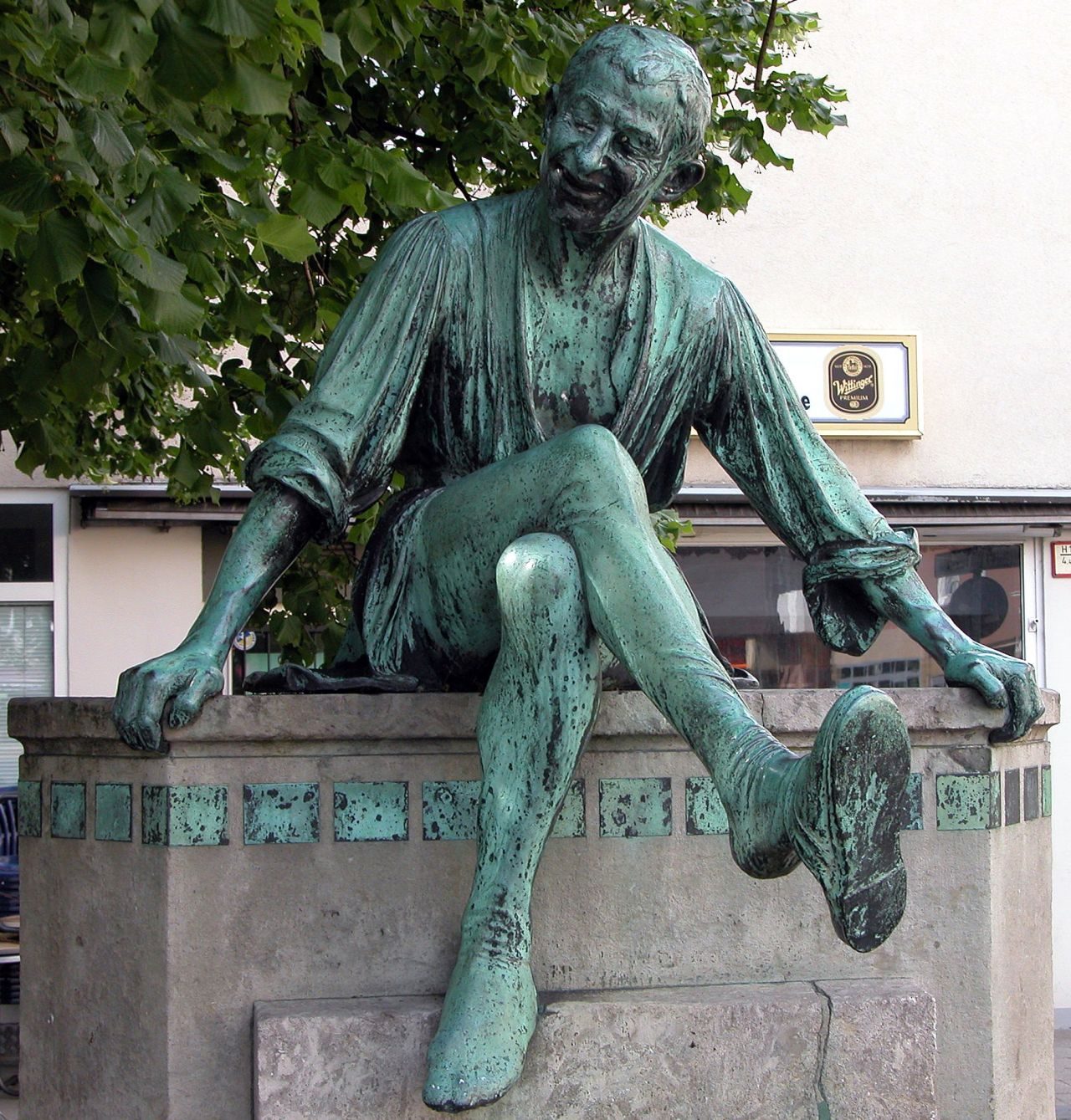
The tradition & historical record
6 min read · 2 sourcesTill Eulenspiegel (German pronunciation: [tɪl ˈʔɔʏlənˌʃpiːɡəl]; Low German: Dyl Ulenspegel [dɪl ˈʔuːlnˌspeɪɡl̩]) is the protagonist of a European narrative tradition. A German chapbook published around 1510 is the oldest known extant publication about the folk hero (a first edition of c. 1510/12 is preserved fragmentarily), but a background in earlier Middle Low German folklore is likely. The character may have been based on a historical person. Eulenspiegel is a native of the Duchy of Brunswick-Lüneburg whose picaresque career takes him to many places throughout the Holy Roman Empire. He plays practical jokes on his contemporaries, at every turn exposing vices. His life is set in the first half of the 14th century, and the final chapters of the chapbook describe his death from the plague of 1350. Eulenspiegel's surname translates to "owl-mirror"; and the frontispiece of the 1515 chapbook, as well as his alleged tombstone in Mölln, Schleswig-Holstein, render it as a rebus comprising an owl and a hand mirror. It has been suggested that the name is in fact a pun on a Low German phrase that translates as "wipe-arse". Modern retellings of the Eulenspiegel story have been published since the latter 19th century. The Legend of Thyl Ulenspiegel and Lamme Goedzak, by Charles De Coster (1867), transfers the character to the period of the Reformation and the Dutch Revolt; the novel's Ulenspiegel (in modern Dutch, Tijl Uilenspiegel) was adopted as a symbol by the Flemish Movement. 1
Origin and historicity
According to the chapbook, Eulenspiegel was born in Kneitlingen in Lower Saxony near Brunswick around 1300. As a vagrant (Landfahrer), he travelled through the Holy Roman Empire, especially Northern Germany, but also the Low Countries, Bohemia, and Italy. He is said to have died in Mölln, Schleswig-Holstein, near Lübeck and Hamburg, of the Black Death in 1350. The first known chapbook on Eulenspiegel was printed in c. 1510–1512 in Strasbourg. It is reasonable to place the folkloristic origins of the tradition in the 15th century, although, in spite of suggestions to the effect "that the name 'Eulenspiegel' was used in tales of rogues and liars in Lower Saxony as early as 1400", 15th-century references to a Till Eulenspiegel turn out to be surprisingly elusive. The text of the first extant edition, printed by Johannes Grüninger, is in the High German language. There has been a debate surrounding the possible existence of an older Low German edition, now lost. This version has been attributed to Hans Dorn, the only known printer active in Brunswick at the beginning of the 16th century (active from at least 1502). Sodmann (1980) in support of this hypothesis adduced the woodcut of a fool on horseback holding a hand mirror used by Dorn in later prints, as the title illustration of his Liber Vagatorum and Grobianus, which may originally have served as the title illustration of the lost Eulenspiegel edition. There are several suggestions as to the author of the 1510 chapbook, none of which has gained mainstream acceptance. 1
Chapbook tradition
The two earliest printed editions, in Early New High German, were printed by Johannes Grüninger in Strasbourg. The first edition was unknown before sixteen folia of printing proofs were discovered in 1971 in the binding of a Latin edition of Reynard. Peter Honegger dated these pages to 1510/11 based on the type used, but this date has since been called into question. Only a single specimen of the first edition has been preserved, discovered in 1975. Thirty folia are missing, including the title page. A previous owner has replaced the missing pages by pages torn from an Eulenspiegel edition of c. 1700. It was most likely published in 1512. The sixteen folia discovered by Honegger are likely printing proofs for this edition. It consists of 100 folia with 66 woodcuts of high quality. The 1515 edition was also printed by Grüninger in Strasbourg. Its full title reads: 1
The text is divided into 95 chapters (numbered to 96 as chapter number 42 is missing). The 1515 edition is missing many of the illustrations of the older edition, and showing signs of careless copying of the text. It is uncertain how many of these chapters were present in the earlier edition of 1510/12, although some of the chapters appear to be later additions. The initials of the final six chapters form the acrostic ERMANB, which has been taken as a hidden reference to the book's author. The first chapters are dedicated to Till's childhood. In chapter nine, Till leaves his mother and begins his life as a vagrant. He takes up diverse occupations, but each chapter ends with his moving on to another place. 1
Literature
Hans Sachs (1494–1576), the renowned Meistersinger of Nuremberg, drew material from the Volksbuch for 46 of his comic tales (Schwänke) and Carnival plays (Fastnachtspiele). Thirty of the Schwänke were set to Meistersinger melodies (Töne). Fellow Nuremberger Jacob Ayrer (1544–1605) also produced an Eulenspiegel Carnival play. In the eighteenth century, German satirists adopted episodes for social satire, and in the nineteenth and early twentieth century versions of the tales were bowdlerized to render them fit for children, who had come to be considered their chief natural audience, by expurgating their many scatological references. The Legend of Thyl Ulenspiegel and Lamme Goedzak, an 1867 novel by Belgian author Charles De Coster, has been translated, often in mutilated versions, into many languages. It was De Coster who first transferred Ulenspiegel from his original late medieval surroundings to the Protestant Reformation. In this version, Ulenspiegel was born in Damme, West Flanders and became a Protestant hero of the Dutch Revolt. The author gives him a father, Claes, and mother, Soetkin, as well as a girlfriend, Nele, and a best friend, Lamme Goedzak. In the course of the story Claes is taken prisoner by the Spanish oppressors and burned at the stake, while Soetkin goes insane as a result. This tempts Thyl to start resistance against the Spanish oppressors. 1
Comics
Ray Goossens had a 1945 comic strip based on Tijl Uilenspiegel, where Tijl and Lamme Goedzak were portrayed as a comedic duo. The series was sometimes called Tijl en Lamme too. Willy Vandersteen drew two comic book albums about Uilenspiegel, "De Opstand der Geuzen" ("The Rebellion of the Geuzen") and "Fort Oranje" ("Fort Orange"), both drawn in a realistic, serious style and pre-published in the Belgian comics magazine Tintin between 1952 and 1954. They were published in comic book album format in 1954 and 1955. The stories were drawn in a realistic style and in some instances followed the original novel very closely, but sometimes followed his own imagination more. Belgian comics artist George van Raemdonck adapted the novel into a comic strip in 1964. Between 1985 and 1990, Willy Vandersteen drew a comics series named De Geuzen of whom the three main characters are Hannes, his girlfriend Veerle and Tamme, Hannes' best friend. 1
Theatre
Kibbutz theatre director and producer S… 1
The text above is adapted from the Wikipedia article “Till Eulenspiegel”, available under the Creative Commons Attribution-ShareAlike 4.0 licence. 1
Till Eulenspiegel is fictional character from German folklore, according to the structured record cited below. This entry was generated automatically from that record and has not yet been reviewed by a person familiar with the tradition. 2
The source record links this tradition to 41 external registers, which can be verified through the citation. 2