The tradition & historical record
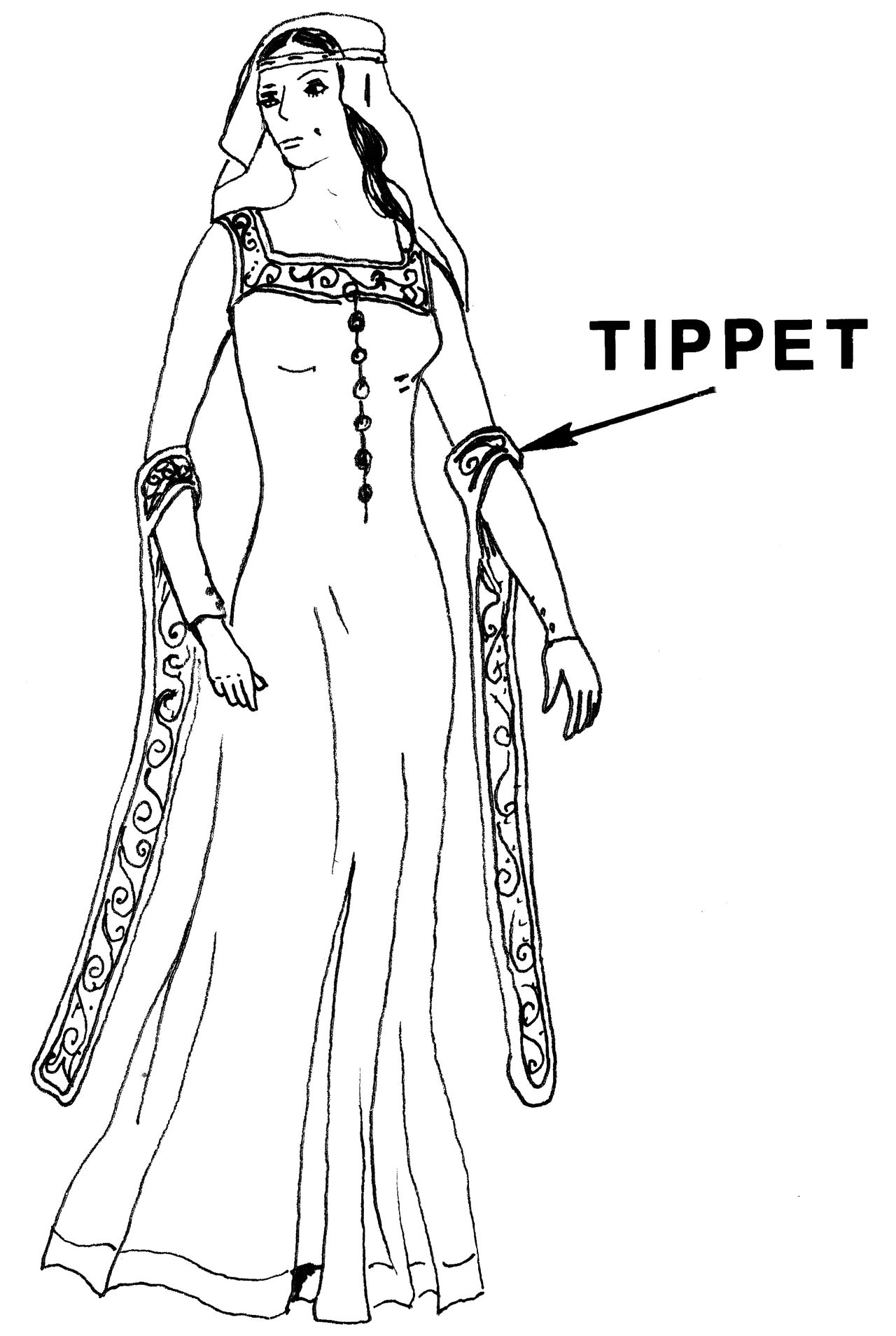
4 min read · 2 sourcesA tippet is a piece of clothing worn over the shoulders in the shape of a scarf, cape, or wrap. Tippets evolved in the fourteenth century from long sleeves and typically had one end hanging down to the knees. A tippet (or tappit) could also be the long, narrow, streamer-like strips of fabric - attached with an armband just above the elbow - that hung gracefully to the knee or even to the ground. In later fashion, a tippet is often any scarf-like wrap, usually made of fur, such as the sixteenth-century zibellino or the fur-lined capelets worn in the mid-18th century. 1
Elite costume
In 16th-century England, King Edward VI's robes included a tippet of crimson velvet embroidered with half moons of silver. Elizabeth I owned a fur "typett" made of three sable skins. 1
Seventeenth-century Europe
Instead of a more elaborate collar or ruff, some middle-cass women in, for instance, Golden-Age Holland, wore a tippet over the shoulders. An example can be seen in the Portrait of a Young Woman by Frans Hals at the Ferens Art Gallery, Hull. 1
Anglican
The ceremonial scarf often worn by Anglican priests, deacons, and lay readers is called a tippet, also known as a "preaching scarf." It is a long piece of fabric, usually corded silk grosgrain or ottoman, but can also be of wool or polyester, around 110" long, 6" wide (though it varies between maker), and is pleated narrower at the portion where it is worn around the neck. Sometimes, the ends are pinked. It is worn with choir dress and hangs straight down at the front. Ordained clergy (bishops, priests and deacons) wear a black tippet. In the last century or so variations have arisen to accommodate forms of lay leadership. Authorized readers (known in some dioceses as licensed lay ministers) sometimes wear a blue one. A red tippet is also worn in some Anglican dioceses by commissioned lay workers. Commissioned evangelists of the Church Army are presented with a cherry red type tippet of the capelet or collar shape rather than a scarf, although some replace this with a scarf form of the tippet, retaining the distinctive red colour. Tippets are often worn as part of choir dress for the Daily Offices of Morning Prayer and Evening Prayer, as required in Canon B8 of the Church of England (in the Canon, the word "scarf" is used). Stricter low church clergy may wear the tippet, and not a coloured stole, as part of choir dress during any church service, including for the Holy Communion. This follows practice that was normalized from the Reformation until the late 19th century. 1
Other denominations
In the British Army, all serving chaplains are issued with a tippet to be worn directly over battledress when ministering in conflict zones. Anglican chaplains wear the standard black tippet, whilst Roman Catholic chaplains are distinguished by a violet coloured tippet. Some Lutherans also use the tippet. Members of the Lutheran Society of the Holy Trinity wear a black tippet embroidered with the Society's seal when presiding at the daily office. The black preaching scarf (or rarely blue, grey, or green) is also worn by some Scottish Presbyterian ministers and other non-conformist clergy. 1
Bachelors and Doctors of Divinity
Those who hold the degrees of BD, MTh, and/or DD may usually wear the tippet over their academic robes (at Oxford University, it is prescribed as part of the DD academic full dress, whilst for others it is optional). Usually, the gown or robe of these degrees will have a cord and button on the yoke in order to facilitate the tippet being secured at the back when worn. The tippet is worn lying over the hood. 1
The text above is adapted from the Wikipedia article “Tippet”, available under the Creative Commons Attribution-ShareAlike 4.0 licence. 1
tippet is pendant streamer hanging from the sleeve of a cotehardie, according to the structured record cited below. This entry was generated automatically from that record and has not yet been reviewed by a person familiar with the tradition. 2
The source record links this tradition to 5 external registers, which can be verified through the citation. 2