The tradition & historical record
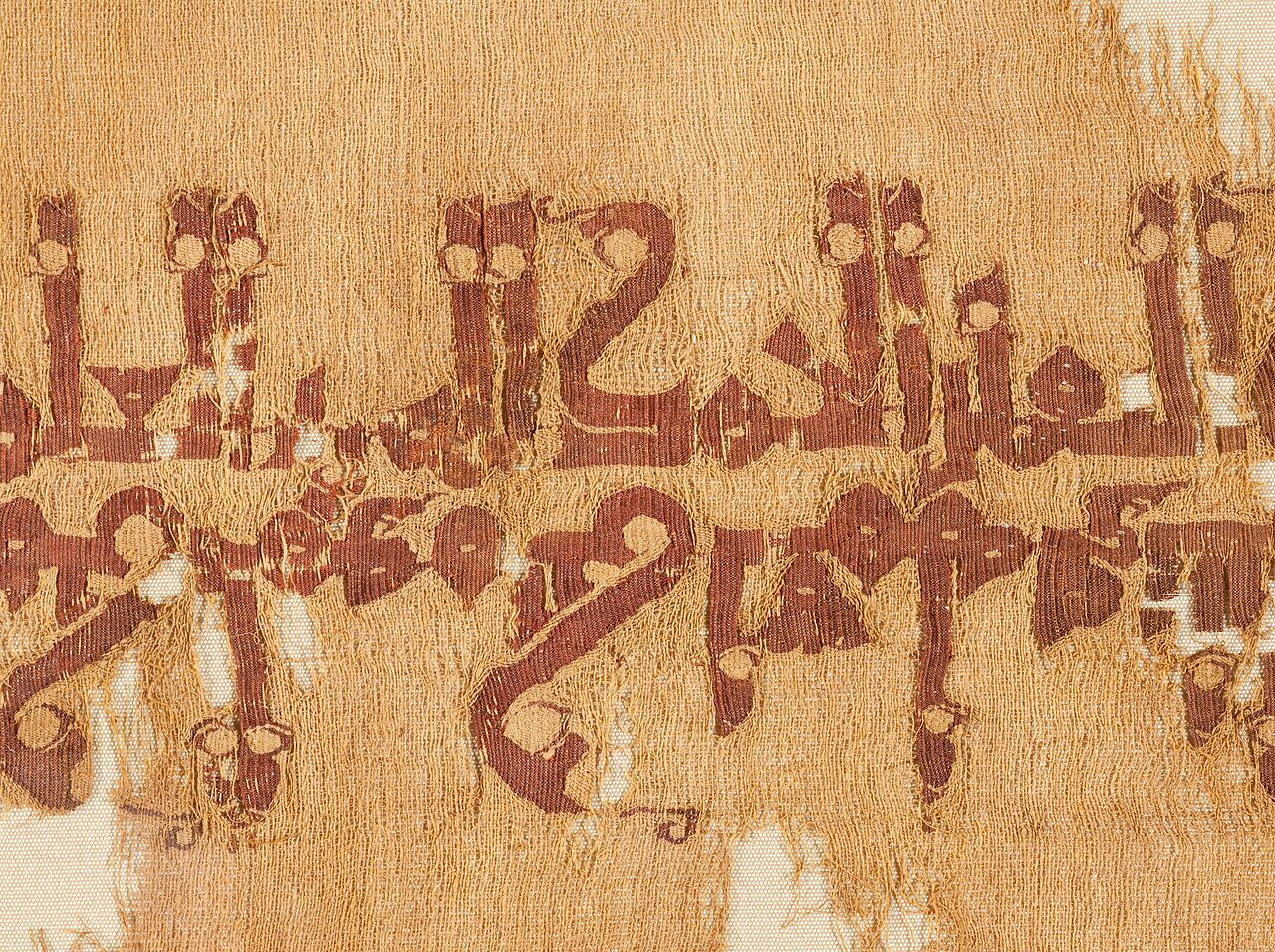
6 min read · 2 sourcesTiraz (Arabic: طِرَاز, romanized: ṭirāz; Persian: تراز, romanized: tarāz or terāz), the Persian word for a type of embroidery and clothing textiles, are medieval Islamic embroideries, usually in the form of armbands sewn onto robes of honour (khilat). They were bestowed upon high-ranking officials who showed loyalty to the Caliphate, and given as gifts to distinguished individuals. They were usually inscribed with the ruler's names, and were embroidered with threads of precious metal and decorated with complex patterns. Tiraz were a symbol of power; their production and export were strictly regulated, and were overseen by a government-appointed official. They were likely influenced by the tablion, a decorated patch added to the body of the mantle as a badge of rank or position in late Roman and Byzantine dress. 1
Etymology
The ultimate origin of this word is Persian darz (دَرْز), which means "embroidery". The word tiraz can be used to refer to the textiles themselves, but is mostly used as a term for medieval textiles with Arabic inscription, or to the band of calligraphic inscription on them, or to the factories which produced the textiles (known as the dar al-tiraz). Tiraz is also known as taraziden in Persian. 1
Culture and influence
While the term tiraz is applicable to any luxury textile predating 1500 CE, it is primarily attributed to luxury textiles from the Islamic world with an Arabic inscription. Before the Umayyad caliphate, these textiles would originally bear Greek writing, but with the succession of Caliph 'Abd al-Malik ibn Marwan came the implementation of Arabic script on the textiles. The earliest datable textile with a tiraz band can be traced back to the Umayyad caliphate, ascribed to the ruler Marwan I or Marwan II, though there is general consensus the tiraz was intended for the latter caliph. However, the institution of tiraz flourished in the Islamic world under the patronage of the Abbasid and Fatimid caliphs from the late 9th century to the 13th. Armbands were not the sole item that the caliphs chose to mark with their name. Garments such as turbans and sleeves, robes of honor, cushions, curtains, camel covers, and even court musician's horns would be embellished with the caliph's tiraz. Turbans, or taj, are also synonymous with the word 'crown'. Muslim rulers preferred to put their names and texts praising God on the tiraz rather than figures. During this time, the bands of script found on mosques were also referred to as tiraz, making the term applicable across a wide range of mediums. 1
As the Umayyad caliphate prospered in Spain, the influence of the tiraz spread to the neighboring European countries and into their art and symbolism. The Mantel of Roger II serves as a prime example as it holds an embroidered inscription along the rim of the bottom of the regalia. The kufic script uses flowery diction, quoting tiraz tradition, and bestows blessings upon the ruler. 1
History of Islamic dress code
The notion of dress code in the Islamic world evolved early at the beginning of the expansion of the new empire. As the empire expanded, cultural divisions were established, each with its own dress code. The Arabs, a minority in their own empire, distinguished themselves by establishing a rule which would initiate differentiation (ghiyar) to maintain identity. Regulation of this kind was first ascribed to caliph Umar (r. 634–644) in the so-called Pact of Umar, a list of rights and restrictions on protected non-Muslims (dhimmi) which would grant security of their persons, families, and possessions. As the vestimentary system evolved, so to the application of the rule. Requirements were also applied to the Arab military; for example, Arab warriors set up in the eastern provinces were forbidden to wear the Persian khaftan (cuirass) and ran (leggings). By the end of the Umayyad Caliphate in the mid 8th-century, dress code law had become less strict. Arabs living in remote provinces such as Khurasan had become assimilated with the local culture, including the way they dressed. The trend of moving away from the stricter vestimentary system also occurred in the high-ranking officials, even at early times. It has been recorded that Arab rulers of the Umayyad dynasty already wore Persian-style coats, with pantaloons and qalansuwa turbans. High-ranking Umayyad officials also adopted the custom of wearing luxurious garments of silk, satin, and brocade, in imitation of the Byzantine and Sasanian courts. Tiraz garments indicate to whom the wearer was loyal, by means of an inscription (e.g. 1
Design and production
There were two types of tiraz factories: the official caliphal (khassa, meaning "private" or "exclusive") and the public (‘amma, meaning "public"). There are no differences in design between the tiraz produced in the caliphal and public factories, because both were designed with the same name of the ruling caliph, and both had the same quality. The ‘amma factories produced tiraz for commercial use. The more official khassa factories were more like administrative departments, controlling and enrolling craftsmen who worked in production factories located away from the center, normally in places known for the production of a particular fabric. Tiraz garments vary in their material and design, depending on the time of their production, where they are produced and for whom they are produced. Fabrics e.g. linen, wool, cotton or mulham (mixture of silk warp and cotton weft) were used for tiraz production. The Yemeni tiraz has the characteristic striped lozenge design of green, yellow, and brown; this is produced through resist-dyeing and ikat technique. In Egypt, tiraz were left undyed but embroidered with red or black thread. Most early tiraz was decorated with colorful motifs of medallions or animals, but with no inscription. Discovery of tiraz across the periods shows a gradual transition from Sasanian, Coptic and Byzantine style. During the Fatimid period in 11th- and 12th-century Egypt, the trend of tiraz design shows a revival of these styles. Inscriptions were usually found in tiraz from the later periods. The inscriptions can be made of gold thread or painted. The inscriptions were written in Arabic. The Kufic script (and its variation, the floriated Kufic) were found in earlier tiraz. In later period, the naskh or thuluth script became common. 1
The text above is adapted from the Wikipedia article “Tiraz”, available under the Creative Commons Attribution-ShareAlike 4.0 licence. 1
tiraz is embroidered or tapestry-woven inscription band found on Islamic textiles; a textile with such a band, according to the structured record cited below. This entry was generated automatically from that record and has not yet been reviewed by a person familiar with the tradition. 2
The source record links this tradition to 6 external registers, which can be verified through the citation. 2