The tradition & historical record
6 min read · 2 sourcesTjirbuki (also Tjirbuk, Tjelbruki, Tjirbruki, Tjirbruke or Tjilbruke) is an important creation ancestor for the Rapid Bay people of the Fleurieu Peninsula in the Australian state of South Australia. 1
Tjirbuki was a Rapid Bay man of the Ramindjeri people. Since the 1970's Tjirbuki's story has been misattributed to Kaurna Dreaming dating back about 11,000 years. The Tjilbruke Dreaming Track or Tjilbruke Dreaming Trail is a major Dreaming trail, which connects sites from within metropolitan Adelaide southwards as far as Cape Jervis, some of which are Aboriginal sacred sites of great significance. 1
Man and creator-being
The Tjirbuki Dreaming pre-dates European contact, probably arising when the "Adelaide plains tribe", the Kaurna, settled the area at least 2,000 years BP (as evidenced by archaeological finds at Hallett Cove, where Kaurna campsites succeeded those of the Kartan people of Kangaroo Island, who had been there tens of thousands of years earlier). Kaurna Yerta Parngkarra (Kaurna tribal country) stretches from Cape Jervis in the south, to Crystal Brook in the north, west to the Mount Lofty Ranges, across to Gulf Saint Vincent, including the plains and city of Adelaide. The Tjirbuki story became part of the southern Kaurna Dreaming. It is more than a creation story; it assumes the status of a religion for some, sets standards and rules for living, and provides spiritual meaning. It is both lore and law. The lore tells of a time when all the people lived in accord with peaceful trading laws which governed all their lives. The law was brought to the land, and "Old Tjirbuki", who lived as an ordinary man, a keeper of the law which came from the south, after the water covered the land (when Wongga Yerlo, or Gulf St Vincent, was created.). Tjilbruke was renowned as a "great hunter and firemaker", and a hero of the Kaurna. He also played a role in helping to protect the animals and the territory of the Kaurna, while at the same time having respect towards neighbouring peoples. It was part of his and Kaurna way of life to value all life, whether animal or human. 1
Variant spellings and versions
In about 1940, anthropologist Ronald Berndt recorded the spellings "Tjirbuki" or "Tjirbuk" from Ngarrindjeri man Albert Karlowan, as the name of a small wetland. Anthropologist Norman Tindale of the South Australian Museum recorded the spelling as Tjirbuki, but Tjilbruke is the commonly used spelling today. Since the early 1980s the Williams family, of the Mullawirra and Mulla mai/Kudnarto clans, have been senior custodians of the Tjilbruke story, and Karl Winda Telfer has collaborated with Gavin Malone to share the story. Milerum, also known as Clarence Long, has also been a contributor. The Tjilbruke story is part of a bigger and more complex story known as the Munaintya Dreaming, that has been passed down through oral tradition through the years. 1
Tjilbruke Dreaming story
The tale of Tjilbruke's journey down the east coast of Wongga Erlo/Gulf St Vincent is the best known of all Kaurna Dreaming stories, and has become a symbol of renewal of the Kaurna culture, although it was first recorded from Ngarrindjeri sources by Tindale and later Ronald and Catherine Berndt. It was recorded by Tindale over a period of many years up to 1964, but it was not until 1987 that he published the most complete version hitherto published, as The Wanderings of Tjirbruki: a tale of the Kaurna People of Adelaide. The story starts with an emu (kari) hunt by three men, Kulultuwi, Jurawi and Tetjawi. They were all nephews of Tjilbruke, but Kulultuwi had a special relationship to his uncle, as he was the son of his sister, and known as his nangari; the other two were his half-brothers. Tjilbruke was responsible for Kulultuwi, as an uncle as well as a father, to help him grow up correctly and do the right thing. While the young men went hunting in the Tarndanya (Adelaide) area, across Mikkawomma (the plains) to Yerta Bulti (Port River estuary), driving the birds up Mudlangga (Le Fevre Peninsula), Tjilrbuke went fishing at Witu-wattingga (the Brighton area). After finishing his fishing, he set up camp at Tulukudangga/Tulukudank (Kingston Park) and then started tracking an emu southwards. When Kulultuwi returned to the area, he found himself tracking the same emu as his uncle, which he was forbidden to do. However he killed the emu, and Tjilbruke, although initially angry, forgave him when he gave him some of the emu meat. 1
Creation of the Tjilbruke Dreaming Track (1986–2006)
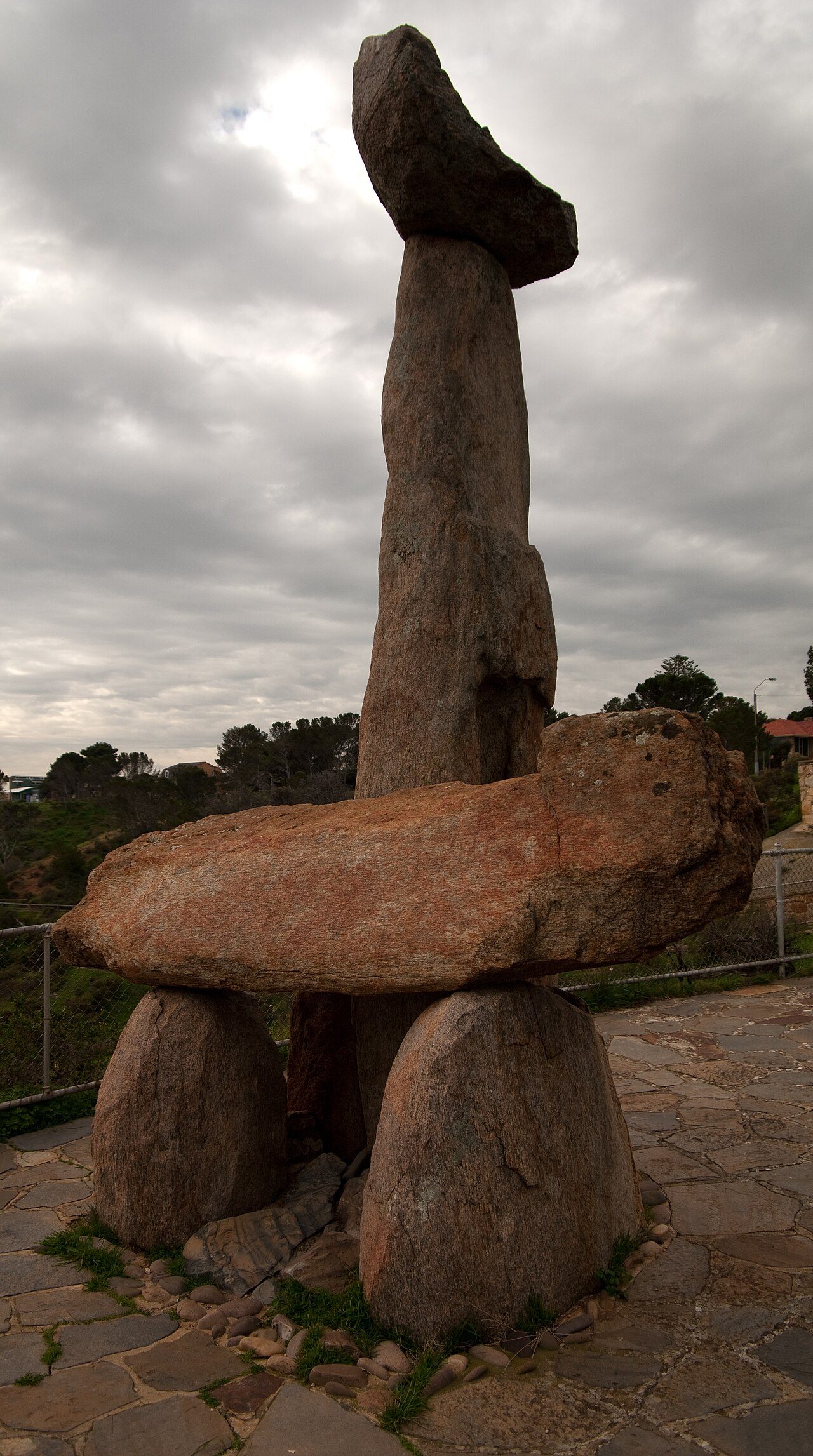
The Tjilbruke Monuments Committee was formed by Robert Edwards of the South Australian Museum (SAM), sculptor John Dowie and staff of the Sunday Mail in 1971. It was largely due to the efforts of Edwards and other non-Aboriginal people that drove the early promotion of Kaurna cultural tourism. A public appeal helped to fund the marking of the trail by plaques and sculptures, to pay homage to the Kaurna culture and to attract and educate tourists. In 1972 John Dowie created the sculpture known as the Tjilbruke Monument at Kingston Park, within the City of Holdfast Bay. Cairns were created at significant points along the Tjilbruke Trail articles and booklets were published in the 1980s, and the trail was included in Aboriginal Studies curricula. However, there was little input from Kaurna people at this stage. In 1981, Georgina Williams (SAM) began to research the trail. It was important to her "because Tjilbruke was to me an example of the law of my people and of the law related to the land and the places along the coast". A number of the sites have special spiritual significance, and in the 1980s, work by the successor to the Tjilbruke Monuments Committee, the Tjilbruke Track Committee, on the track became a central focus of Kaurna identity. The committee was later renamed the Kaurna Heritage Committee and then grew into the Kaurna Aboriginal Community and Heritage Association (KACHA) in the 1990s, which became recognised as the representative body for all Kaurna people on cultural heritage and other matters. The Tjilbruke Dreaming Track, or Tjilbruke Dreaming Trail, marked by commemorative plaques at ten locations, was created during the 150th anniversary of British colonisation of South Australia (1986), along the coast in close proximity to the sea shore. 1
The Tjilbruki Gateway (1997)
The Tjilbruki Gateway is a modern art installation installed by the City of Marion at Warriparinga ("windy place by the river"), developed by Adelaide artists Margaret Worth, Sherry Rankine and Gavin Malone. A complex and highly symbolic artwork, it incorporates coloured sands from the Red Ochre Cove area, morthi (tinder) made from stringybark tree trunks, and eucalypts. After being planned since 1995, official opening in October 1997 was attended by the Governor General of Australia, William Deane, Lowitja O'Donoghue, and several Kaurna representatives, and celebrated with traditional ceremony and dance. 1
The text above is adapted from the Wikipedia article “Tjilbruke”, available under the Creative Commons Attribution-ShareAlike 4.0 licence. 1
Tjilbruke is Creation being in Kaurna (an Aboriginal Australian group) mythology, according to the structured record cited below. This entry was generated automatically from that record and has not yet been reviewed by a person familiar with the tradition. 2
The source record links this tradition to 1 external register, which can be verified through the citation. 2