The tradition & historical record
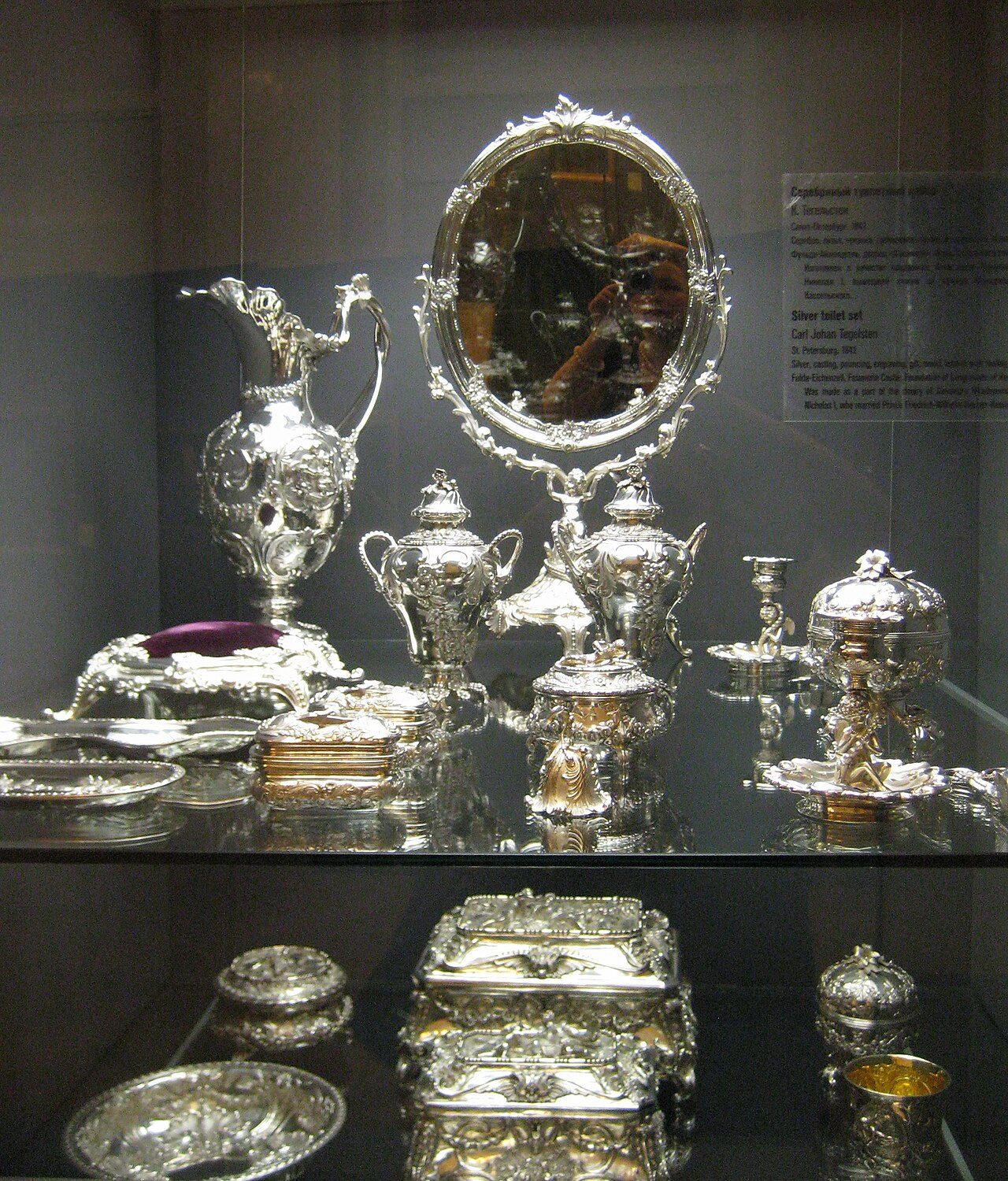
6 min read · 2 sourcesA toilet service is a set of objects for use at the dressing table. The term is usually reserved for large luxury sets from the 17th to 19th centuries, with toilet set or vanity set used for later or simpler sets. Historically, services were made in metal, ceramics, and other materials, for both men and women, though male versions were generally much smaller. The rich had services in gold, silver, or silver-gilt. The contents vary, but typically include a mirror, one or more small ewers and basins, two candlesticks, and an assortment of bowls, boxes, caskets, and other containers. One or more brushes and a pin-cushion, often as a top to a box, are often included. The sets usually came with a custom-made travelling case, and some services were especially designed for travelling. The toilet service was the most important item of "dressing plate", as opposed to table plate, and was often a gift upon marriage; sometimes augmented on the birth of children. It was normally the personal property of the wife. The morning levée was sometimes a semi-public occasion for great persons in the early modern period, and the toilet service might be seen by many people. The U.S. market for vanity sets had almost entirely disappeared by 1937 due to changes in women's lifestyles and associated simplified hairdos. 1
Terminology
The word toilet comes from the French toile meaning 'cloth', and toilette ('little cloth') first came to mean the morning routine of washing, tidying hair, and shaving and making up as appropriate, from the cloth often spread on the dressing-table where this was done. This meaning entered the English language as toilet in the 17th century; only later did toilet start to compete with lavatory as a euphemism for the plumbing fixture. The Oxford English Dictionary records toilet in English from 1540, first as a term for a cloth used to wrap clothes, then from 1662 (by John Evelyn) for a gold toilet service, and by 1700 for a range of related meanings (a towel, the cloth on a dressing-table, the act of using a dressing-table, and so on), but not for a lavatory, which did not come into use until the 19th century. 1
Contents
The contents of a service were variable but the classical grouping had as its largest piece the mirror, usually decorated at the top with some form of crest. In the 17th century these were rectangular, usually oblongs in "portrait" format, though the Louvre mirror and the Lennoxlove service use a "landscape" format. The frame normally had a wooden framework holding the glass, over which the metal was fitted. In the 18th century oval mirrors began to be used, and later the introduction of dressing tables with built-in mirrors was part of the decline from fashion of the toilet service. Depictions in art, such as the Zoffany of Queen Charlotte, usually show that the elaborate crest at the top of the mirror has disappeared beneath the lace covers spreading to the sides, which are probably tied round it. These were used to pull over the service on its table when it was not in use, or when husbands or other inconvenient visitors appeared in the dressing room. The service usually contained two fairly small candlesticks, allowing the face to be lit from below. There may also be "hand-candles", "chamber candles" or "chamber sticks", short, with a wide saucer-like base and a loop or handle. These were the last lights to be put out at night, and were carried in the hand. Candlestick makers (who always used casting) were treated as a speciality within silversmithing, and the candlesticks may be made by different workshops from the other pieces, as may any snuffers, also regarded as a speciality. 1
The service often contains one or a pair of ewer and basin sets for washing. There is normally a number of other vessels of various sizes and shapes, some covered and others not, which go by a great variety of names, and whose purpose was perhaps always rather undefined. 1
History and style
Earlier examples of the component pieces existed, as is clear from documentary records and stray surviving pieces, but the toilet service as a large matching set of pieces seems to become common among the rich in the 17th century, and especially the France of Louis XIV. Sets of ewers and basins such as the Lomellini Ewer and Basin were a staple of display plate well before this, but the many paintings of the Toilet of Venus, for example by Rubens, show that until about 1650 even goddesses used mirrors with wooden frames. Although many were made, very few Louis XIV toilet services survive, and these are all ones that left France quickly, and escaped the very effective drives at the end of Louis's reign to get the nobility to donate their plate to help pay for the ruinous Nine Years' War and War of the Spanish Succession. Exiled Huguenot silversmiths helped to spread French styles in England and elsewhere. Once established, the characteristic types of pieces changed little, but their style followed general fashions in the decorative arts. Heraldic decoration with the coat of arms of the owner was very common. This could be engraved, or on small cast pieces attached to the main vessel by bolts. This method made it easier to change the heraldry if a service changed hands to a different family, and is used on the Lennoxlove and other services. It is clear that many services were mainly made up from standard designs, perhaps often available from a silversmith's stock, and often built up taking some individual pieces from other silversmiths working with the same designs. Moulds were also lent between workshops. 1
Porcelain
Porcelain services were produced from the 18th century onwards. Initially the grandest examples were hardly less expensive than silver. What was probably Madame de Pompadour's Sèvres porcelain service of 1763 is in the Wallace Collection in London. She died the following year and the service was probably incomplete and never delivered. Lacking a mirror, it has three pairs of containers and two brushes. When Maria Feodorovna, wife of the future Tsar Paul I of Russia visited Paris in 1782 under a thin incognito as the "Comtesse du Nord", Queen Marie Antoinette gave her a Sèvres toilet service that cost 75,000 livres, though this included decoration in a complicated technique using gold foil, enamel and jewels. Another large service in Meissen porcelain with gold mounts was given to Maria Amalia of Saxony, Queen of Naples and later of Spain, by her mother Maria Josepha of Austria in 1747, to celebrate the birth of her son. A service in Vincennes porcelain with Parisian gold mounts was apparently intended as a diplomatic gift to Constantinople in the mid-1750s, but was never completed, perhaps because Franco-Turkish relations deteriorated. 1
Travelling services
Most services originally had custom travelling cases, as most owners had more than one residence. 1
The text above is adapted from the Wikipedia article “Toilet service”, available under the Creative Commons Attribution-ShareAlike 4.0 licence. 1
Toilet service is objects used at a dressing table, according to the structured record cited below. This entry was generated automatically from that record and has not yet been reviewed by a person familiar with the tradition. 2
The source record links this tradition to 1 external register, which can be verified through the citation. 2