The tradition & historical record
5 min read · 2 sourcesA tortilla ( tor-TEE-ə, Spanish: [toɾˈtiʝa]) is a thin, circular unleavened flatbread, originally made from corn (maize) but now also made of wheat flour. The corn tortilla is a staple food in most of Mexico and Central America, while the flour tortilla is typical of Northern Mexican and Mexican-American cuisine. The tortilla has become popular across the world. Corn tortillas are made by treating corn with limewater, a process known as nixtamalization, forming a dough known as masa, which is baked on a griddle. Flour tortillas are made of refined wheat flour, water, and shortening, and are generally larger than corn tortillas. Both types are commonly industrially produced, with corn tortillas usually using a dehydrated form of masa called masa harina. Tortillas are soft but quickly become stale. They are high in calories but lack essential nutrients. Fresh tortillas can be used to carry various ingredients, forming dishes such as the taco, burrito, enchilada, and quesadilla. They may instead be used as a spoon to pick up accompanying food. Other uses of tortillas include dishes such as tortilla soup and fried products such as tostadas and tortilla chips. Tortillas were first made by ancient peoples of Mesoamerica, where corn was an important crop. Corn tortillas became a cornerstone of Mesoamerican cuisine as complex societies formed, including the Oaxaca Valley and the Aztec civilization. Tortillas also spread to the Maya civilization. 1
Terminology
The word tortilla is derived from the Spanish word torta, meaning roughly 'cake', plus the diminutive suffix -illa; therefore, tortilla can be translated as 'little cake'. In Mexico, a tortilla bakery is known as a tortilleria; it is distinguished from a wheat bread bakery, or panadería. In Spanish cuisine, the word tortilla instead refers to a type of omelette. In Nahuatl (spoken by the ancient Aztecs and modern Nahuas), tortillas are called tlaxcalli ([t͡ɬaʃˈkalli]). The Ancient Maya used the word cauhimich. The contemporary Maya languages use the word wah, originally a broader term for various corn products. 1
Varieties
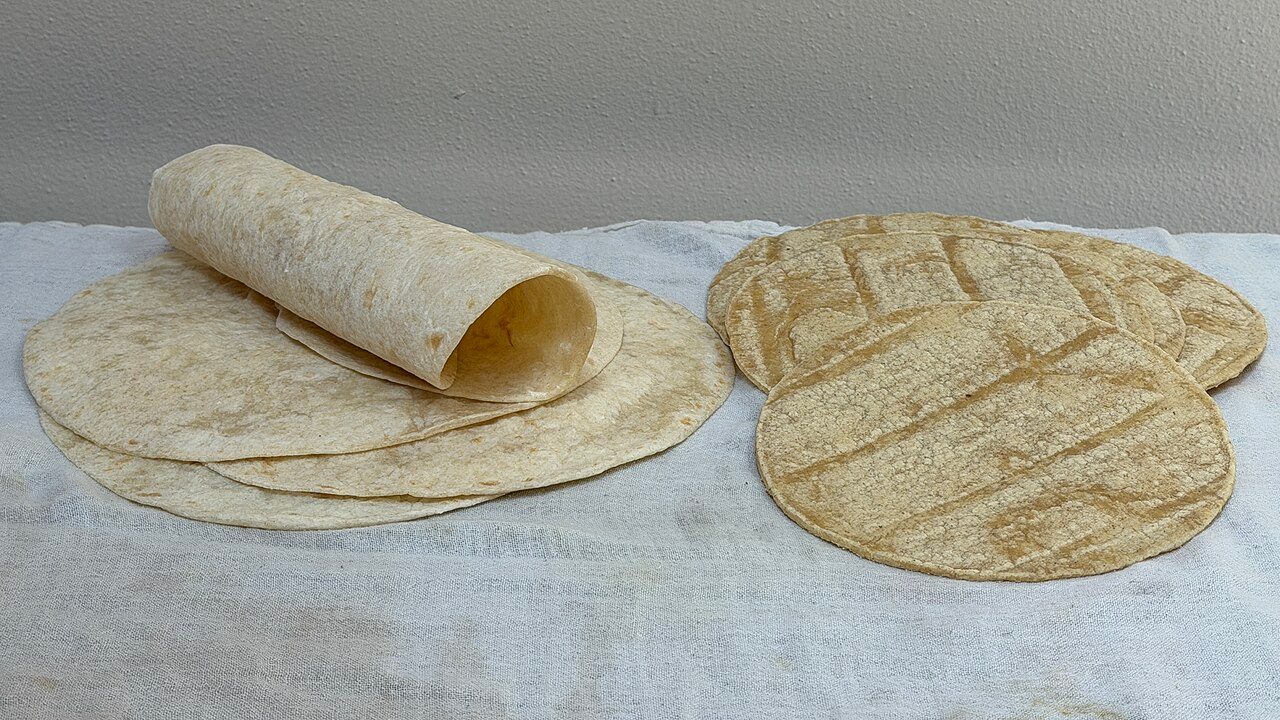
Tortillas are round unleavened flatbreads. They are very thin, consisting almost entirely of crust. There are two main types, corn tortillas and flour tortillas, which undergo vastly different processing. Industrially produced versions of both types are common, which have standardized recipes and mild flavor. Tortilla machines continuously produce them using dough sheeters and extruders; some can produce 30,000 per hour. 1
Corn
The ingredients of corn tortillas are corn (maize) and limewater (an alkaline solution of calcium hydroxide). They typically use white or yellow corn, though other varieties such as blue corn are occasionally used. The corn is soaked in limewater, a step known as nixtamalization. This step has the largest impact on the final product, increasing its flexibility and nutritional value. The nixtamalized corn, known as nixtamal, is stone-ground into a dough known as masa. The masa is flattened between the hands, against a flat surface, or using tortilla press. It is then baked on a griddle—or, in industrial settings, in an oven that performs continuous sheeting and baking. While baking, it undergoes reactions including browning and starch gelatinization, and it slightly puffs up. Corn tortillas are about 15 cm in diameter, while the thickness varies. There are three methods of producing masa for tortillas. The traditional method involves cooking corn in a pot of limewater, then steeping it overnight and discarding the liquid; the resulting nixtamal is ground with a stone known as a metate to produce masa, which is hand-shaped and baked on both sides on a clay griddle known as a comal. Tortillas using this method are thicker than others. Fresh masa is industrially produced with a similar process using a rotating grinder. This is extruded and baked in an oven to produce tortillas. Dry masa, also known as masa harina, is produced by grinding nixtamal into pieces that are dried to form a flour. Masa harina is rehydrated to be baked into tortillas; this method is much easier, faster, and labor-saving than making fresh masa, and allows the production of masa to be separated from the production of tortillas both in time and place. 1
Wheat
Flour tortillas are made of wheat flour—usually white flour—which is mixed with water, fat, and salt. Fat is used as shortening, which changes the flavor and texture, while water contributes to the development of gluten contained in the flour. Additionally, baking powder and other ingredients are typically used outside of Mexico and Central America. The ingredients are mixed into dough, then rested and shaped. They may puff up while baking due to steam leavening. Flour tortillas have a thickness of about 1–2 mm and a diameter of 15–60 cm, larger than corn tortillas. They have some dark spots, while the color of other spots is translucent. In industrial production, most flour tortillas are hot pressed, while others are oven-baked after being die-cut or, less commonly, shaped by hand. Hot pressing results in an irregularly shaped, smooth, strong product (for dishes such as tacos). Die cutting, a cheaper method, results in a perfectly round, less moist product (for dishes such as burritos). Internationally, many types of tortillas are sold. Some have dietary adaptations such as being low-fat or gluten-free, while others have flavors such as spinach or garlic. The wrap, a product sold in the United States, is a whole-wheat tortilla, often with flavorings. The term wrap is used rather than tortilla to lessen the perceived connection with Mexican cuisine. 1
Other varieties
Nixtamalized sorghum is sometimes mixed with corn for tortillas in Guatemala, Honduras, Nicaragua, and El Salvador. Tortillas may be made with only sorghum or with a mix of sorghum, corn and cassava. Quinoa is also used for tortillas. 1
The text above is adapted from the Wikipedia article “Tortilla”, available under the Creative Commons Attribution-ShareAlike 4.0 licence. 1
tortilla is type of flat bread, according to the structured record cited below. This entry was generated automatically from that record and has not yet been reviewed by a person familiar with the tradition. 2
The source record links this tradition to 16 external registers, which can be verified through the citation. 2