The tradition & historical record
7 min read · 2 sourcesTraditional clothing (folk costume) is one of the factors that has differentiated Kosovo from neighboring countries, dating back as far as the Illyrian era. Kosovar clothing has evolved in service of modernization and contemporary style, however the fundamental symbols and motifs of the garments designs still tend to resemble the Illyrian clothing of antiquity, with the materials and fabrication methods not having changed much. These characteristic Kosovar clothes, are made with a type of loom called a vegjë or vek, which resembles the English spinning jenny and flying shuttle. The motifs and patterns on these garments can be interpreted through prehistoric religion. Triangles, rhombuses, circles, and crosses appear often and symbolize health and fertility. Chromatically, there are three main colors in these clothes, the most symbolic of which is red. Additionally, women would wear gold around their necks and bodies, intending to look elegant and modest. 1
Historical origin
Among 140 types of traditional Albanian costumes, the Podgur's attire Veshja e Podgurit is Kosovar, differentiated by its variety and is an influence in all other regions. This costume belonged to the majority of the Illyrian and Albanian regions included in the international framework. The clothing items consist of the shirts of men and women, which are wide sleeved with a narrow collar which was buttoned up and a white traditional hat worn by men called plis, leather moccasins or opinga. According to archaeologists of the Museum of Pristina, Podgur's clothing dates back to the 5th and 4th century BC. However, transformations of this costume happened due to different social and cultural situations, technical inventions and also element exchange between the ethnic groups. From field investigation, it has been reported that in the 19th century and the first two decades of the 20th century, women's clothing went through morphological changes. The 19th-century look consisted of the combing of their hair and braiding them. They also wore red semi-spherical shaped hats which were embellished with tiny gold coins. Around the crown of the hat they wore a tight lace, lidhëse, which was 60 cm long. It was tied so that their hair remained hidden. Marhama is a type of material which was worn along their neck and chin, but the embroidered tail of marhama was laid down along the right shoulder, and it was called masdorja. The shirt was of foot-length and the sleeves were long and wide, approximately 35 cm and also embroidered. Shtjellakët (pështjellakët, mbështjellakët) which were pieces of material that resemble an apron, were big in size and tight in width, and it had geometrical motives, such as an axe or a circle. 1
Men's clothing
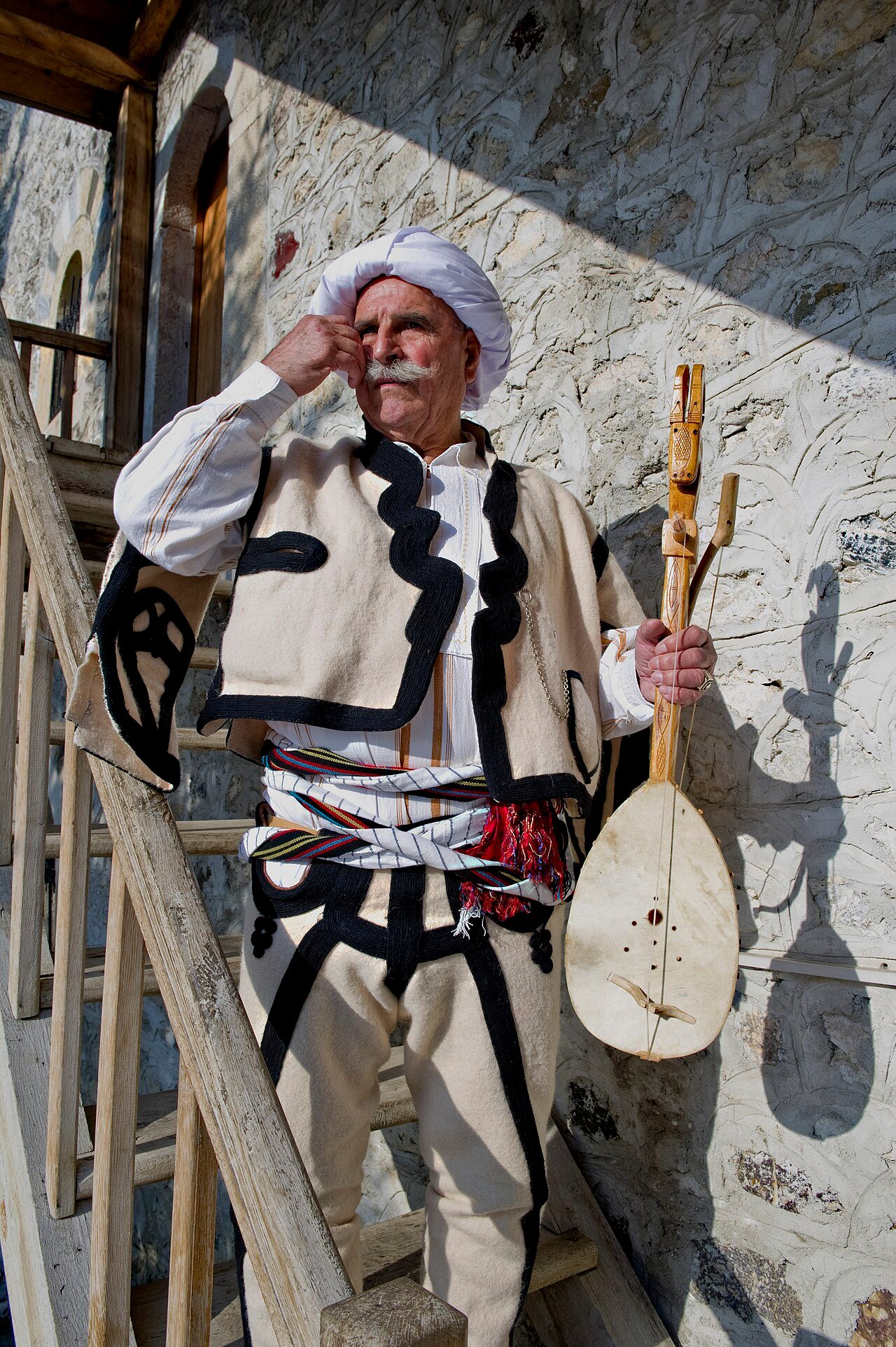
Men's clothing was the symbol of beauty at the time. This attire includes a shirt, tëlinat which were long underpants, a scarf and tirqe. There were differences among the clothing of adults, based on their economical standing. In the men clothing framework, the groom's attire was the most symbolic one. The costume is built upon the symbolic meaning of starting a new phase of life. Men of Podgur used to wear white semi-spherical plis. Along with it there was also a scarf made of white fabric which consisted of a few horizontal shokë of different colors. This scarf was circled around plis and covered a part of their head and ears. Scarfs were worn by men of older age, around their forties. Men's shirts were called "chestnut shirts" because they were made of horizontal shokë of chestnut color. "Chestnut shirts" are rarely seen today, except in mountain regions. Blazers were the items worn over shirts. The part among the sleeves, the collar and arms contained a black stripe. The vest or xhamadani made of soutane was wide sleeved and reached the waist in length and had no collar. It was buttoned up with a clasp. The vest was double-breasted, and it was of black color. In cold weather, they used to wear a type of blazer called mitani and was made of soutane material. It was randomly worn over the vest or xhamadani. It had long sleeves, but no collar. The black strap covered the parts along the sleeves, around the neck and along the elbows. Mitani had an opening from the armpits to the elbows, and these openings were used to hold mitani freely. On the left part, a small pocket was sewn where men used to keep their cigars. Mitani was also worn by youngsters, but it was simpler than the mitani of men. 1
Women's clothing
Girls' clothing 1
Even though young girls' costumes are not considered to be very specific or unique, in contrast to the women's attire, these costumes have gone through many transformations during their time being. A part of girls' look was their hairstyle which resembled that of boys. The shirts they wore were the same as those of women, although they were quite more simple. They also used to wear a type of tight skirt called pështjellci which was knee-length and made of woolen threads using a loom. During the last few years, these skirts were also made of linen threads. At the edge of the skirt, different floral designs are embroidered, symbolizing youth and vitality. Their moccasins were identical to those of women. Traditional clothing of young girls has not been completely preserved because of its transition to modernism. Women's clothing The transformation of women's attire mainly happened between the years of World War I and World War II. The semi-spherical shaped hats with gold coin embroidery were replaced with laces, called lidhsa. In the region of Istok, these laces were called hotoz. The fabric shirt was also to change its structure during this period of time. Instead of the fabric shirts, këmisha e arrës which is also a part of men's clothing was being used more often. The sleeves were shortened to the elbows and they were also tightened. When the sleeves were shortened, a different type of material was used to cover the part of the palm and up to the elbow. These were made of woolen thread and were known as mëngët or sleeves. Often, they were knitted using different colors. Mitani also went through changes; it had long sleeves and a tight collar. It was waist-length and it was deep purple. It was usually sold by tailors. 1
Women's clothing
Women's clothing is better preserved than the men's in the regions of Kosovo. There are regional variations of the women's apparel. 1
Pështjellak clothing
The most famous apparel was called ‘'pështjellak'’ which consistent of a long white shirt, and two ‘'pështjellak'’ (a white apron), the front and the back one. ‘'pështjellaku i parmë'’, or the front apron is as long as the shirt, and it was tailored to fit the woman's hip. ‘'pështjellaku i pasëm'’, the back apron was shorter than the front one. Other components of this clothing were : ‘'tëlina't’ (traditional underwear), ‘'jeleku'’ –resembles a short vest which was embroidered, ‘'shokë’' a large woolen material circling the waist, traditional black socks, and different color head scarves. 1
The text above is adapted from the Wikipedia article “Traditional clothing of Kosovo”, available under the Creative Commons Attribution-ShareAlike 4.0 licence. 1
Traditional clothing of Kosovo is recorded in open cultural data. The structured record cited below does not describe the practice, and this entry has not yet been reviewed by a person familiar with the tradition. 2
The source record links this tradition to 1 external register, which can be verified through the citation. 2