The tradition & historical record
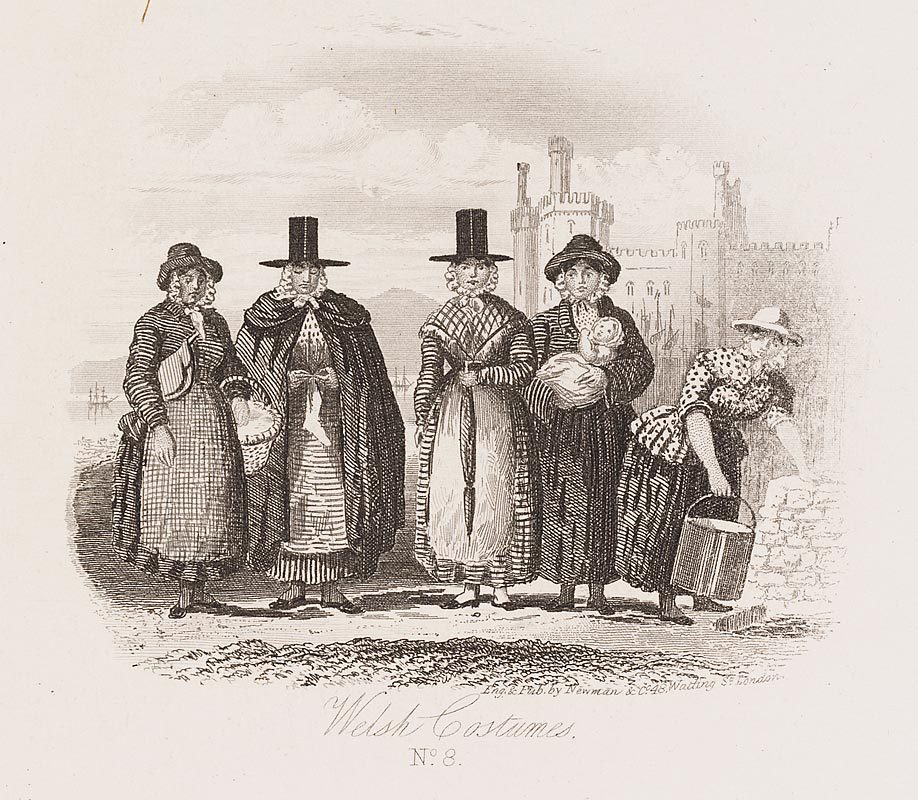
6 min read · 2 sourcesThe traditional Welsh costume (Welsh: Gwisg Gymreig draddodiadol) was worn by rural women in Wales. It was identified as being different from that worn by the rural women of England by many of the English visitors who toured Wales during the late 18th and early 19th centuries. It is very likely that what they wore was a survival of a pan-European costume worn by working rural women. This included a version of the gown, originally worn by the gentry in the 17th and 18th centuries, an item of clothing that survived in Wales for longer than elsewhere in Britain. The unique Welsh hat, which first made its appearance in the 1830s, was used as an icon of Wales from the 1840s. It is likely that the Welsh costume began as a rural costume (with regional variations within Wales) and became recognized as a traditional costume by the wives and daughters of the better-off farmers, who wore it for special occasions and when going to market to sell their produce. From the 1880s, when the traditional costume had gone out of general use, selected elements of it became adopted as a National Costume. From then on it was worn by women at events such as royal visits, by choirs, at church and chapel, for photographs and occasionally at eisteddfodau. It was first worn by girls as a celebration on Saint David's Day just before the First World War. The costume is now recognised as the national dress of Wales. 1
History
Very little evidence for traditional Welsh costume survives before about 1770 when the first tourists came to Wales and recorded in words and pictures the costumes worn by women in Wales. They noted that the women in rural parts of Wales wore a distinctive costume which varied from place to place. Women in towns and those who lived near the Welsh-English border or near busy ports were already wearing English fashions, often made of cotton. During the 1830s, certain members of the gentry, especially Augusta Hall (later Lady Llanover) of Llanover near Abergavenny, recorded and tried to preserve some Welsh traditions, including costume. The prints of costumes of parts of Wales which she may have commissioned did not have a wide distribution. Some of them were published in an article in 1951. This was the first time that they had been published since the 1830s. Her apparent influence on Welsh costume was greatly exaggerated following the publication in 1963 of an article on Welsh Peasant costume and this caused the general misapprehension that she was responsible for either inventing or preserving traditional Welsh costume. From then on, many writers assumed that she had a great influence on the wearing of Welsh costume by rural women throughout Wales during the 19th century, which, it was supposed, led to the creation of a National Costume but there is very little evidence for this. 1
The origins of the national costume
Although the traditional costume went out of common use by the middle of the 19th century it was still worn by some women at market and for special events. There were calls for Welsh costume to be revived and used at major national events, especially royal visits. In 1834, Augusta Hall wrote a prize-winning essay for the Monmouthshire and Glamorganshire eisteddfod held in Cardiff but this contains very little about costume, and nothing about National costumes. In the 1840s Hall organised balls at which her friends wore costumes based on the set of fashion plates which she may have commissioned, but they were made of satins, not wool. The adoption of the costume coincided with the growth of Welsh Nationalism, where the industrialisation of much of south Glamorgan was seen as a threat to a traditional agricultural way of life. The national costume made from Welsh wool was therefore seen as a visual declaration of a Welsh identity. During an 1881 visit by the Prince of Wales to Swansea, the Welsh costume was worn by a number of young women including members of a choir. From the 1880s both old and modern versions of the costume were worn by performers at concerts and eisteddfodau, by stall holders at fund raising events and for royal visits. The numbers of women who wore Welsh costume in this way was always small but its use was remarkable enough to mention in reports of such events. Some of those who wore it may have been the younger members of the new middle-class families who could afford the money to buy the costumes and the time to attend such events. 1
Modern usage
The modern costume worn by girls on St David's Day, which used to be made by mothers from old costumes, is now commercially available. The design, colours and use of lace (which was very rarely associated with Welsh costume during the 19th century), may well be derived from costumes made especially for those competing at the International Eisteddfodau at Llangollen (established in 1947) and other events where dancers required a comfortable and practical costume which was distinct from those worn by representatives from other nations. The costume now generally worn by dance teams is based on the tailored gowns originally found in south west Wales. The modern costumes worn by girls are normally red with white lace detailing, accompanied by a black and white chequered apron. A white shawl and a black hat are also worn, with many wearing the costume on St David's Day (Diwrnod Dewi Sant) accompanying the outfit with a yellow daffodil pinned onto it; the flower most associated with Wales. 1
The gown or bedgown
The most distinctive feature of the Welsh costume, other than the hat, is the gown and bedgown. Although both have often been referred to as bedgowns (spelt in various ways in Welsh, most commonly now as betgwn) the term gown is now used for the long-tailed, tailored garment. (1) a tailored form with a tightly fitted low-cut top and long wide tail These were common in Ceredigion and Carmarthenshire and possibly in parts of mid-Wales and were often made of red and very dark blue or black striped flannel which was sourced locally. See example on the left in the illustration above 'Welsh Fashions Taken on a Market Day in Wales'. (2) a loose T-shaped bedgown. The T-shaped form was found in north-west and south-east Wales; these were often of printed cotton. (3) a shorter tailed, jacket, in plain fabric, worn in Pembrokeshire. 1
The skirt and underskirt (pais)
These were normally of heavy flannel with vertical or occasionally horizontal stripes in bold colours, often reds and dark blue or black and white. 1
The text above is adapted from the Wikipedia article “Traditional Welsh costume”, available under the Creative Commons Attribution-ShareAlike 4.0 licence. 1
traditional clothing of Wales is rural clothing of Welsh women in the 19th century, later adopted as national dress, according to the structured record cited below. This entry was generated automatically from that record and has not yet been reviewed by a person familiar with the tradition. 2
The source record links this tradition to 1 external register, which can be verified through the citation. 2