The tradition & historical record
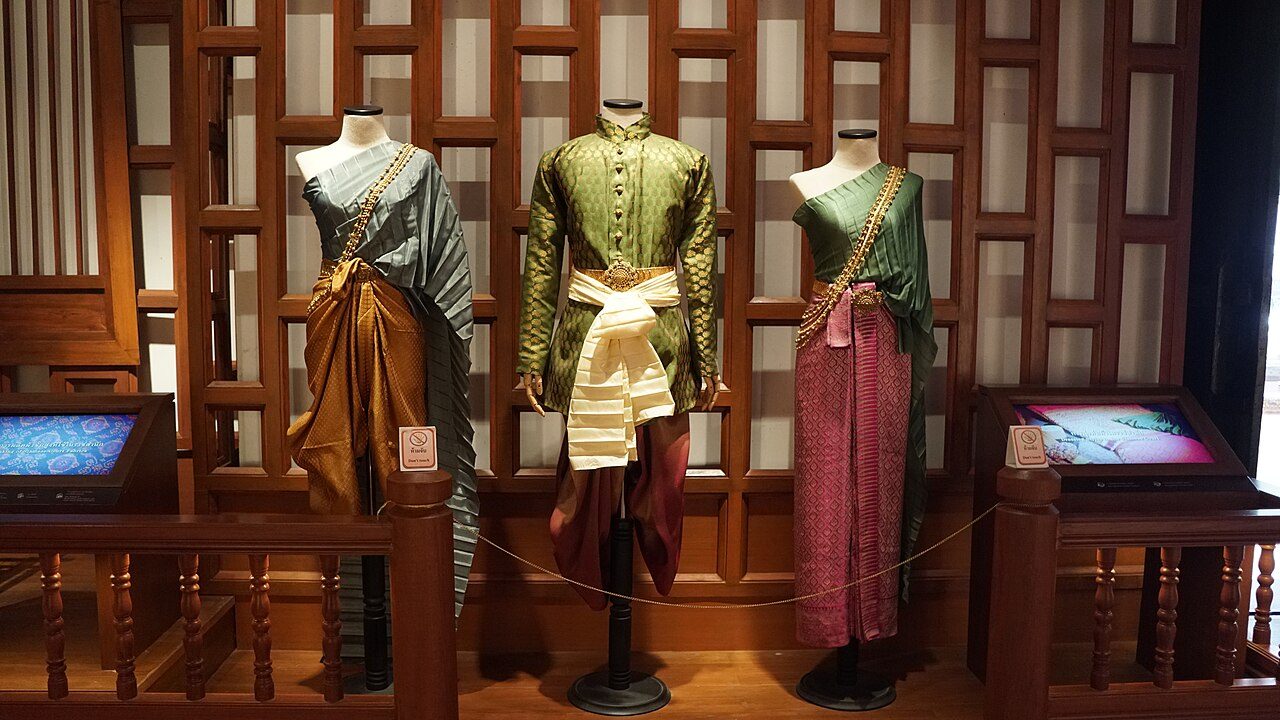
6 min read · 2 sourcesTraditional Thai clothing (Thai: ชุดไทย, RTGS: Chut Thai, Thai English: Chud Thai lit. 'Thai outfit') refers to the traditional styles of dress worn by the Thai people. It can be worn by men, women, and children. Traditional clothing for Thai women usually consists of a panung (or chong kraben), and a sabai. The Northern and the Northeastern women may wear a sin instead of a panung and a chong kraben with either a blouse or a suea pat. Traditional clothing for men includes a chong kraben, pants, or a raj pattern shirt, with optional knee-length white socks and a sabai. Traditional clothing for The Northern Thai men is composed of a sado, a white Manchu-styled jacket, and sometimes a khian hua. In formal occasions, people may choose to wear a so-called formal Thai national costume. 1
History
Historically, both Thai males and females dressed themselves with a loincloth wrap called chong kraben. Men wore their chong kraben to cover the waist to halfway down the thigh, whilst women wore their chong kraben down the waist to well below the knee. Members of the nobility wore silk robes called khrui and a tall, pointed hat called lomphok in attendance of royal affairs. Bare chests and bare feet were accepted as part of the Thai formal dress code, and are observed in murals, illustrated manuscripts, and early photographs up to the middle–1800s. Prior to the 20th century, the primary markers that distinguished class in Thai clothing were the use of cotton and silk cloths with printed or woven motifs, but both commoners and royals alike wore wrapped, not stitched clothing. Prior to the 1700s, Thai men and women both kept their hair long. However, following the Burmese–Siamese wars between 1759–1760, 1765–1767 and repeated Burmese invasions into Ayutthaya Kingdom, Central Thai women began cutting their hair in a crew cut short style, which remained the national hairstyle until the 1900s. From the 1860s onward, Thai royals "selectively adopted Victorian corporeal and sartorial etiquette to fashion modern personas that were publicized domestically and internationally by means of mechanically reproduced images". Stitched clothing, including court attire and ceremonial uniforms, were invented during the reign of King Chulalongkorn. 1
Chong kraben
Chong kraben (Thai: โจงกระเบน, Thai pronunciation: [tɕoːŋ.kra.beːn]) is a traditional lower-body garment that originated in Cambodia and was later adopted in Thailand where it is commonly worn. In Khmer, "chong" means the area of cloth that't twisted into a bunch, and "kben" is the bunch's role in concealing "private parts". In Thailand, the chong kraben became prominent during the Ayutthaya period (14th–18th centuries), where it was worn across different social classes, from commoners to the royal court, with variations in fabric and decoration reflecting status. It remained a standard form of attire into the early Rattanakosin period, particularly in formal and courtly contexts. However, during the reign of King Chulalongkorn in the late 19th and early 20th centuries, dress reforms influenced by Western styles led to the gradual decline of the chong kraben in everyday use. Today, it is preserved as an important element of Thai cultural identity and is commonly worn in traditional ceremonies, classical dance, and formal occasions. 1
Pha nung and Pha sin
Panung or Pha nung (Thai: ผ้านุ่ง, Thai pronunciation: [pʰâː nûŋ]) is a traditional Thai lower-body garment made from a long rectangular piece of cloth wrapped around the waist and legs, resembling a skirt. It is traditionally worn by both men and women across Thailand. The term pha nung can be used broadly to describe various types of lower garments in Thai culture, including region-specific styles. One notable variant is Pha sin (Thai: ผ้าซิ่น, Thai pronunciation: [pʰâː sîn]), a tubular skirt traditionally worn by women, especially in the Northern, Northeastern Thailand and Laos. The pha sin is typically handwoven and decorated with intricate regional patterns. It is commonly divided into three sections: the hua sin (waistband), tua sin (main body), and tin sin (hem), each reflecting local artistry and identity. Another widely used version is Pha thung (Thai: ผ้าถุง, Thai pronunciation: [pʰâː tʰūŋ]), a cylindrical skirt sewn at the ends for convenience. The pha thung is popular in daily life throughout Thailand due to its comfort, ease of wear, and versatility, often used at home, in markets, and even for bathing. These garments reflect Thailand's rich textile heritage, with variations in style, fabric, and pattern often indicating the wearer's region, social status, or occasion. 1
Sabai or Pha biang
Sabai (Thai: สไบ; Thai pronunciation: [sa.baj]), also known as Pha biang (Thai: ผ้าเบี่ยง, Thai pronunciation: [pʰâː.bìaŋ]), is a traditional Thai shawl-like garment worn by both women and, occasionally, men. It is typically made of silk and consists of a long rectangular piece of fabric, approximately one foot wide, draped diagonally across the chest, covering one shoulder, with the end hanging down the back. The sabai could be worn over a bare upper body or layered atop another piece of clothing. During the reign of King Chulalongkorn (Rama V, r. 1868–1910), the sabai or pha biang was often paired with Victorian-style garments before Western clothing began to dominate. However, its everyday use later declined under Field Marshal Plaek Phibunsongkhram's 1930s and 1940s cultural mandates promoting Western-style dress. Despite its decline in daily use, the sabai remains a symbol of Thai cultural heritage and is still worn today in traditional ceremonies, classical dance performances, and historical reenactments. 1
Raj pattern
Raj pattern (Thai: ชุดราชปะแตน, Thai pronunciation: [t͡ɕʰút râːt.pà.tɛːn]) refers to a traditional Thai men's outfit, or more specifically, to its signature jacket. It has similarities with the Nehru jacket, but specific characteristics like a five-button front. This formal attire, introduced during the reign of King Chulalongkorn in the late 18th century, typically includes a high-collared white jacket with five buttons, worn with a chong kraben, knee-length socks, and black leather shoes. Originally worn by government officials and the upper class in Siam, it became popular among Bangkok's elite and remains a symbol of national pride today. In modern times, the Raj pattern is worn in a variety of ceremonial and formal settings, such as royal functions, weddings, ordinations, and even cultural festivals like Loy Krathong. Style adaptations now include the use of premium fabrics like silk or fine cotton, and color variations such as cream, ivory, or even light pastels to suit different themes or skin tones. Some choose to pair the jacket with slacks for a more contemporary look, or coordinate accessories like metallic belts, cufflinks, or minimal jewelry to enhance elegance. Despite its historical roots, the Raj pattern continues to evolve, blending tradition with modern style for a timeless, dignified appearance. 1
The text above is adapted from the Wikipedia article “Traditional Thai clothing”, available under the Creative Commons Attribution-ShareAlike 4.0 licence. 1
traditional Thai clothing is national clothing of Thailand, according to the structured record cited below. This entry was generated automatically from that record and has not yet been reviewed by a person familiar with the tradition. 2
The source record links this tradition to 3 external registers, which can be verified through the citation. 2