The tradition & historical record
6 min read · 2 sourcesTristan and Iseult, also known as Tristan and Isolde and other names, is a medieval legend told in numerous variations since the 12th century. Of disputed source, usually assumed to be primarily Celtic, the tale is a tragedy about the illicit love between the Cornish knight Tristan and the Irish princess Iseult in the days of King Arthur. During Tristan's mission to escort Iseult from Ireland to marry his uncle, King Mark of Cornwall, Tristan and Iseult ingest a love potion, instigating a forbidden love affair between them. Depending on the version, Tristan may marry another woman, Iseult of the White Hands, but never stops loving the Irish princess. The tale typically ends in their deaths from love and sorrow. The legend has had a strong and lasting impact on Western culture. Its different versions exist in many European texts in various languages from the Middle Ages. The earliest instances take two primary forms: the so-called courtly and common branches, respectively associated with the 12th-century poems of Thomas of Britain and Béroul, the latter believed to reflect a now-lost original tale. A subsequent version emerged in the 13th century in the wake of the greatly expanded Prose Tristan, merging Tristan's romance more thoroughly with the Arthurian legend. 1
Narratives
The story and character of Tristan varies considerably between different tellings. His name also varies, as does that of Iseult, although Tristan is the most common modern spelling. The two earliest known, and highly distinct from one another, traditions of the romance of Tristan and Iseult come from the French verse romances written by Béroul and Thomas of Britain (considered origins of the so-called "common branch" and the "courtly branch", respectively), two 12th-century poets who each wrote c. 1170, based on uncertain origins. A later major tradition is that of cyclical prose works beginning c. 1240, markedly different from those by both Thomas and Béroul. 1
Early poetry
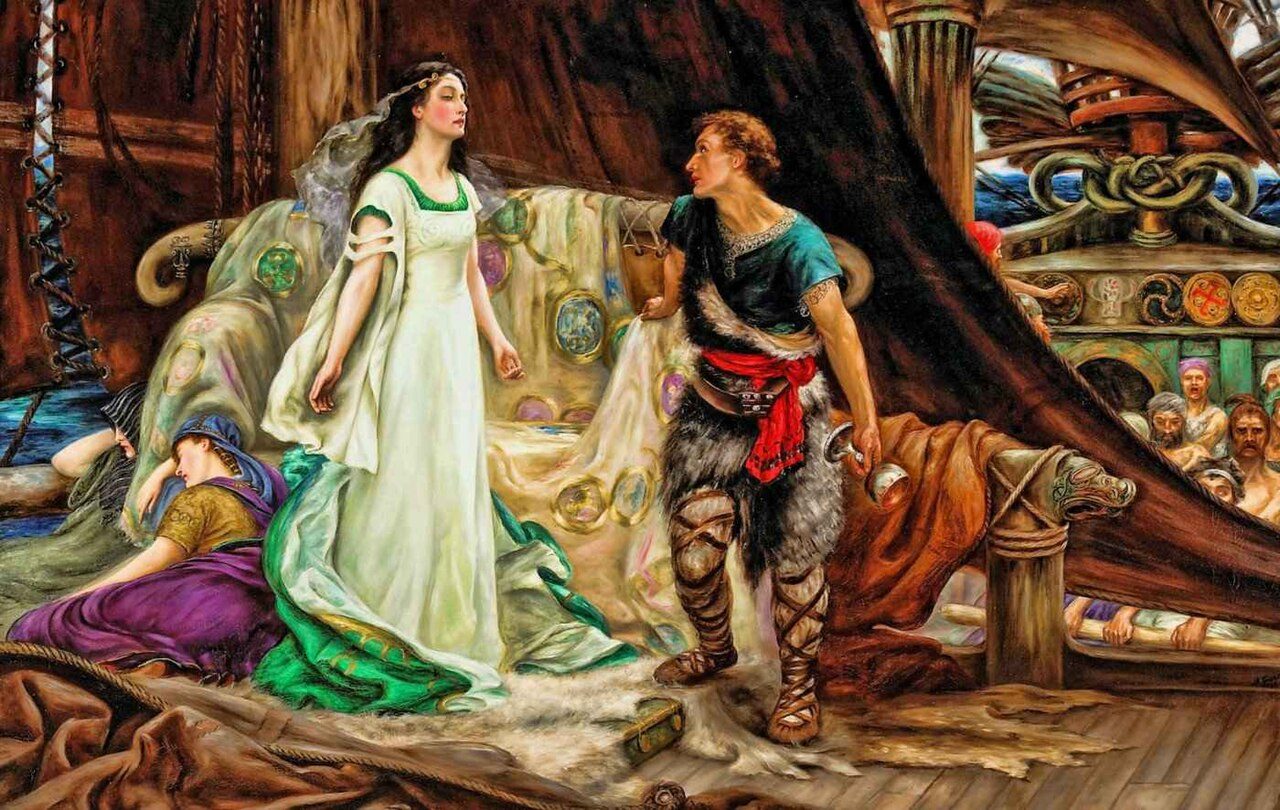
After defeating the Irish knight Morholt in a duel, the young prince Tristan travels to Ireland to bring back the fair Iseult (often known as Isolde, Isolt, or Yseult) to marry his uncle King Mark of Cornwall (originally written as Marc or Marc'h). Along the way, Tristan and Iseult ingest a love potion, which causes them to fall madly in love. The potion's effects last a lifetime in the legend's so-called courtly branch. However, in the common branch version (Béroul's), the potion's results end after three years. In some versions, including Béroul's, Tristan and Iseult ingest the potion accidentally after it was given to her by her mother to use on her wedding night. In others, the potion's maker gives it to Iseult to share with Mark, but she gives it to Tristan instead. Although Iseult marries Mark, the spell forces her and Tristan to seek each other as lovers. The King's advisors repeatedly try to charge the pair with adultery, but the lovers use trickery to preserve their façade of innocence. 1
In Béroul's poem, the love potion eventually wears off, but the two lovers continue their adulterous relationship for some time, until returning to the kingdom of Cornwall, where King Mark is alerted to the affair by the machinations of three of his barons (one of them called Ganelon, in a possible nod to the famous traitor) and then seeks to entrap his nephew and wife. Mark acquires what seems to be proof of their guilt and resolves to punish Tristan by hanging and Iseult by burning at the stake. However, Mark changes his mind about Iseult and lodges her in a leper colony. Tristan escapes on his way to the gallows, making a miraculous leap from a chapel to rescue Iseult. 1
Association with Arthur and death
The earliest surviving Tristan poems already include references to King Arthur and his court. Mentions of Tristan and Iseult are also found in some early Arthurian texts. Writers expanded the connection between the story and the Arthurian legend over time. Shortly after the completion of the Vulgate Cycle (the Lancelot-Grail cycle) in the first half of the 13th century, two authors created the vast Prose Tristan, which establishes Tristan as one of the most outstanding Knights of the Round Table in a cycle rivalling the Vulgate, telling many of his new adventures of chivalric kind. Here, he is portrayed as a knight-errant, a former enemy turned close friend of Lancelot, and an abortive participant in the Quest for the Holy Grail. The Prose Tristan, with (eventually, in the later versions) its distinctive take on the Grail Quest, evolved into the familiar medieval tale of Tristan and Iseult that became a part of the Post-Vulgate Cycle. Two centuries later, it became the primary source for the seminal Arthurian compilation Le Morte d'Arthur. In the popular extended version of the Prose Tristan, and the works derived from it, Tristan is attacked by King Mark while he plays the harp for Iseult. Mark strikes Tristan with a poisoned or cursed lance, mortally wounding him, and the lovers die together. The poetic treatments of the Tristan legend, however, offer a very different account of the hero's death, and the short version of the Prose Tristan and some later works also use the traditional account of Tristan's death as found in the poetic versions. In Thomas' poem, Tristan is wounded by a poisoned lance while attempting to rescue a young woman from six knights. Tristan sends his friend Kahedin to find Iseult of Ireland, the only person who can heal him. 1
Post-death
Some French (such as the ones chosen in the English translation by Hilaire Belloc in 1903) and other (such as the early German Tristrant) sources state that a bramble briar grows out of Tristan's grave, growing so thickly that it forms a bower and roots itself into Iseult's grave. King Mark tries to have the branches cut three separate times, and each time the branches grow back and intertwine. Later French and German versions embellish the story with either briar or grape vine above Tristan's grave intertwining with a rose tree from Iseult's grave. In Marie de France's Chevrefoil, the intertwined hazel and honeysuckle is an "amorous metaphor" in a lay that recounts one of their clandestine meetings. Later versions state that the lovers had children, including a son and a daughter named after themselves. Their children may have adventures of their own, as in the epilogue of the Saga af Tristram ok Isodd. In the 14th-century French romance Ysaÿe le Triste (Ysaÿe the Sad), the eponymous hero is the son of Tristan and Iseult. He becomes involved with the fairy king Oberon and marries a girl named Martha, who bears him a son named Mark. The 16th-century Spanish Tristan el Joven, also known as I Due Tristani, features Tristan's son known as Tristan the Younger. 1
Origins and analogues
There are several theories about the tale's origins, although historians disagree over which is the most accurate. 1
The text above is adapted from the Wikipedia article “Tristan and Iseult”, available under the Creative Commons Attribution-ShareAlike 4.0 licence. 1
Tristan and Iseult is medieval romance told in numerous variations, according to the structured record cited below. This entry was generated automatically from that record and has not yet been reviewed by a person familiar with the tradition. 2
The source record links this tradition to 13 external registers, which can be verified through the citation. 2