The tradition & historical record
5 min read · 2 sourcesThe Tumaco-La Tolita culture or Tulato culture, also known as the Tumaco culture in Colombia or as the Tolita culture in Ecuador, was an archaeological culture that inhabited the northern coast of Ecuador and the southern coast of Colombia during the Pre-Columbian era. It takes its name from the two most representative archaeological sites of the culture, the Isla del Morro in the city of Tumaco and the Isla de la Tolita. They are known for the construction of earthen mounds known as Tolas, ceramic crafts and especially metalworking, since they handled gold with great skill and were also the first artisans in the world known to work with platinum. 1
Geography and climate
The Tumaco-La Tolita culture lived on the coasts of the present-day province of Esmeraldas in Ecuador and extended as far north as Buenaventura, in Colombia. The region has a warm climate, with temperatures of 27 or 28 °C. The landscape of the region is dominated by large and fertile plains covered by tropical rainforest, while the coastal zone is covered by mangrove forests. Riversare abundant in the area, such as the Cayapas River, the Mataje River, the Mira River, the Patía River, etc. The large number of rivers provided Tumaco-La Tolita people with excellent communication routes with the Andean highlands. 1
History
The origins of the Tumaco culture go back to the first known settlers of the region, the Chorrera culture. They arrived at the beginning of the first millennium BC, and by the year 600 BC. C. the Island of La Tolita was inhabited for the first time. With the passage of time their culture slowly transformed and became unique to the region, by 350 BC. C. their culture had already become what is known as Tumaco-La Tolita. Some researchers think that there were large migrations from Mesoamerica that influenced the Tolita culture on its origins, although this hypothesis has not been proven. The peak of the Tolita culture lasted around 700 years, after which new cultural transformations took place, these are marked by the appearance of the El Morro cultural phase in AD 350. C. in the area of Tumaco, which was characterized by a totally different ceramic style, and by the abandonment of the Island of La Tolita around 400 AD. C. A transition period occurred between 500 and 700 AD. C., it was marked by the gradual depopulation of the coastal regions. Its causes are unknown. 1
Discovery, looting and research
The first archaeological studies of the Tumaco-La Tolita Culture were carried out by non-Ecuadorian or Colombian archaeologists. The first of them was the American Marshall Saville, who visited the Island of la Tolita and surrounding areas of Esmeraldas and Nariño attracted by the news of the incredible gold hoards found there, he published the results of his research in 1910 already using and the name of Tolita Culture. The gold and platinum artifacts from La Tolita became very popular after this publication in museums around the world. The German archaeologist Max Uhle visited the island in 1925 and published the first maps of the site, in which the Tolas that give name to the place can be seen. In 1949, the American John Rowe published the first work on this culture in Colombia, and, in 1955, the Colombian Julio César Cubillos published his studies of the area, already using the name Tumaco Culture, despite the fact that both Cubillos and Rowe were well aware that the same culture had already been named as La Tolita on the other side of the border. The Austrian Gerardo Reichel-Dolmatoff carried out the first Carbon-14 dating studies on the Colombian side, while the American Betty Meggers began the task of the chronological periodization of the Tolita culture on the Ecuadorian side in 1966. These first researchers were highly influenced by the theories of diffusionism, which proposed the existence of nuclear zones of high culture, from which it spread to peripheral zones. 1
Material culture
From the remains of the Tolita material culture, metallurgy and pottery are the ones that stand out the most, although there is also evidence of the use of stone, shells, horns, bone, wood, basketry, textiles, feathers, etc. 1
Metallurgy
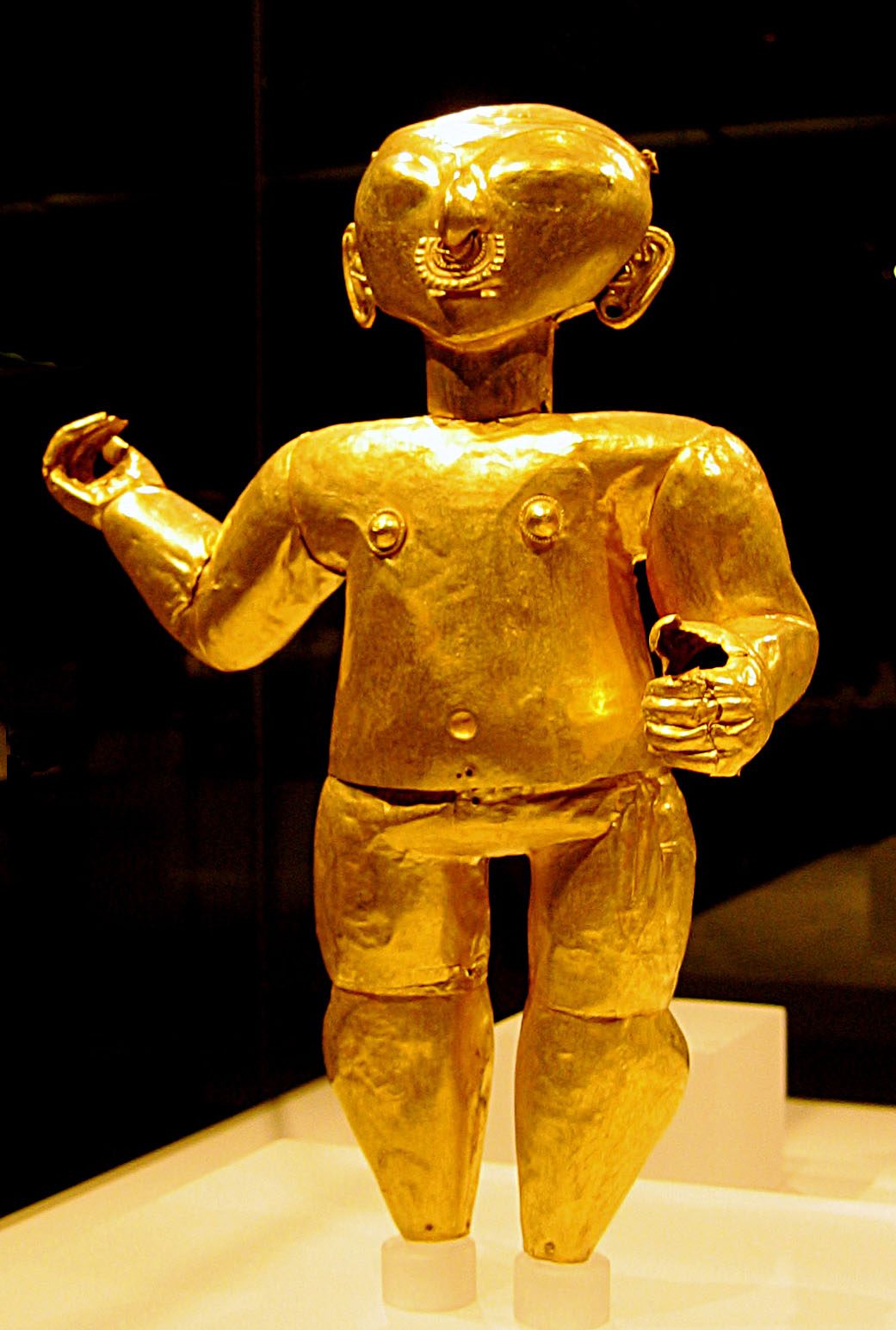
The artisans of the Tumaco culture excelled in the work of gold, platinum and tumbaga (an alloy between gold and copper). These metals were mainly used for the manufacture of artistic objects. A large number of metallic masks and body ornaments such as beads, rings, diadems, bracelets, dental inlays, and even gold threads were made, which were presumably used to decorate clothing. Although some copper tools were also made, such as chisels, tweezers, needles, pins, hooks, etc. The earliest evidence of the use of metals in the region comes from the archaeological site called Las Balsas, near the Islandof la Tolita, where a sheet of gold was found that was dated between 915 and 780 BC. The metal-smiths of the Tolita culture were the first in the world to work the platinum, at least 1,400 years before European blacksmiths, who did not use this metal until the 18th century. This metal has a very high melting point, which was not achieved until the Industrial Revolution, so the Tolita blacksmiths had to develop techniques to work the metal without melting it, one of them is called sintering, which is achieved by mixing platinum powder in gold or silver. The contrast of the white color of the platinum with the yellow of the gold was used to create bi-colored pieces. 1
The text above is adapted from the Wikipedia article “Tumaco-La Tolita culture”, available under the Creative Commons Attribution-ShareAlike 4.0 licence. 1
Tumaco-La Tolita culture is Archaeological culture from Colombia and Ecuador, according to the structured record cited below. This entry was generated automatically from that record and has not yet been reviewed by a person familiar with the tradition. 2
The source record links this tradition to 8 external registers, which can be verified through the citation. 2