The tradition & historical record
6 min read · 2 sourcesTumble finishing, also known as tumbling or rumbling, is a technique for smoothing and polishing a rough surface on relatively small parts. In the field of metalworking, a similar process called barreling, or barrel finishing, works upon the same principles. Tumbled stones are made with rock tumblers in a process very similar to the natural processes that produce "sea glass" or "beach glass". 1
Stones
Tumbling of rocks as a lapidary technique for rock polishing usually requires a plastic or rubber-lined barrel loaded with a consignment of rocks, all of similar or the same hardness, some abrasive grit, and a liquid lubricant. Silicon carbide grit is commonly used, and water is a universal lubricant. The barrel is then placed upon slowly rotating rails so that it rotates. The optimal speed of rotation depends on the size of the tumbler barrel and materials involved. Vibratory finishing process can be used instead. A well-chosen speed for stone polishing causes the rocks within the barrel to slide past each other, with the abrasive grit between them. The result of this depends on the coarseness of the abrasive, and the duration of the tumble. Typically, a full tumble polish from rough rock to polish takes 3–5 weeks, and is done in a minimum of 3 steps. Initially, the rocks are smoothed with a coarse grit (such as 60-90 mesh). The idea behind the first step is to take rough rock or stone and grind it (tumble it) down into a form which is indistinguishable (in shape) from the final product. This is followed by washing and then a stage of finer grits (120-220 then 400-600 mesh), before the (optional) use of a pre-polishing compound (1200 grit), a washing cycle with detergent to remove any grit on the stones. The final step is a polishing stage using powdered polish, (such as cerium oxide or tin oxide), water, and often small plastic pellets that are designed to cushion the stones as they tumble (so as not to cause chipping) and carry the polish evenly across the stones. The precise tumbling duration is determined by many factors, including the hardness of the rock and the degree of smoothing desired in the coarser steps. 1
Metal
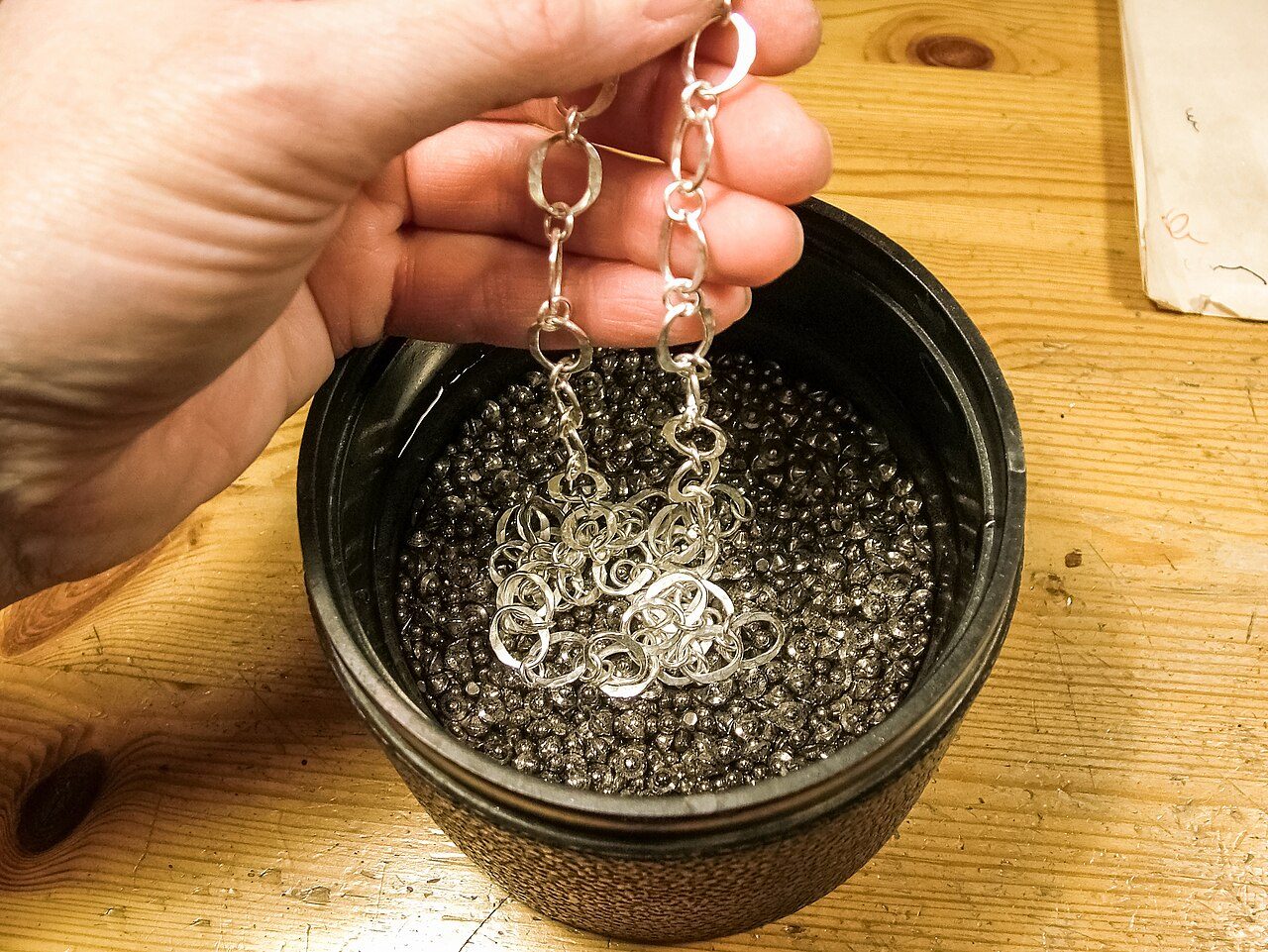
Metal tumbling is used to burnish, deburr, clean, radius, de-flash, descale, remove rust, polish, brighten, surface harden, prepare parts for further finishing, and break off die cast runners. The process is fairly simple: a horizontal barrel is filled with the parts which is then rotated. Variations of this process usually include media, water, or other lubricants. As the barrel is rotated the material rises until gravity causes the uppermost layer to landslide down to the other side. The barrel may also have vanes, typically made of rubber, which run along the inside of the barrel. As the barrel turns the vanes catch and lift the parts, which eventually slide down or fall. In a wet processes a compound, lubricant, or barreling soap is added to aid the finishing process, prevent rusting, and to clean parts. A wide variety of media is available to achieve the desired finished product. Common media materials include: sand, granite chips, slag, steel, ceramics, and synthetics. Moreover, these materials are available in a wide variety of shapes. Usually different shapes are used in the same load to reach into every geometry of the part. Tumbling is an economical finishing process because large batches of parts can be run with little or no supervision by the operator. A full cycle can take anywhere from 6 to 24 hours with the barrel turning at 20 to 38 RPM. Tumbling is usually most efficient with the barrel half full. Some processes also use a filter system to allow parts or other materials in the cylinder to be separated. The disadvantages of this process are that the abrasive action cannot be limited to only certain areas of the part, cycle times are long, and the process is noisy. 1
Specific types
Barrel burnishing is a type of barreling where no cutting action is desired. The goal is to reduce minute irregularities and produce a clean, smooth surface. The parts are usually tumbled against themselves or with steel balls, shot, rounded-end pins, or ballcones to achieve this. It is also usually a wet process that uses water and a lubricant or cleaning agent, such as soap or cream of tartar. The barrel is not loaded more than half full and if media is used then a 2:1 ratio of media to parts is maintained to keep the parts from rubbing. Centrifugal barrel tumbling uses a tumbling barrel at the end of a rotating arm to add centrifugal forces to the barreling process. This can accelerate the process 25 to 50 times. Spindle finishing mounts the workpieces onto spindles that rotate the parts opposite that of the media flow. This prevents the parts from interacting with each other and accelerates the cycle time, but extra time and cost are required to fixture the workpieces. 1
Glass
Stained glass shards used for mosaic glass are also tumbled. No abrasive is used, to avoid clouding the glass; there is only water as a lubricant. The object of this tumbling is to remove the sharp edges from the glass, so that it may be handled safely. As little as 8 hours of tumbling may be sufficient for tumbled glass. 1
Other
Tumbling is used to polish and smooth dice for recreational use, but it has the unfortunate effect of making their sides and faces somewhat uneven and thus making the dice less than fair. Tumbling can be used in 3D printing to correct small artifacts on the printed objects, such as visible layers. These techniques, although they take a long time, involve very little operator intervention and thus are very cheap. Small tumblers (one pound capacity) are available and inexpensive for home/hobbyist use. At the other end of the scale, professionals can use very large barrels to do a lot of work at once. The main disadvantage of tumbling is its limited scope - stones will be smooth and have semi-random shapes (like pebbles from the beach), and metals need to be relatively simple shapes, with no fine work. 1
The text above is adapted from the Wikipedia article “Tumble finishing”, available under the Creative Commons Attribution-ShareAlike 4.0 licence. 1
tumble finishing is technique for smoothing and polishing a rough surface on relatively small parts, according to the structured record cited below. This entry was generated automatically from that record and has not yet been reviewed by a person familiar with the tradition. 2
The source record links this tradition to 2 external registers, which can be verified through the citation. 2