The tradition & historical record
7 min read · 2 sources"Turtle Island" is a name used by some Indigenous peoples of the Americas to refer to Earth or North America. It is also commonly used among both Indigenous and non-Indigenous activists for Indigenous rights. The name is based on an oral history once common to the Indigenous peoples of the Northeastern Woodlands, which today roughly encompasses southeastern Canada and the northeastern United States. A number of contemporary works continue to use and/or tell the Turtle Island creation story. 1
Lenape
The Lenape story of the "Great Turtle" was first recorded by European colonists from an interview on October 16, 1679, in the 1679–80 journal of the Labadist missionary Jasper Danckaerts. It was explained to the missionary by the Hackensack elder Tantaqué, who was then visiting the Fort James area in Lower Manhattan. The story is shared by other Northeastern Woodlands tribes, notably the Haudenosaunee peoples. The Lenape believe that before creation there was nothing, an empty dark space. However, in this emptiness, there existed a spirit of their creator, Kishelamàkânk. Eventually in that emptiness, he fell asleep. While he slept, he dreamt of the world as we know it today, the Earth with mountains, forests, and animals. He also dreamt up man, and he saw the ceremonies man would perform. Then he woke up from his dream to the same nothingness he was living in before. Kishelamàkânk then started to create the Earth as he had dreamt it. First, he created helper spirits, the Grandfathers of the North, East, and West, and the Grandmother of the South. Together, they created the Earth just as Kishelamàkânk had dreamt it. One of their final acts was creating a special tree. From the roots of this tree came the first man, and when the tree bent down and kissed the ground, woman sprang from it. All the animals and humans did their jobs on the Earth, until a problem eventually arose. There was a tooth of a giant bear that could give the owner magical powers, and the humans started to fight over it. Eventually, the wars got so bad that people moved away, and made new tribes and new languages. Kishelamàkânk saw this fighting and decided to send down a spirit, Nanabush, to bring everyone back together. 1
Haudenosaunee
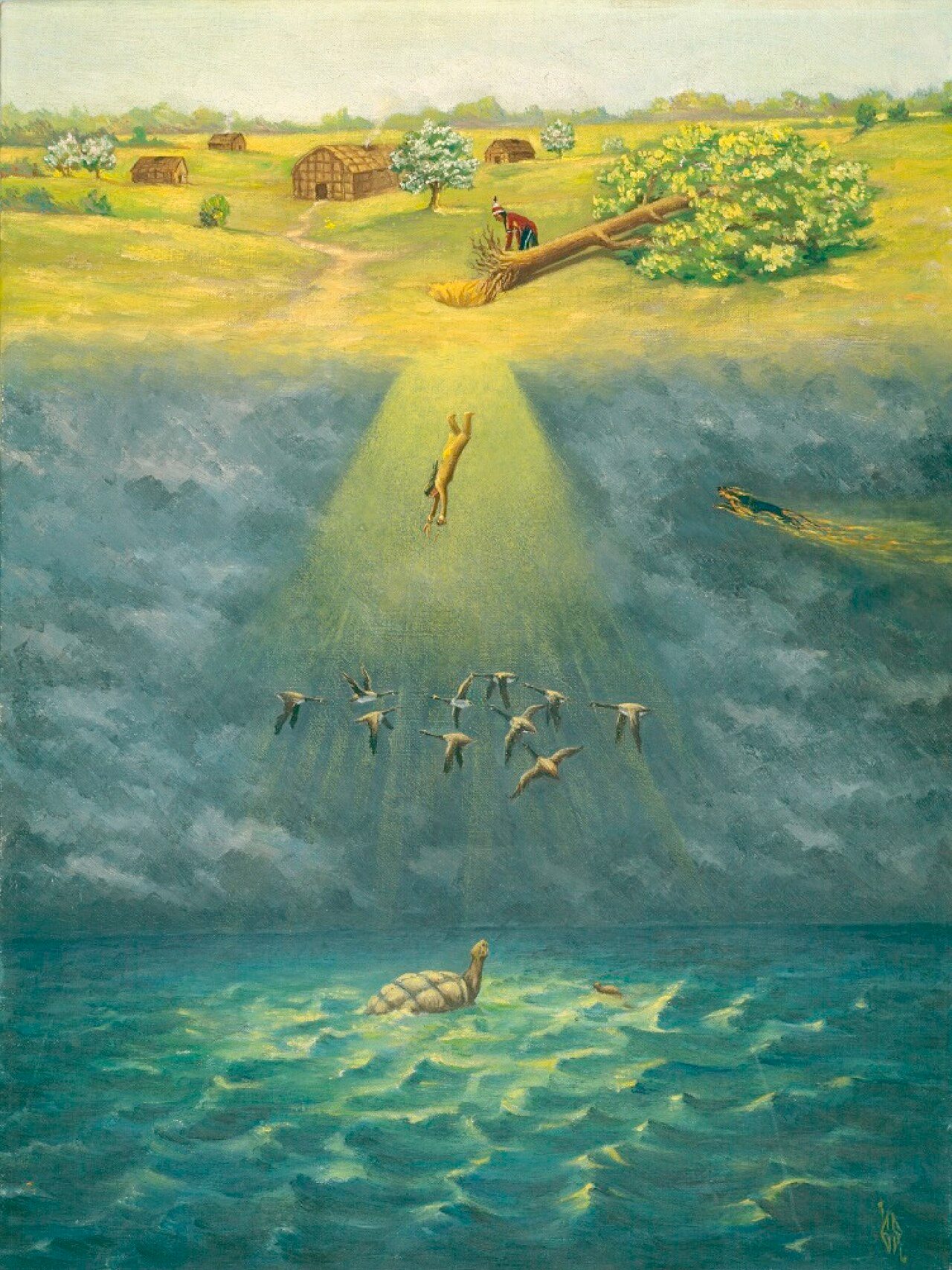
According to the oral tradition of the Haudenosaunee, "the earth was the thought of [a ruler of] a great island which floats in space [and] is a place of eternal peace." Sky Woman fell down to the earth when it was covered with water, or more specifically, when there was a "great cloud sea". Various animals tried to swim to the bottom of the ocean to bring back dirt to create land. Muskrat succeeded in gathering dirt, which was placed on the back of a turtle. This dirt began to multiply and also caused the turtle to grow bigger. The turtle continued to grow bigger and bigger and the dirt continued to multiply until it became a huge expanse of land. Thus, when Haudenosaunee cultures refer to the earth, they often call it Turtle Island. According to Converse and Parker, the Haudenosaunee faith shared with other religions the "belief that the Earth is supported by a gigantic turtle." In the Seneca language, the mythical turtle is called Hah-nu-nah, while the name for an everyday turtle is ha'no:wa:h. In Susan M. Hill's version of the story, the muskrat or other animals die in their search for land for the Sky Woman (named Mature Flower in Hills's version). This is a representation of the Haudenosaunee beliefs of death and chaos as forces of creation, as all people give their bodies to the land to become soil, which in turn continues to support life. This concept plays out again when Mature Flower's daughter dies during childbirth, becoming the first person to be buried on the turtle's back and whose burial post helped grow various plants such as corn and strawberries. This, according to Hill, also shows how soil, and the land itself, has the ability to act and shape creation. 1
Indigenous rights activism and environmentalism
The name Turtle Island has been used by many Indigenous cultures in North America, and both American Indian and non-American Indian activists, especially since the 1970s when the term came into wider usage. American author and ecologist Gary Snyder uses the term to refer to North America, writing that it synthesizes both indigenous and colonizer cultures, by translating the indigenous name into the colonizer's languages (the Spanish Isla Tortuga being proposed as a name as well). Snyder argues that understanding North America under the name of Turtle Island will help shift conceptions of the continent. Turtle Island has been used by writers and musicians, including Snyder for his Pulitzer Prize-winning book of poetry, Turtle Island; the Turtle Island Quartet jazz string quartet; Tofurky manufacturer Turtle Island Foods; and the Turtle Island Research Cooperative in Boise, Idaho. The Canadian Association of University Teachers has put into practice the acknowledgment of indigenous territory and claims, particularly at institutions located within unceded land or covered by perpetual decrees such as the Haldimand Tract. At Canadian universities, many courses, student and academic meetings, as well as convocation and other celebrations begin with a spoken acknowledgement of the traditional Indigenous territories, sometimes including reference to Turtle Island, in which they are taking place. 1
Contemporary works
There are a number of contemporary works which continue to use and/or tell the story of the Turtle Island creation story. 1
The Truth About Stories by Thomas King
Thomas King's book tells us that "the truth about stories is they're all we are." King's book explores the power of story both in native lives and in the lives of every person on this planet. Every chapter opens with a telling of the story of the world on the back of a turtle in space, and in each chapter, it is slightly altered to show how stories change through tellers and audiences. Their fluidity is itself a characteristic of the story as they traverse through time. King provides us with his own telling of the story using a woman named Charm as his Sky Woman. Charm is from a different planet and is described as being curious to a fault, often asking the animals of her planet questions they deem to be too nosy. When she becomes pregnant, she develops a craving for Red Fern Root, which can only be found underneath the oldest tree. While digging for the Red Fern Root she digs so deep she makes a hole in the planet, and in her curiosity falls through all the way to earth. King tells us that this is a young Earth from before land was created, and in order to save Charm from falling hard and fast into the water and upsetting the stillness of the water, all the water birds fly up to catch her. With no land to set her on they offer her the back of the turtle. When Charm is almost ready to give birth the animals fear that the turtle will be too crowded, so she asks the animals to dive down to find mud so that she can use its magic to build dry land. 1
The text above is adapted from the Wikipedia article “Turtle Island”, available under the Creative Commons Attribution-ShareAlike 4.0 licence. 1
Turtle Island is traditional name for (North) America among some indigenous groups, according to the structured record cited below. This entry was generated automatically from that record and has not yet been reviewed by a person familiar with the tradition. 2
The source record links this tradition to 2 external registers, which can be verified through the citation. 2