The tradition & historical record
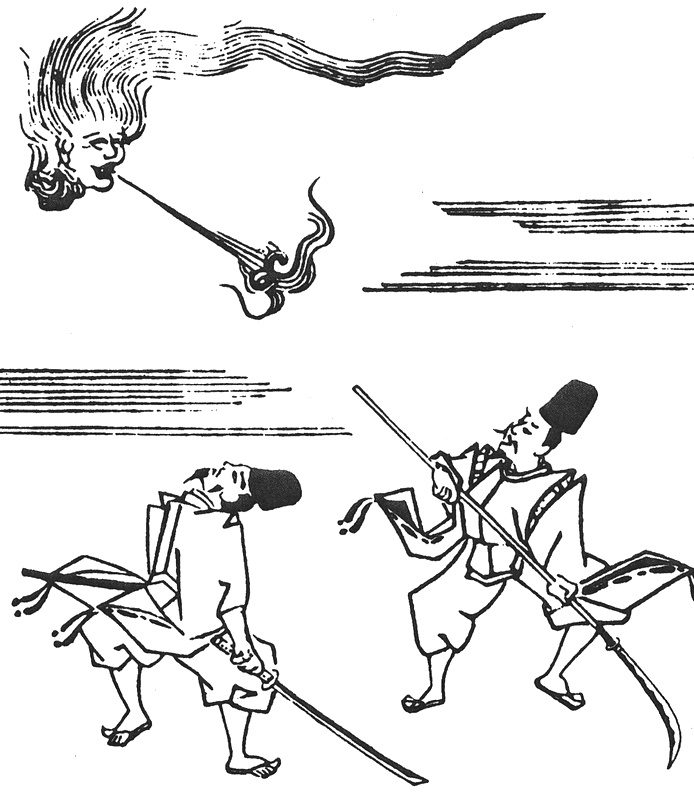
3 min read · 2 sourcesThe ubagabi (姥ヶ火 or 姥火, "old woman's fire") is an atmospheric ghost light in legends of Kawachi Province (now Osaka Prefecture) and Tanba Province (now northern Kyoto Prefecture). They are mentioned in old literature, such as the Tenpō period book the Shokoku Rijin Dan (諸国里人談) and Ihara Saikaku's collection of miscellaneous tales the Saikaku Shokoku Banashi (西鶴諸国ばなし) as well as Edo period kaidan books such as the Kokon Hyaku Monogatari Hyōban (古今百物語評判'), the Kawachi Kagami Meishōki (河内鑑名所記), and Toriyama Sekien's collection of yōkai depictions, the Gazu Hyakki Yagyō, among other mentions. 1
Concept
According to the Shokoku Rijin Dan, on a rainy night, in Hiraoka, Kawachi (now Higashiōsaka, Osaka Prefecture), it would appear as a ball of fire with a length of one shaku (about 30 centimeters). It is said that in the past, an old woman stole oil from Hiraoka Shrine and became a mysterious fire from a resulting curse. Once, when someone was walking along the road at night in Kawachi, the ubagabi suddenly appeared from nowhere and hit this person's face, and when this person looked closely, it took on the form of a chicken-like bird. It is said that when the ubagabi eventually flew away, it turned back into its original appearance as a ball of fire. From this, the yōkai manga artist Mizuki Shigeru suggested the possibility that the ubagabi was actually a bird. In the tale where an old woman became an ubagabi, the Saikaku Shokoku Banashi, it is written about here as the "Mi wo Sute Abura-tsubo (the oil pot that threw away its body)." According to this, the ubagabi is said to fly a length of about one ri (about four kilometers) in a mere instant, and it is said when the ubagabi grazes around someone's shoulder, that person would die within three years. However, it is said that ubagabi would disappear if you say "abura-sashi" (meaning "oil pourer"). There is also a legend about an ubagabi appearing at the Hozu River in Kyoto Prefecture. In the Kokon Hyaku Monogatari Hyōban, there was once an old woman who lived near Kameyama (now Kameoka, Kyoto Prefecture) who would receive money from parents, telling them that she would take them to meet people they needed to see, and put the children into the Hozu River. Eventually, perhaps as divine punishment, the old woman experienced a flood and drowned. 1
The text above is adapted from the Wikipedia article “Ubagabi”, available under the Creative Commons Attribution-ShareAlike 4.0 licence. 1
Ubagabi is legendary ghost, according to the structured record cited below. This entry was generated automatically from that record and has not yet been reviewed by a person familiar with the tradition. 2
The source record links this tradition to 2 external registers, which can be verified through the citation. 2