The tradition & historical record
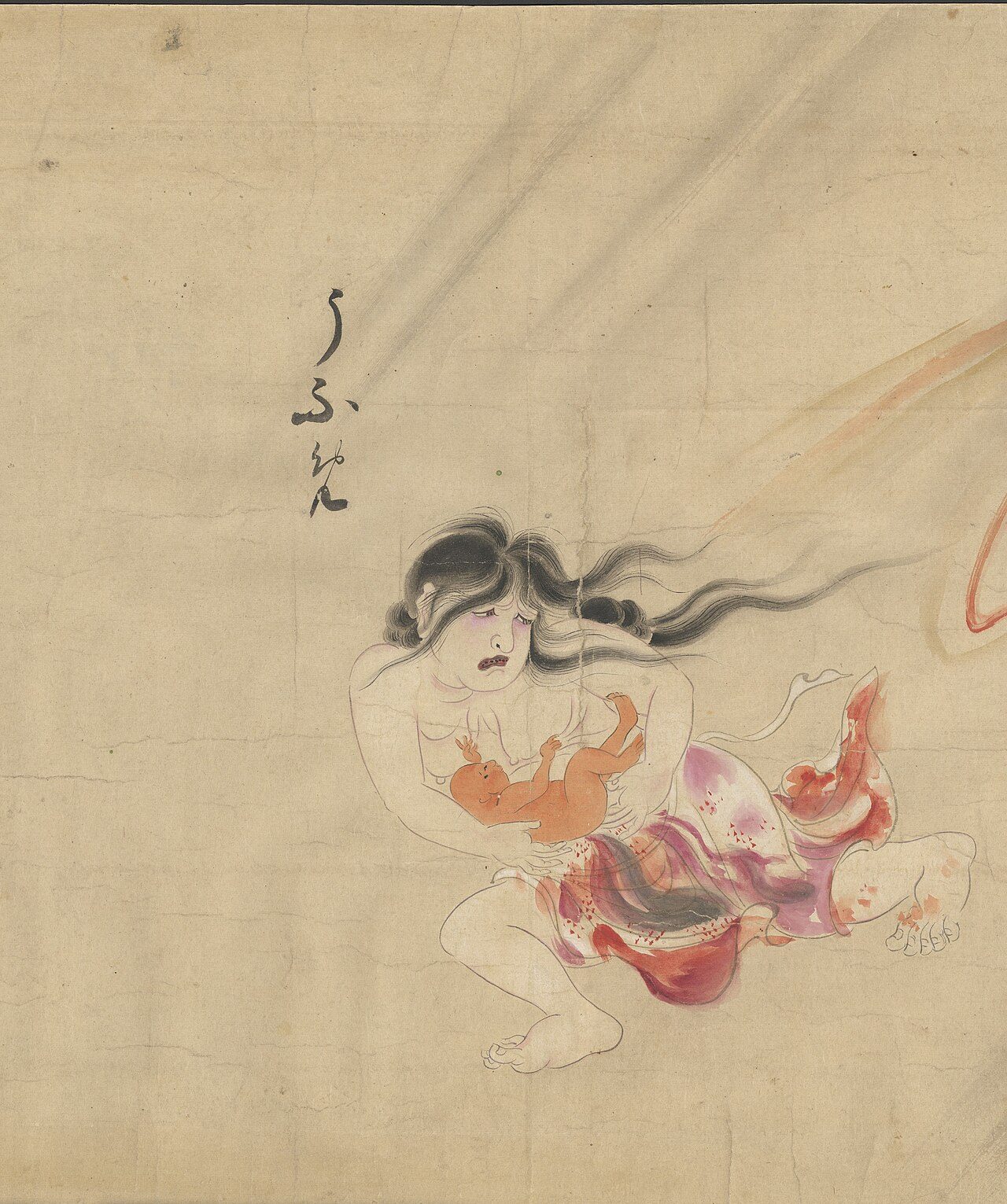
5 min read · 2 sourcesUbume (Japanese: 産女) (also ubumedori (姑獲鳥) or ubumetori (産女鳥)) are Japanese yōkai, ghosts of women who died in childbirth, but may have borne a child alive. The creature is equivalent to the Chinese Guhuoniao (Chinese: 姑獲鳥, "wench bird") but local Japanese folklore has been blended into the legend. Throughout folk stories and literature the identity and appearance of ubume varies. However, she is most commonly depicted as the spirit of a woman who has died during childbirth. Passersby will see her as a normal-looking woman carrying a baby. She will typically try to give the passerby her child then disappears. When the person examines the child in his arm, he discovers it to be a bundle of leaves or large rock. 1
Nomenclature
The ubume (産女, 姑獲) of Japanese lore was considered the equivalent of the Chinese guhuoniao (姑獲鳥; pinyin: gū huò niǎo, lit. "lady capturing-bird", translated as "wench bird"), alias rumu niao (乳母鳥; 'mother's milk bird') or yèxíng yóunǚ (夜行遊女; lit. 'nighttime travelling girl') —as well-explained in various pieces of Edo period scholarship. Due to the ubume being equated with or conflated with the Chinese version, the Chinese written name 姑獲鳥 has been coopted to be read as ubume or "ubumedori". An alternate kanji representation gives it the meaning of 産女 (ubume, "birthing woman"). Supposedly also called nyūbochō (乳母鳥; "mother's milk bird"), due to its resemblance to a wetnurse (menoto (乳母)). 1
General description
The ubume is explained to be the ghost of a mother who died giving childbirth, i.e., a "birthing woman ghost". When a pregnant woman dies without delivering her child, and is buried, but the child still comes out alive, her soul (konpaku (魂魄), i.e. hun and po) turns into this monstrous female, soaked in blood below the waist and frail-like, asking passersby to hold her baby, and if the person complies he gains some sort of a boon (e.g. extraordinary strength), according to a certain source (cf. § Kii zōdan shū of 1687 below). If the passerby refuses and flees, he may be cursed and develop a fever, even unto death. But typically in folk narratives, the ubume asks a passerby to hold her child for just a moment and disappears when her victim takes the swaddled baby. The baby then becomes steadily heavier, (even heavier than stone) until it is impossible to hold. It is then revealed not to be a human child at all, but a boulder or a stone image of Jizō, a stone tower (stupa), or tree leaves. She has been depicted wearing blood-stained loincloth (koshimaki) by various Edo-period artists (cf. § In art), as according to folk tradition. She is also said to try to snatch other people's baby out of craving to have a child of her own. Or she may have borne the child alive, and the ghost mother seeks out nourishment for the bereft or orphaned child. It also has the habit that of trying to breastfeed the child it kidnaps, leading to its alias name nyūbochō (乳母鳥; "mother's milk bird"), as aforementioned. Another piece of lore is that the ubume tends to leave droplets of blood on clothing when it intrudes into a household, and this should be taken as a sign of its presence (Cf. 1
Konjaku monogatarishū
Stories about ubume have been told in Japan since at least the 12th century, in the Konjaku Monogatarishū, where a samurai (Urabe no Suetake, cf. image right) encounters a woman (ubume (産女)) at the riverbank who asks him to hold her child. She demands her child back and when the samurai refused, it turned into a bundle of leaves. 1
Kokon hyakumonogatari hyōban
They are also mentioned in the Hyakumonogatari Hyōban: "When a woman loses her life in childbirth, her spiritual attachment itself becomes this ghost. In form, it is soaked in blood from the waist down and wanders about crying, 'Be born! Be born!' (obareu, obareu; をばれう)". 1
Kii zōdan shū
The Kii zōdan shū ("Collected yarns of the uncanny"; pub. Jōkyō4/1687) was already drawn on above to provide the general description that if a woman who dies in labor but produces a live child after internment, her soul transmogrifies into the ubume. The same work returns somewhat later to explain that when "a woman wanting a child (for a long time) gets pregnant by chance, but dies in difficult labor or delivery, her obsession or double-soul (kon and haku) transforms into the shape of a bird, flies by night, and captures other people's children". It has been stressed that it is the obsession (obsessed soul) that transforms into this being, and that a similar description also occurs in the Kokon hyakumonogatari hyōban (above). This work also provides the aforementioned lore about the breasted bird having cravings to breastfeed the child it abducts, and how the bird flies by at night and leaves blood stains on children's clothing, leading to the taboo against leaving clothes hung out to dry overnight. 1
The text above is adapted from the Wikipedia article “Ubume”, available under the Creative Commons Attribution-ShareAlike 4.0 licence. 1
Ubume is Japanese yōkai of pregnant women, according to the structured record cited below. This entry was generated automatically from that record and has not yet been reviewed by a person familiar with the tradition. 2
The source record links this tradition to 2 external registers, which can be verified through the citation. 2