The tradition & historical record
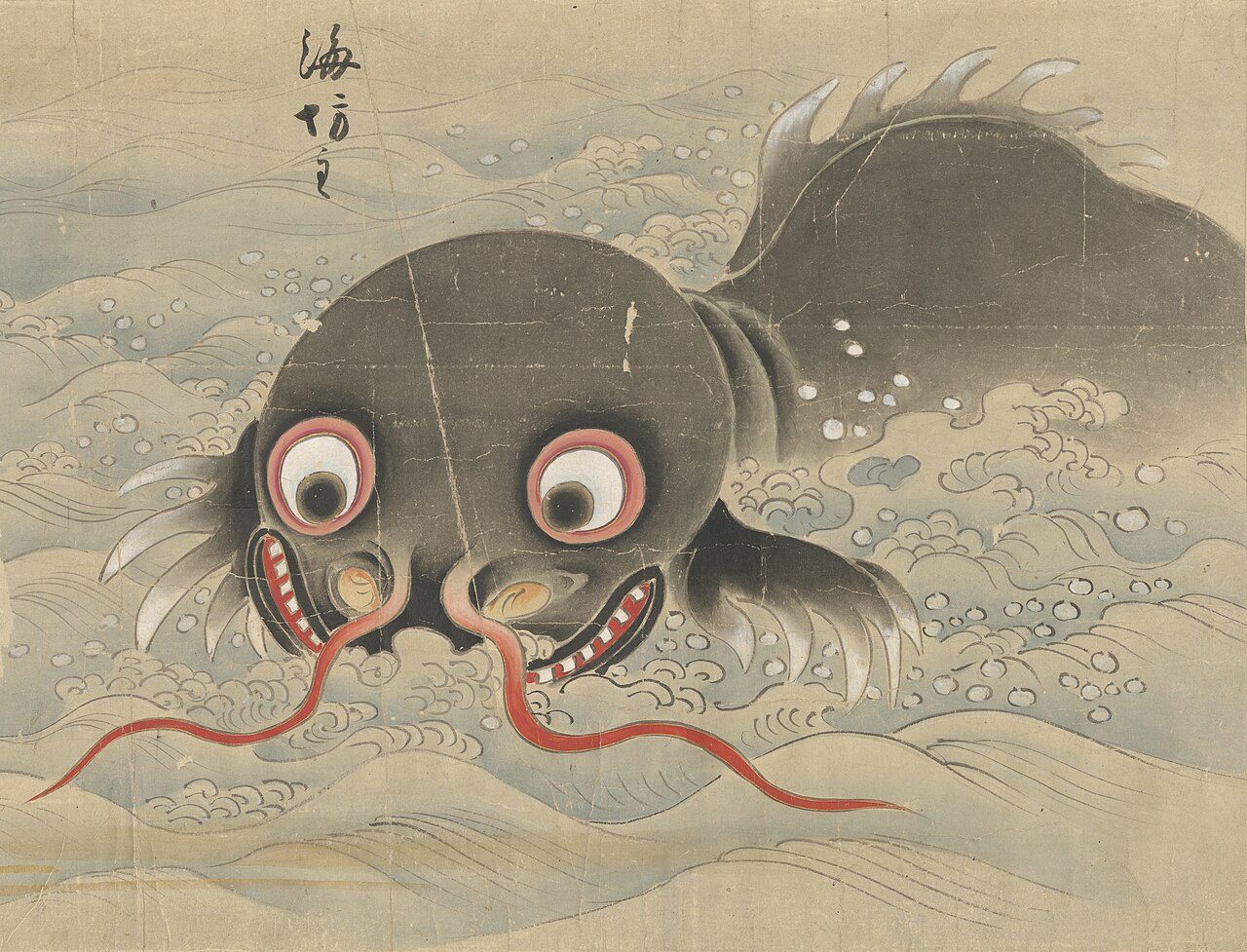
6 min read · 2 sourcesUmibōzu (海坊主; Japanese pronunciation: [ɯ.mʲi.boꜜː.(d)zɯ, ɯꜜ.mʲi.boː-], lit. 'sea monk') is a yōkai from Japanese folklore that has the form of a giant, black, human-like being. Little is known of the origin of umibōzu but it is a mythical sea-spirit creature and as such has multiple sightings throughout Japan. Normally, umibōzu appears to sailors on calm seas which quickly turn tumultuous. It either breaks the ship on emergence or demands a ladle from the sailors and proceeds to drown them. The only safe way to escape an umibōzu is to give it a bottomless ladle and sail away while it is confused. The monster is known by other near-synonymous names such Umihōshi (海法師) or Uminyūdō (海入道). 1
Overview
They are often encountered by ships at night. A calm sea would suddenly surge and a giant black bōzu (bald-shaven) head surfaces, and destroy or damage ships. They are said to range from a few meters to tens of meters in length, but some are about human-size. It typically reveals only its upper body above the waist. The umibōzu is not always solitary, and some lore claim that swarms of them arrive on ships to do mischief, such as clinging to the hull and scull as well as put out the basket fire. Their weakness is said to be smoke (tobacco fumes according to some) which causes them to flee. The umibōzu is explained by some to be the ghost of the drowned, a belief held locally in Chiba Prefecture, though the lore from Chōshi, Chiba asserts that a certain priest named Shōgaku-bō (正覚坊) had drowned and became the umibōzu, according to Edo Period literature. (Cf. § Sea turtle below). An English source claims the umibōzu is more generally regarded as the spirit of the drowned priest. The lore of the umibōzu is widespread and occurs all over Japan. Also the story of the umibōzu (or some maritime yōkai under various names) that asks for a ladle-type utensil then tries to sink the gift-giver's ship by scooping water in it, is found all over Japan. In a commonplace story, the umibōzu asks for a ladle-type utensil from the gullible seafarer, only to have the creature try to fill the ship with the implement and try to sink it. In the version of Ukujima island (of the Gotō Islands, Nagasaki Prefecture), the creature is called either umibōzu or funayūrei, and demands a hishaku (wooden dipper). Since it would try to use it to pour water into the fisherman's vessel, the wise strategy to survive this is to lend a ladle with the bottom punched out. 1
Nomenclature
Other (near-synonymous) names include Umihōshi (海法師) or Uminyūdō (海入道), where hōshi (法師) (literally "law-master") and nyūdō (入道) both refer to a monk or priest. The umibōzu has a clean shaven head like a priest's, as aforementioned. Some English sources also generalize the umibōzu to be the spirits of drowned priests. Sometimes the umibōzu is conflated with the funayūrei (船幽霊; lit. "ship ghost"), and it is difficult to make a stark distinction between them. As in the aforementioned example the same yōkai may be known as either funayūrei or umibōzu (Gotō Islands). In the western seas the creature known as umibōzu is a human-headed sea turtle, corresponding to the heshang yu (or oshōuo in Japanese, meaning "monk-fish") from Chinese literature (cf. § Sea turtle) In European folklore, there is also said to be sea creatures of like meaning, namely the sea monk and sea bishop. 1
Kyūshū region
In the aforementioned lore around northern Gotō Archipelago, the part about the umibōzu aka funayūrei demanding the ladle is a motif that is widespread throughout Japan as aforementioned, but there are more superstitions about this yōkai according to fishermen of the area, namely, that it never tries to come aboard ship from the aft (stern) of the ship because the Funaō-sama (船王様; "Lord Ship King") faces that way, and always tries to climb from the prow. Also, if it clings onto the scull (oar), then one should keep pushing it until the edge of the oar digs in, and the umibōzu would start screaming "aitata (ouch ouch)" in pain.. 1
Skikoku region
In Uwajima, Ehime Prefecture, there are tales where they would shapeshift into a zatō (blind person) and kill human women. Also, while there are many legends of them attacking humans, in Uwajima there is the legend that those who see an umibōzu would live a long life. 1
Chūgoku region
In Nagato Province (now Yamaguchi Prefecture), at a part of Mukatsuku village called Kawashiri, there is a tale passed down about a fisherman long ago who had been out night-fishing and witnessed a umibōzu that came to extinguish the basket fire, so he threw the fire-lit torches at the monster. In the Bisan Seto Sea in-between Okayama Prefecture and Kagawa Prefecture, tales are told of a type of umibōzu called the nurarihyon with a large round head: they float towards the boat, and slowly slicker (nurari) away and then unexpectedly (hyon) float approaching the boat again. They would do this several times over to taunt people. This marine creature is completely different from the old man-like yōkai called nurarihyon that bears the same name. Around the San'in region it is said that one can encounter the umibōzu on the shore as well, while walking on the beach at night, and the slick, black mass-like creature will rub itself onto the passerby and attempt to drag the person into the sea. There are anecdotes of some survivor who got away with all his might. From Tottori Prefecture, a piece of writing from the Edo period called Inaba kaidan-shū (因幡怪談集; "Inaba ghost stories") attests to the umibōzu. A strong man from the village next to Yonagomachi (now part of Matsue) who boasted of being undefeated in sumo matches held at ceremonies encountered the one-eyed monster shaped like a stake measuring 2 shaku (66 centimetres (26 in)) circumference. The man captured the monster after a struggle. Most villagers who gathered could not identify it, but a 90-year old man suggested this might be the umibōzu, said to lean on to people it finds, with its body slick with goo, causing an itch all over the body if touched, or so the old man had been told by his grandfather long ago.。 1
The text above is adapted from the Wikipedia article “Umibōzu”, available under the Creative Commons Attribution-ShareAlike 4.0 licence. 1
Umibōzu is paranormal phenomena or yōkai from Japanese folklore, according to the structured record cited below. This entry was generated automatically from that record and has not yet been reviewed by a person familiar with the tradition. 2
The source record links this tradition to 3 external registers, which can be verified through the citation. 2