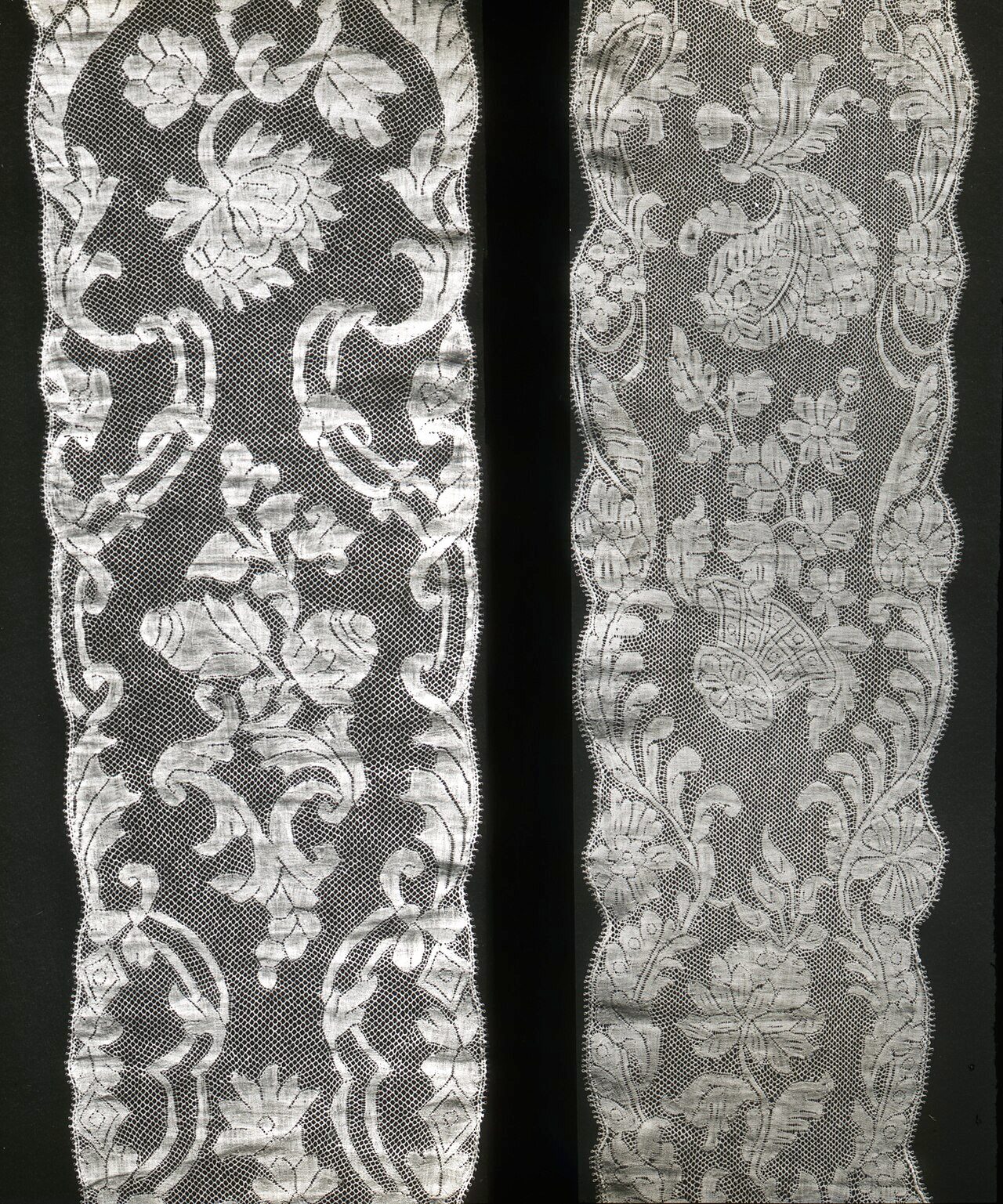
The tradition & historical record
2 min read · 2 sourcesValenciennes lace is a type of bobbin lace that originated in Valenciennes, in the Nord département of France, and flourished from about 1705 to 1780. Production later moved to Belgium, in and around Ypres. The industry continued into the 19th century on a diminished scale. By the 19th century, Valenciennes lace could be made by machine. Valenciennes lace is made on a lace pillow in one piece, with the réseau (the net-like ground) being made at the same time as the toilé (the pattern). It differentiates itself from other types of lace because the openness of the réseau, the closeness and evenness of the toilé, which resembles cambric, and that it lacks any cordonnet (a loosely spun silk cord used to outline and define the pattern). Also, in real Flemish Valenciennes lace there are no twisted sides to the mesh; all are closely plaited, and as a rule the shape of the mesh is diamond but without the openings. The réseau ground is made of four threads braided together, with eight threads at the crosses, which makes it very strong and firm. This is simpler and easier to make than the ground for Mechlin lace, though similar in appearance. Valenciennes lace received an impetus in the seventeenth century, when the Scheldt was channelled for river navigation between Cambrai and Valenciennes, benefiting the export of Valenciennes' wool, fabric and fine arts. To use up flax yarn, women began to make the famous Valenciennes lace. 1
The text above is adapted from the Wikipedia article “Valenciennes lace”, available under the Creative Commons Attribution-ShareAlike 4.0 licence. 1
Valenciennes lace is type of bobbin lace, according to the structured record cited below. This entry was generated automatically from that record and has not yet been reviewed by a person familiar with the tradition. 2
The source record links this tradition to 4 external registers, which can be verified through the citation. 2