The tradition & historical record
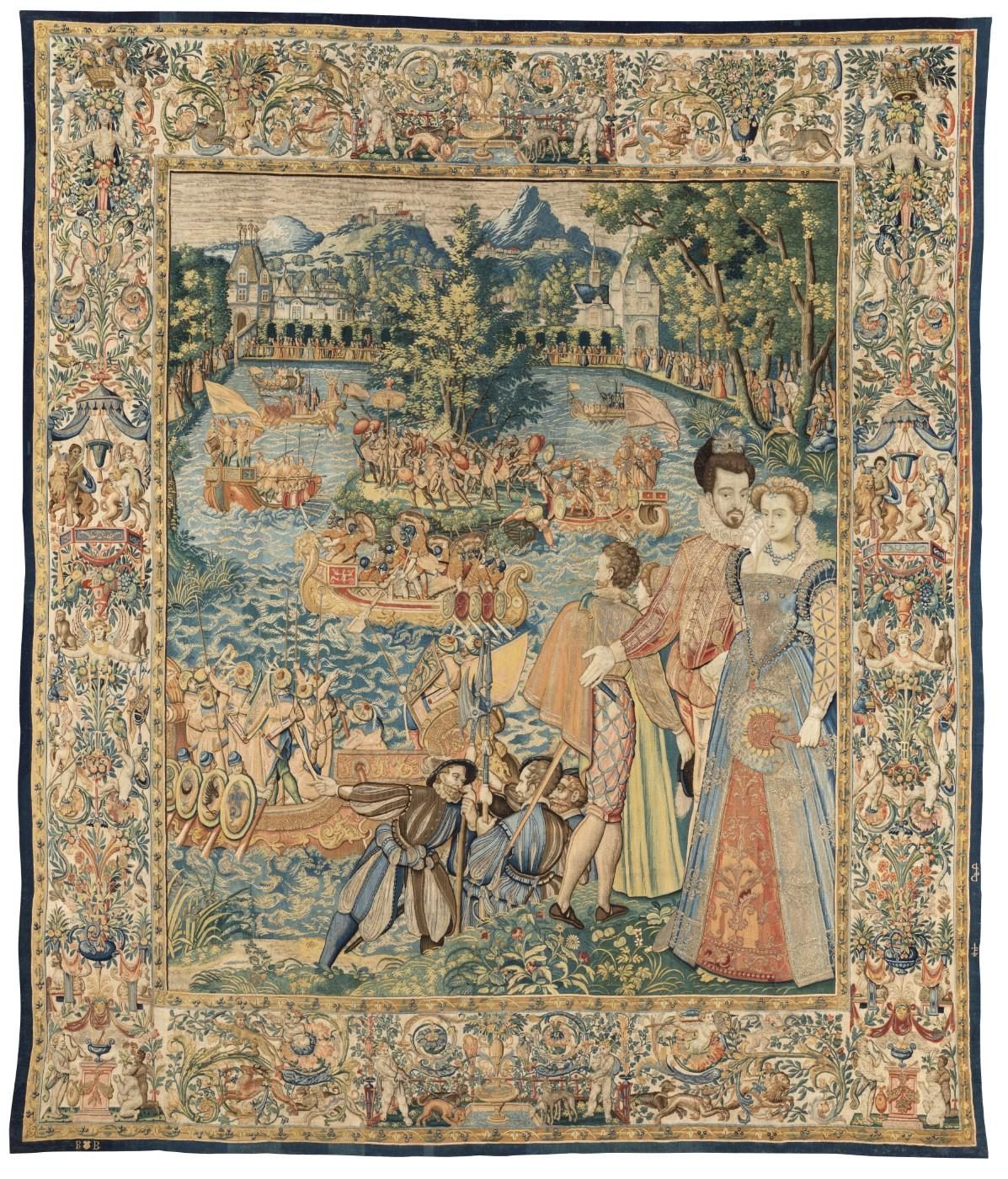
5 min read · 2 sourcesThe Valois Tapestries (Dutch: Valois tapijten) are a series of eight large tapestries depicting festivities or "magnificences" held by Catherine de' Medici's Royal Courts in the second half of the 16th century. The tapestries were primarily modeled on drawings by Antoine Caron, but to Caron's distant views of large panoramas crowded with figures much larger portraits of leading persons at the French court have been added in the foreground, usually to the side, as well as elaborate borders. They were produced by teams of weavers in the Spanish Netherlands, probably in Brussels or Antwerp, shortly after 1580. A number of great artists and artisans worked on the creation of these tapestries but today we are left with nothing but theories and speculation to their identities. Scholars such as Frances Yates and Jean Coural have developed nuanced theories backed by solid evidence to identify these unknown contributors, and also the political meaning of the tapestries, but research has yet to confirm many of these findings. These works display surprisingly intimate and personal moments within the royal inner circle clashing against the busy backdrops of these lavish festivals. The tapestries are now in the Uffizi Museum in Florence, Italy. 1
Design and construction
The tapestries are based on six (possibly eight) designs drawn by the artist Antoine Caron during the reign of King Charles IX of France (1560–1574). These were modified by a second artist, who reveals a strong personality of their own, to include groups of full-length figures in the foreground. Historian Frances Yates believed that this second artist was the influential Lucas de Heere, this claim holds grounds and is backed by solid evidence but is nevertheless highly contested and debated among historians. 1
Composition
The eight tapestries can be distinctly divided into several sections. Initially, the original sketches by Antoine Caron form the chaotic backgrounds of each piece, acting as the foundational layers for the creations. Over this chaotic backdrop, nearly separate portraits were later added by a second artist, enhancing the narrative of the tapestry cycle and the imagery of the immediate royal circle. Finally, each tapestry features incredibly detailed borders, likely crafted entirely by a third artist employed by the producing workshop. Although the borders have been largely understudied, they remain crucial for identifying the origins and creators of these tapestries. 1
Themes and iconography
The artists seem to have consulted written accounts of Catherine de' Medici's court festivals. Some of the entertainments recorded in the tapestries can be identified with known events, such as the festivals mounted at Fontainebleau and at Bayonne during Charles IX's royal progress of 1564–65; and the ball held for the Polish ambassadors at the Tuileries in 1573. Particularly lavish were the tournaments and fêtes held in 1565 in Bayonne, near the Spanish border of France, where Catherine de' Medici met with her daughter Elisabeth, Queen of Spain, amidst rituals of display from both courts. The latest event identifiable in the tapestries was held in 1573 at the Tuileries, where Catherine laid on a ball for ambassadors from the Polish governing council, who had elected her son Henry as king of Poland. The costumes worn by the courtiers in the tapestries have been dated to not later than c. 1580. For Catherine de' Medici, who masterminded these occasions and may have ordered the tapestries that commemorated them, such entertainments were worth their colossal expense, since they served a political purpose. Presiding over the royal government at a time when the French monarchy was in steep decline, she set out to show not only the French people but foreign courts that the Valois monarchy was as prestigious and magnificent as it had been during the reigns of Francis I and her husband Henry II. At the same time, she believed these elaborate entertainments and sumptuous court rituals, which incorporated martial sports and tournaments of many kinds, would occupy her feuding nobles and distract them from fighting against each other to the detriment of the country and the royal authority. Catherine also exercised her own creative gifts in the devising of the court festivals. 1
Notable figures
Most of the full-length figures in the foreground of the tapestries are recognizable as members of the French royal family and court. Francis, Duke of Anjou is featured prominently in some of the tapestries, and Catherine de' Medici, dressed in her widow's black, occupies the central position in all of the tapestries except one. Catherine's daughter Marguerite de Valois can also be seen. One absentee from the tapestries is King Charles IX of France, who was on the throne at the time of the events depicted, but who had died (1574) by the time the hangings were woven. Yates speculates that the Protestant creators of the tapestries deliberately cut him out because of his involvement in the St. Bartholomew's Day massacre of 1572, in which thousands of French Protestants, or Huguenots, were slaughtered on his orders. Caron's original drawings for the tapestries, of which six survive, show Charles IX taking part in the festivities. It is the later artist who removed Charles from the designs and added the figures in the foreground who relate to the court of Charles's successor Henry III. 1
Descriptions
The collection of eight tapestries has no formal title, but is usually called the "Valois tapestries" and sometimes the "Fêtes des Valois". The tapestries, none of which has an official name are described and summarized in the table below. 1
The text above is adapted from the Wikipedia article “Valois Tapestries”, available under the Creative Commons Attribution-ShareAlike 4.0 licence. 1
Valois Tapestries is series of tapestries depicting festivities at the court of France, according to the structured record cited below. This entry was generated automatically from that record and has not yet been reviewed by a person familiar with the tradition. 2
The source record links this tradition to 2 external registers, which can be verified through the citation. 2