The tradition & historical record
6 min read · 2 sourcesVitreous enamel, also called porcelain enamel, is a material made by fusing powdered glass to a substrate by firing, usually between 750 and 850 °C (1,380 and 1,560 °F). The powder melts, flows, and then hardens to a smooth, durable vitreous coating. The word vitreous comes from the Latin vitreus, meaning "glassy". Enamel can be used on metal, glass, ceramics, stone, or any material that will withstand the fusing temperature. In technical terms fired enamelware is an integrated layered composite of glass and another material (or more glass). The term "enamel" is most often restricted to work on metal, which is the subject of this article. Essentially the same technique used with other bases is known by different terms: on glass as enamelled glass, or "painted glass", and on pottery it is called overglaze decoration, "overglaze enamels" or "enamelling". The craft is called "enamelling", the artists "enamellers" and the objects produced can be called "enamels". 1
Enamelling is an old and widely adopted technology, for most of its history mainly used in jewellery and decorative art. Since the 18th century, enamels have also been applied to many metal consumer objects, such as some cooking vessels, steel sinks, and cast-iron bathtubs. 1
Ancient
The earliest enamel all used the cloisonné technique, placing the enamel within small cells with gold walls. This had been used as a technique to hold pieces of stone and gems tightly in place since the 3rd millennium BC, for example in Mesopotamia, and then Egypt. Enamel seems likely to have developed as a cheaper method of achieving similar results. The earliest undisputed objects known to use enamel are a group of Mycenaean rings from Cyprus, dated to the 13th century BC. Although Egyptian pieces, including jewellery from the Tomb of Tutankhamun of c. 1325 BC, are frequently described as using "enamel", many scholars doubt the glass paste was sufficiently melted to be properly so described, and use terms such as "glass-paste". It seems possible that in Egyptian conditions the melting point of the glass and gold were too close to make enamel a viable technique. Nonetheless, there appear to be a few actual examples of enamel, perhaps from the Third Intermediate Period of Egypt (beginning 1070 BC) on. But it remained rare in both Egypt and Greece. The technique appears in the Koban culture of the northern and central Caucasus, and was perhaps carried by the Sarmatians to the ancient Celts. Red enamel is used in 26 places on the Battersea Shield (c.350–50 BC), probably as an imitation of the red Mediterranean coral, which is used on the Witham Shield (400–300 BC). Pliny the Elder mentions the Celts' use of the technique on metal, which the Romans in his day hardly knew. The Staffordshire Moorlands Pan is a 2nd-century AD souvenir of Hadrian's Wall, made for the Roman military market, which has swirling enamel decoration in a Celtic style. 1
Medieval and Renaissance Europe
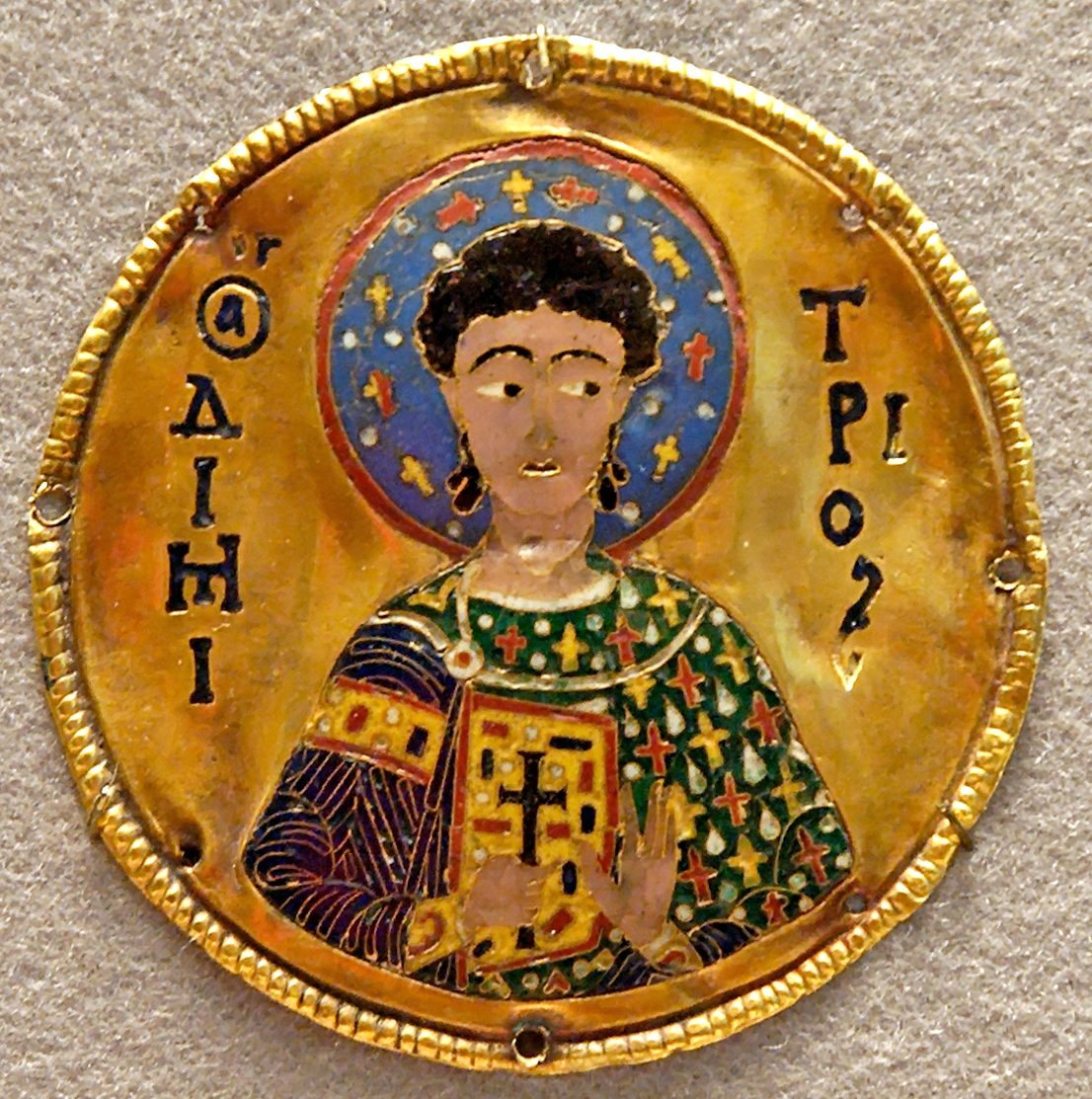
In European art history, enamel was at its most important in the Middle Ages, beginning with the Late Romans and then the Byzantine, who began to use cloisonné enamel in imitation of cloisonné inlays of precious stones. The Byzantine enamel style was widely adopted by the peoples of Migration Period northern Europe. The Byzantines then began to use cloisonné more freely to create images; this was also copied in Western Europe. In Kievan Rus a finift enamel technique was developed. 1
Mosan metalwork often included enamel plaques of the highest quality in reliquaries and other large works of goldsmithing. Limoges enamel was made in Limoges, France, the most famous centre of vitreous enamel production in Western Europe, though Spain also made a good deal. Limoges became famous for champlevé enamels from the 12th century onwards, producing on a large scale, and then (after a period of reduced production) from the 15th century retained its lead by switching to painted enamel on flat metal plaques. The champlevé technique was considerably easier and very widely practiced in the Romanesque period. In Gothic art the finest work is in basse-taille and ronde-bosse techniques, but cheaper champlevé works continued to be produced in large numbers for a wider market. Painted enamel remained in fashion for over a century, and in France developed into a sophisticated Renaissance and the Mannerist style, seen on objects such as large display dishes, ewers, inkwells and in small portraits. After it fell from fashion it continued as a medium for portrait miniatures, spreading to England and other countries. 1
China
From either Byzantium or the Islamic world, the cloisonné technique reached China in the 13–14th centuries. The first written reference to cloisonné is in a book from 1388, where it is called "Dashi ('Muslim') ware". No Chinese pieces that are clearly from the 14th century are known; the earliest datable pieces are from the reign of the Xuande Emperor (1425–1435), which, since they show a full use of Chinese styles, suggest considerable experience in the technique. Cloisonné remained very popular in China until the 19th century and is still produced today. The most elaborate and most highly valued Chinese pieces are from the early Ming dynasty, especially the reigns of the Xuande Emperor and Jingtai Emperor (1450–1457), although 19th century or modern pieces are far more common. 1
Japan
Japanese artists did not make three-dimensional enamelled objects until the 1830s but, once the technique took hold based on analysis of Chinese objects, it developed very rapidly, reaching a peak in the Meiji and Taishō eras (late 19th/early 20th century). Enamel had been used as decoration for metalwork since about 1600, and Japanese cloisonné was already exported to Europe before the start of the Meiji era in 1868. Cloisonné is known in Japan as shippo, literally "seven treasures". This refers to richly coloured substances mentioned in Buddhist texts. The term was initially used for colourful objects imported from China. According to legend, in the 1830s Kaji Tsunekichi broke open a Chinese enamel object to examine it, then trained many artists, starting off Japan's own enamel industry. Early Japanese enamels were cloudy and opaque, with relatively clumsy shapes. This changed rapidly from 1870 onwards. The Nagoya cloisonné company (Nagoya shippo kaisha existed from 1871 to 1884, to sell the output of many small workshops and help them improve their work. In 1874, the government created the Kiriu kosho kaisha company to sponsor the creation of a wide range of decorative arts at international exhibitions. This was part of a programme to promote Japan as a modern, industrial nation. Gottfried Wagener was a German scientist brought in by the government to advise Japanese industry and improve production processes. Along with Namikawa Yasuyuki he developed a transparent black enamel which was used for backgrounds. Translucent enamels in various other colours followed during this period. 1
India and Islamic world
Enamel was established in the Mughal Empire by around 1600 … 1
The text above is adapted from the Wikipedia article “Vitreous enamel”, available under the Creative Commons Attribution-ShareAlike 4.0 licence. 1
vitreous enamel is material made by fusing powdered glass to a substrate by firing, according to the structured record cited below. This entry was generated automatically from that record and has not yet been reviewed by a person familiar with the tradition. 2
The source record links this tradition to 35 external registers, which can be verified through the citation. 2