The tradition & historical record
4 min read · 2 sourcesWashing the Ethiopian (or at some periods the Blackamoor) White is one of Aesop's Fables and is numbered 393 in the Perry Index. The fable is only found in Greek sources and, applied to the impossibility of changing character, became proverbial at an early date. It was given greater currency in Europe during the Renaissance by being included in emblem books and then entered popular culture. There it was often used to reinforce outright racist attitudes. 1
The fable and its meaning
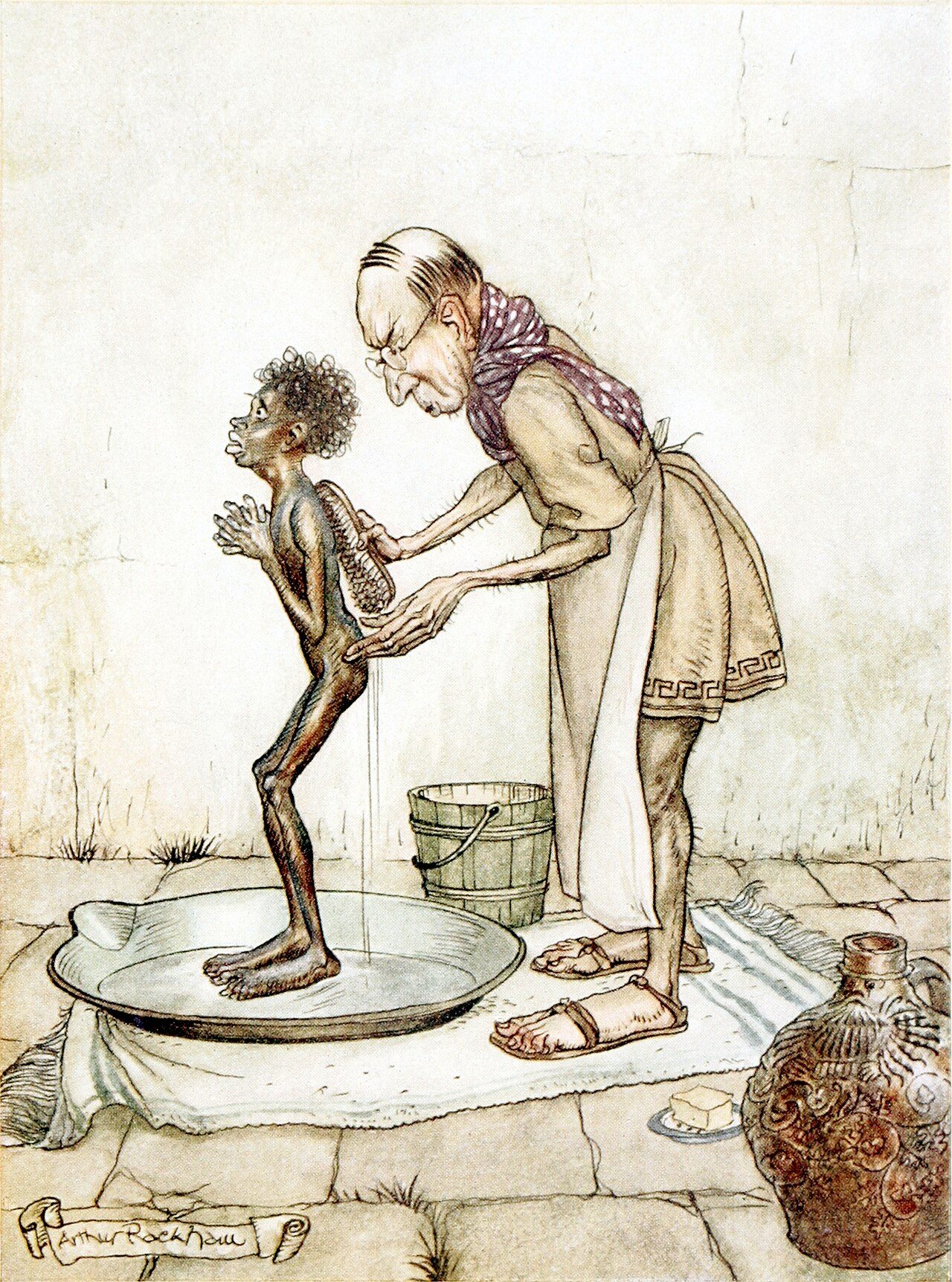
The story concerns the owner of a black slave who imagines that he has been neglected by his former master and tries to wash off the blackness. Some versions mention that this goes on so long that the poor man is made ill or even dies of a cold. In early times, the Greek word Άιθιοψ (Aithiops) was used of anyone of black colour; in the unreliable version by Syntipas, the man (who there is washing himself in a river) is identified as from India. The usual meaning given the fable is that a person's basic nature cannot be changed or, as Thomas Bewick has it in his tale "The Blackamoor": "What's bred in the bone will never come out of the flesh". He goes on to comment that "when men aspire to eminence in any of the various arts or sciences, without being gifted with the innate powers or abilities for such attainments, it is only like attempting to wash the Blackamoor white." In the 18th and 19th centuries, the fable was used to underline the perception of the black man's 'natural' inferiority, both moral and social. So, while Bewick's generalising conclusion seems innocent enough, its uglier subtext becomes apparent when referred back to the allusion to the fable in The Pilgrim's Progress (1678): 1
There the travellers come across the characters Fool and Want-Wit 'washing of an Ethiopian with intention to make him white, but the more they washed him the blacker he was. They then asked the Shepherds what that should mean. So they told them, saying, "Thus shall it be with the vile person. All means used to get such a one a good name shall in conclusion tend but to make him more abominable." 1
Emblematic and proverbial use
Early allusion to the fable appears in the work of Lucian, who uses the phrase Αιθοπα σμηχεις proverbially in his epigram "Against an Ignoramus": 1
You wash the Ethiopian in vain; why not give up the task? You will never manage to turn black night into day. In the 15th century the proverb appeared in the Greek collection of Michael Apostolius (1.71), which was consulted by Erasmus when he was compiling his Adagia. In this book, which was written in Latin but cited Greek sources, Erasmus gave two versions. Firstly Aethiopem lavas or dealbas (You wash or make the Ethiopian white), which appeared in a list of other impossible tasks. The other version was Aethiops non albescit (The Ethiopian does not whiten). Though the Adagia's many editions were one source for the proverb's widespread use in Europe, another work was equally influential. This was Andrea Alciato's Book of Emblems, first published in 1534 with frequent later editions. Here a despondent Ethiopian is pictured seated at a fountain where two Europeans are attempting to wash away his colour; the illustration is followed by a translation into Latin of Lucian's epigram. From here the theme was taken up by Hieronymus Osius (1564) and the English emblematist Geoffrey Whitney (1586). The long verse commentary by the latter draws the conclusion that Nature is not to be withstood; therefore in all dealings 'Let reason rule, and doe the thinges thou maie'. A third source reinforcing use of the fable in Christian Europe was an apparent reference to it by the Jewish prophet Jeremiah: 'Can the Nubian ['Cushite' in the Hebrew] change his skin or the leopard his spots?' (13.23). Dating from the turn of the 6th century BCE, it suggests that a proverb of West Asian origin may even have preceded the fable. 1
The text above is adapted from the Wikipedia article “Washing the Ethiopian White”, available under the Creative Commons Attribution-ShareAlike 4.0 licence. 1
Washing the Ethiopian White is Aesop's fable, according to the structured record cited below. This entry was generated automatically from that record and has not yet been reviewed by a person familiar with the tradition. 2
The source record links this tradition to 2 external registers, which can be verified through the citation. 2