The tradition & historical record
5 min read · 2 sourcesWelsh mythology, also known as Y Chwedlau (Welsh for 'the legends'), consists of both folk traditions developed in Wales, and traditions developed by the Celtic Britons elsewhere before the end of the first millennium. As in most predominantly oral societies, Celtic mythology and history were recorded orally by specialists such as druids (Welsh: derwyddon). This oral record has been lost or altered as a result of outside contact and invasion over the years. Much of this altered mythology and history is preserved in mediaeval Welsh manuscripts, which include the Red Book of Hergest, the White Book of Rhydderch, the Book of Aneirin and the Book of Taliesin. Other works connected to Welsh mythology include the ninth-century Latin historical compilation Historia Brittonum ('History of the Britons') and Geoffrey of Monmouth's 12th-century Latin chronicle Historia Regum Britanniae ('History of the Kings of Britain'), as well as later Welsh folklore, such as the materials collected in The Welsh Fairy Book by William Jenkyn Thomas (1908). 1
Cosmogony and creation
As with other Insular Celts, no direct written accounts of the origins of the cosmos survive. It can be assumed that these Celts did have a complex cosmogony, given the accounts from classical authors about the depth of knowledge of the druids who passed down their knowledge via orature. However, scholars can find connections to the broader Proto-Indo-European system in both the names of the deities themselves and in the later written tales that likely preserve remnants of the earlier orally transmitted narratives. Legends were not written down until after the Christianization of Britain, however, so these accounts are rather indirect; additionally, they likely evolved substantially over time anyway, as narrative systems typically do. John T. Koch proposes that the name of the goddess Dôn, for instance, likely comes from *ghdhonos, meaning "the earth." In this sense she serves as the Welsh version of the *dheghom figure from Proto-Indo-European mythology, i.e. the primordial Earth Goddess from which all other gods originate. 1
Realms of existence
1) Elfydd: The Earth; the realm of humans 2) Annwn: The Otherworld; the realm(s) of the gods. Depending on the source, this could be a more typical Indo-European underworld (i.e. a realm below the earth) where souls wait to be reincarnated, or the "deep" areas within the natural realm (e.g. deep within the woods, as with the First Branch of The Mabinogi, or within/near lakes, e.g. the Arthurian Lady of the Lake, Ceridwen in Hanes Taliesin, etc.). Rather than being separate from nature, the Celts likely saw the Otherworld as being a mysterious but essential aspect of nature and a parallel to Elfydd. While the sky and its celestial bodies are clearly separate from the earth, there does not seem to be an association between gods and the sky in extant Welsh myth (though there likely would have been at some earlier point; "cf. yn Annwfyn is eluydd, yn awyr uch eluydd ‘in the Un-world below elfydd, in the air above elfydd,’" from The Book of Taliesin. Sharon Paice Macleod proposes that the ancient Celts had a concept of the World Tree that links the various realms of the world (akin to the Norse Yggdrasil), given the centrality of trees in Celtic knowledge, but there is no clear evidence for this. 1
Legends
Unlike the section above, we find the following legends in actual literary texts instead of etymological and mythical reconstructions by academic scholars. 1
The Four Branches of the Mabinogi
Four of the mythological stories contained in the Mabinogion are collectively known as the Four Branches of the Mabinogi. They concentrate largely on the exploits of various British deities who have been Christianized into kings and heroes. The only character who appears in every branch is Pryderi fab Pwyll, the king of Dyfed, who is born in the first Branch, is killed in the fourth, and is probably a reflex of the Celtic god Maponos. The only other recurring characters are Pryderi's mother Rhiannon, associated with the peaceful British prince Manawydan, who later becomes her second husband. Manawydan and his siblings Brân the Blessed (Welsh: Bendigeidfran or Brân Fendigaidd "Blessed Crow"), Branwen and Efnysien are the key players of the second branch, while the fourth branch concerns itself with the exploits of the family of Dôn, which includes the wizard Gwydion, his nephew, Lleu Llaw Gyffes, and his sister, Arianrhod. 1
Pwyll, Prince of Dyfed
The first branch tells of how Pwyll, prince of Dyfed, exchanges places for a year with Arawn, the ruler of Annwn (the "otherworld"), defeats Arawn's enemy Hafgan, and on his return encounters Rhiannon, a beautiful maiden whose horse cannot be caught up with. He manages to win her hand at the expense of Gwawl, to whom she is betrothed, and she bears him a son, but the child disappears soon after his birth. Rhiannon is accused of killing him and forced to carry guests on her back as punishment. The child has been taken by a monster, and is rescued by Teyrnon and his wife, who bring him up as their own, calling him Gwri of the Golden hair, until his resemblance to Pwyll becomes apparent. They return him to his real parents, Rhiannon is released from her punishment, and the boy is renamed Pryderi. 1
The text above is adapted from the Wikipedia article “Welsh mythology”, available under the Creative Commons Attribution-ShareAlike 4.0 licence. 1
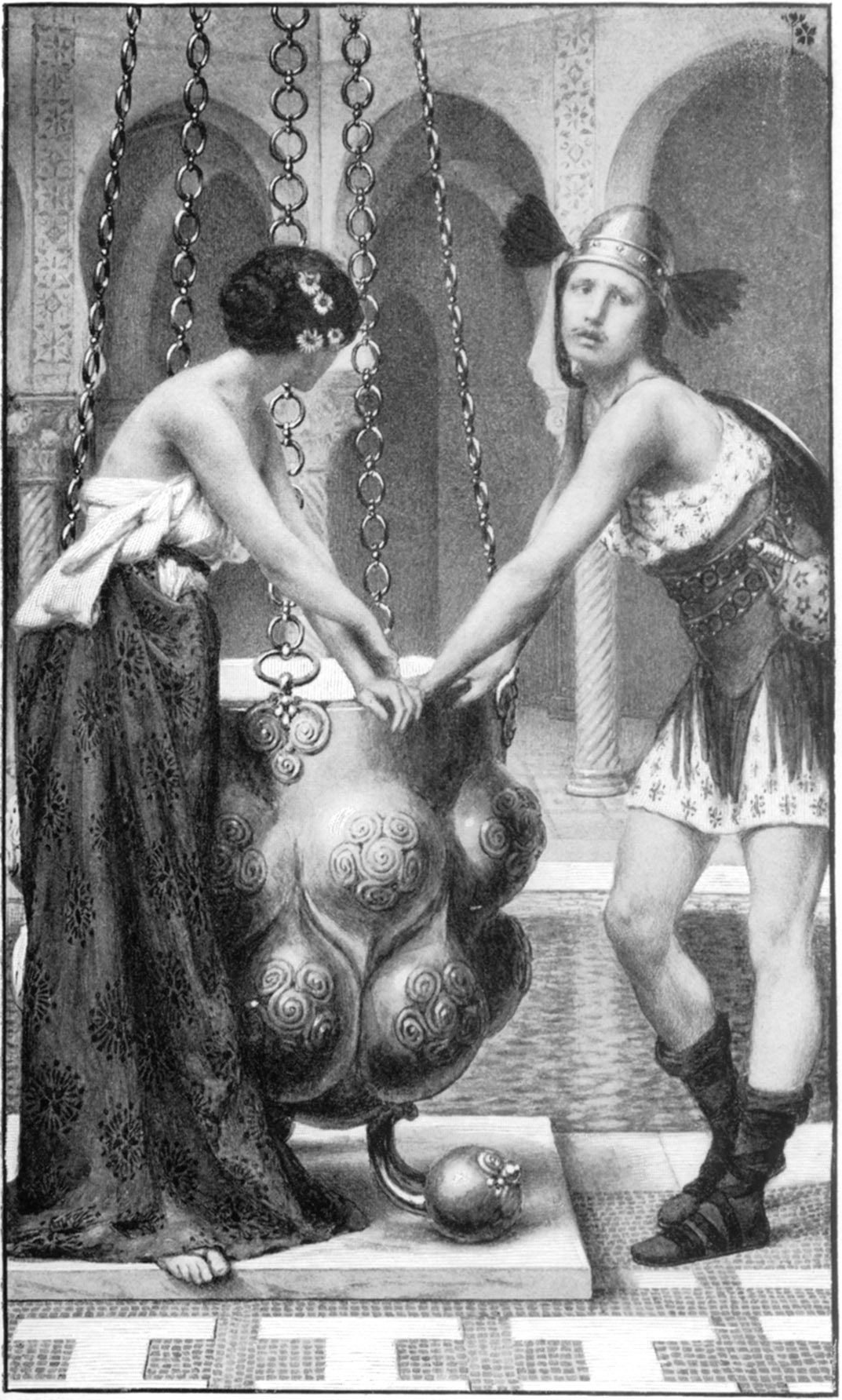
Welsh mythology is folk traditions developed in Wales and by the Celtic Britons elsewhere, according to the structured record cited below. This entry was generated automatically from that record and has not yet been reviewed by a person familiar with the tradition. 2
The source record links this tradition to 5 external registers, which can be verified through the citation. 2