The tradition & historical record
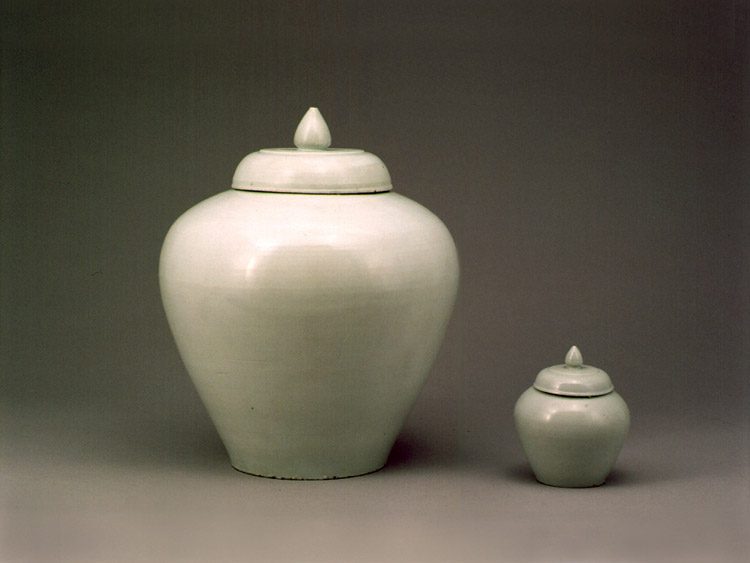
3 min read · 2 sourcesThe white porcelain lidded jar (Korean: 백자 유개항아리) refers to a pair of early Joseon Dynasty white porcelain vessels designated as 261st National Treasures of South Korea on January 25, 1991. The set comprises two jars—one large and one small—crafted with identical structural proportions and design elements. Made in the 15th to early 16th century during the peak of early royal porcelain production, these vessels are currently housed at the Leeum Museum of Art in Seoul. They represent the pristine aesthetic, structural harmony, and technical refinement of pure white porcelain produced for the Joseon royal court. 1
Specification
The pair consists of two proportional vessels distinguished primarily by their dimensions: larger Jar has an overall height of 34.0 cm (body height: 27.2 cm) with its mouth diameter of 10.1 cm, and base diameter of 13.7 cm. Smaller jar has a height of 12.5 cm (body height: 9.5 cm), mouth diameter of 4.2 cm, and base diameter of 5.7 cm. 1
Significance
White porcelains were preferred and praised over other porcelains during the time to represent Korean Confucian ethics such as frugality and pragmatism. These vessels are said to have been crafted at the official royal kilns (Bunwon-yo) located in Gwangju, Gyeonggi, specifically areas such as Usan-ri and Beoncheon-ri. Given the quality of the clay, glaze, and craftsmanship, scholars estimate that these jars were produced as ceremonial vessels or storage containers for royal court ceremonies during the 15th to early 16th century. As rare surviving examples of completion, the pair strongly reflects the quintessence of Joseon baekja, the plain white porcelain jars from the early Joseon period. 1
Forms
The jars exhibit the classic silhouette of early Joseon jars. The rim gently curves outward, leading down to a shoulder that expands rapidly before tapering softly into a smooth, elegant curve toward a stable base. Each vessel is fitted with a lid shaped like an inverted dish. The center of the lid features a stylized knob in the shape of a lotus bud. 1
Material
The jars were crafted using highly refined, high-grade white kaolin clay (백토). The glaze applied across the interior and exterior surfaces is evenly coated and carries a pale bluish tint. When combined with the underlying white porcelain body, the surface emits a soft, milk-white tone. The execution reflects advanced firing techniques, leaving a clean finish devoid of heavy decoration, highlighting the intrinsic beauty of the material. 1
The text above is adapted from the Wikipedia article “White Porcelain Lidded Jar”, available under the Creative Commons Attribution-ShareAlike 4.0 licence. 1
White Porcelain Lidded Jar is Korean cultural heritage item, according to the structured record cited below. This entry was generated automatically from that record and has not yet been reviewed by a person familiar with the tradition. 2
The source record links this tradition to 2 external registers, which can be verified through the citation. 2