The tradition & historical record
3 min read · 2 sourcesWood grain is the longitudinal arrangement of wood fibers or the pattern resulting from such an arrangement. It has various derived terms referring to different aspects of the fibers or patterns. Wood grain is important in woodworking and it impacts aesthetics. 1
Definition and meanings
Wood grain is the longitudinal arrangement of wood fibers or the pattern resulting from such an arrangement. R. Bruce Hoadley wrote that grain is a "confusingly versatile term" with numerous different uses, including the direction of the wood cells (e.g., straight grain, spiral grain), surface appearance or figure, growth-ring placement (e.g., vertical grain), plane of the cut (e.g., end grain), rate of growth (e.g., narrow grain), and relative cell size (e.g., open grain). 1
Physical aspects
Grain in growing wood follows the grown fibres of the timber and is mostly, but not entirely, longitudinal to the trunk of the tree. This can be influenced in branches, where the effect of gravity on the branch can distort the regularity of timber structure, compared to a vertical trunk. For this reason, branch wood is often not usable, or is of less value. 1
Growing
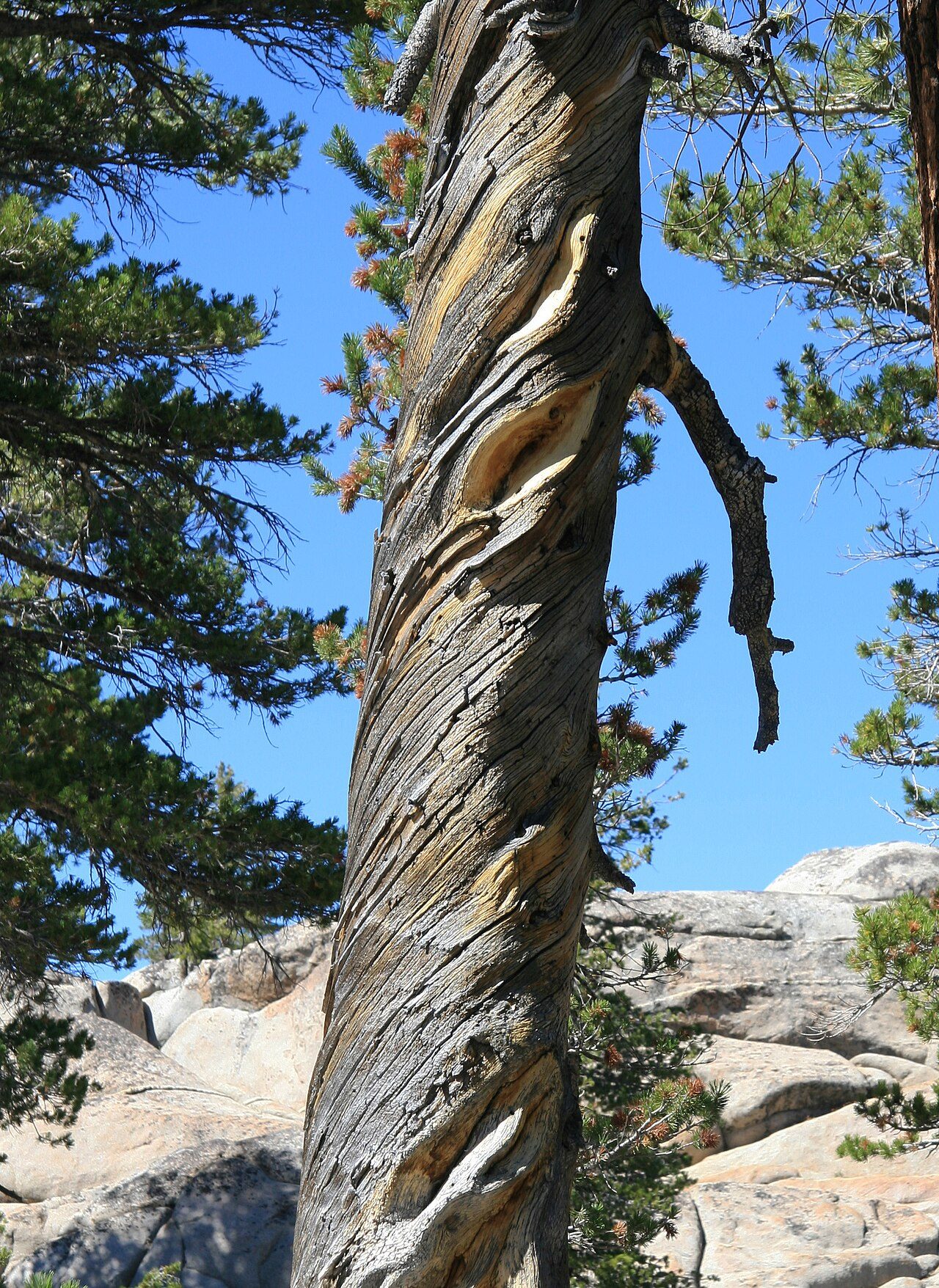
In describing the alignment of the wood in the tree, a distinction may be made. Different tree species may have one of the following basic grain descriptions and types: straight - grain which runs in a single direction, parallel to the axis of the tree. spiral - grain which spirals around the axis of the tree. interlocked - grain which spirals around the axis of the tree, but reverses its direction for periods of years resulting in alternating directions of the spiral grain. On quartersawn surfaces the change in grain direction creates a ribbon stripe figure. wavy - grain which grows in a wavy fashion up the trunk; seen best in flatsawn sections of wood. irregular - grain that swirls or twists. It can be found in a number of different patterns. This can be caused by factors such as knots, burls or "crotch" wood - where large branches separate from the trunk. 1
Aesthetic
In most timber, the grain of the timber is not the primary aesthetic feature. This is instead the figure of the timber, which is produced by the annual growth rings. In most timber, especially deciduous hardwoods, this is much more visible than the grain. 1
Mechanical strength
The two categories of grain in a piece of sawn timber are straight grain or long grain and cross grain or short grain. Straight grain runs parallel to the longitudinal axis of the piece. Cross grain deviates from the longitudinal axis in two ways: spiral grain or diagonal grain. The amount of deviation is called the slope of the grain. Bulk timber is much stronger along the grain, so a finished piece with long grain will be much stronger than one with short grain. Much of joinery is about techniques to manage this and to avoid having pieces with short grain. Furniture, especially chairs, has developed traditional designs to resist breakage by careful orientation of the grain. In shipbuilding, curved construction is often needed and so knees would be chosen when growing, from branches or branch junctions with a trunk, and then these could be incorporated into a design to match their natural curved grain to the curve of the finished component. 1
The text above is adapted from the Wikipedia article “Wood grain”, available under the Creative Commons Attribution-ShareAlike 4.0 licence. 1
wood grain is alignment and texture of the fibres in wood, according to the structured record cited below. This entry was generated automatically from that record and has not yet been reviewed by a person familiar with the tradition. 2
The source record links this tradition to 4 external registers, which can be verified through the citation. 2