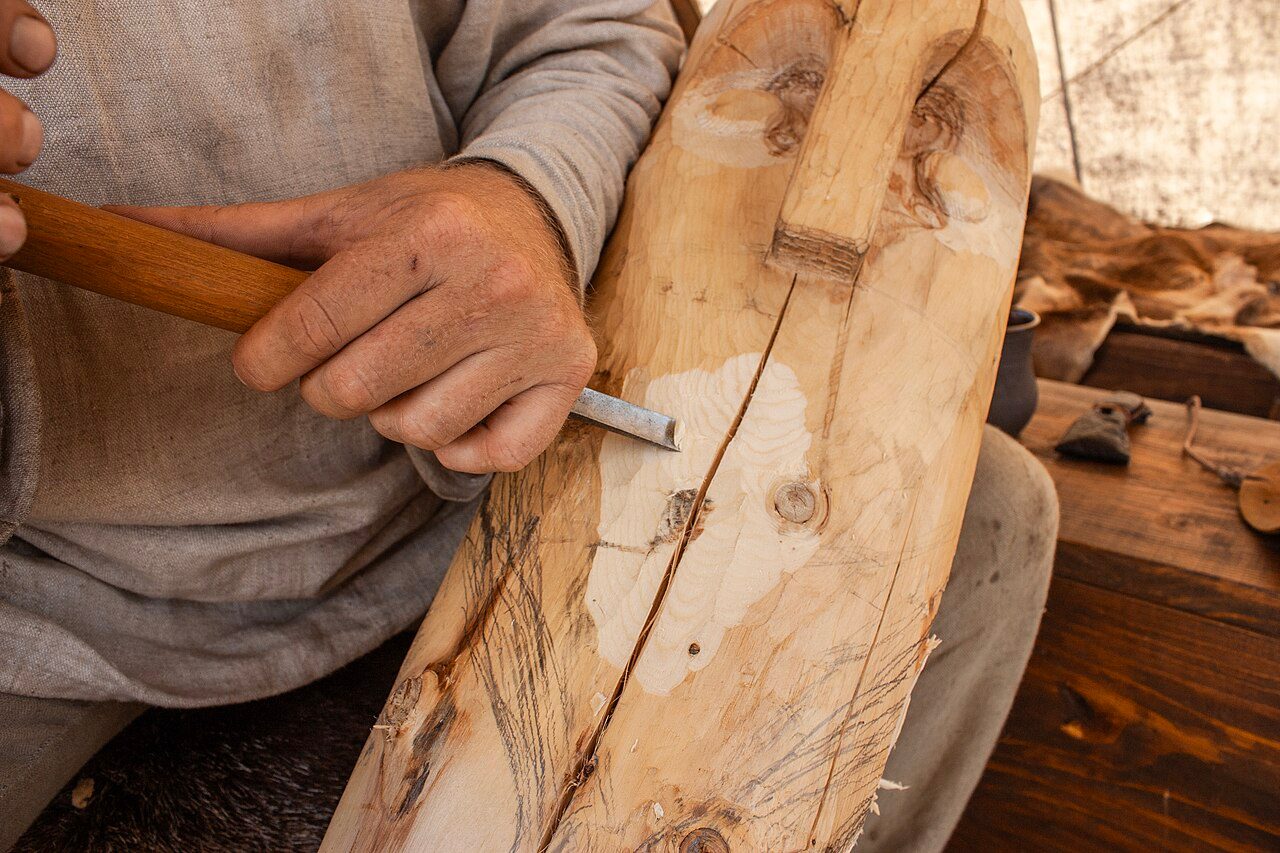
The tradition & historical record
5 min read · 2 sourcesWoodworking is the skill of making items from wood, and includes cabinetry, furniture making, wood carving, joinery, carpentry, and woodturning. 1
History
Along with stone, clay, and animal parts, wood was one of the first materials worked by early humans. Microwear analysis of the Mousterian stone tools used by the Neanderthals show that many were used to work wood. The development of civilization was closely tied to the development of increasingly greater degrees of skill in working these materials. Among the earliest finds of woodworking are shaped sticks displaying notches from Kalambo Falls in southern Africa, dating to around 476,000 years ago. The Clacton spearhead from Clacton-on-Sea, England, dating to around 400,000 years ago, the Schöningen spears, from Schöningen (Germany) dating around 300,000 years ago and the Lehringen spear from northern Germany, dating to around 120,000 years ago, provide some of the first examples of wooden hunting implements. Wooden tools likely used for domestic activities including probable awls have also been found at Schöningen. Flint tools were used for carving. Since Neolithic times, carved wooden vessels are known, for example, from the Linear Pottery culture wells at Kückhofen and Eythra. Examples of Bronze Age woodcarving include tree trunks worked into coffins from northern Germany and Denmark and wooden folding-chairs. The site of Fellbach-Schmieden in Germany has provided fine examples of wooden animal statues from the Iron Age. Wooden idols from the La Tène period known from a sanctuary at the source of the Seine in France. 1
Ancient Egypt
There is significant evidence of advanced woodworking in ancient Egypt. Woodworking is depicted in many extant ancient Egyptian drawings, and a considerable amount of ancient Egyptian furniture (such as stools, chairs, tables, beds, chests) have been preserved. Tombs contain a large collection of these artifacts, and the inner coffins found within them were also made of wood. The metal used by the Egyptians for woodworking tools was originally copper and eventually, after 2000 BC, bronze, as iron working was unknown until much later. Each metal used over time for woodworking was harder and more able to hold an edge than the one used prior. Commonly used woodworking tools included axes, adzes, chisels, pull saws, and bow drills. Mortise and tenon joints are attested from the earliest Predynastic period. These joints were strengthened using pegs, dowels and leather or cord lashings. Animal glue came to be used only in the New Kingdom period. Ancient Egyptians invented the art of veneering and used varnishes for finishing. However, the composition of these varnishes is unknown. Although different native acacias were used, as was the wood from the local sycamore and tamarisk trees, deforestation in the Nile valley resulted in the need for the importation of wood, notably cedar, but also Aleppo pine, boxwood and oak, starting from the Second Dynasty. 1
Ancient Rome
Woodworking was essential to the Romans. It provided material for buildings, transportation, tools, and household items. Wood also provided pipes, dyes, waterproofing materials, and heat.Although most examples of Roman woodworking have been lost, the literary record preserved much of the contemporary knowledge. Vitruvius dedicates an entire chapter of his De architectura to timber, preserving many details. Pliny, while not a botanist, dedicated six books of his Natural History to trees and woody plants, providing a wealth of information on trees and their uses. 1
Ancient China
The progenitors of Chinese woodworking are considered to be Lu Ban (魯班 pinyin: Lǔbān) and his wife Lady Yun, from the Spring and Autumn period (771 to 476 BC). Lu Ban is said to have introduced the plane, the chalk line, and other tools to China. His teachings were supposedly left behind in the book Lu Ban Jing (魯班經, "Manuscript of Lu Ban")(魯班經 pinyin: Lǔbān jīng). Despite this, it is believed that the text was written some 1500 years after his death. This book is largely filled with descriptions of dimensions for building various items, such as flower pots, tables, altars, etc., and also contains extensive instructions on Feng Shui. It mentions almost nothing of the intricate glue-less and nail-less joinery for which Chinese furniture was so famous. 1
Modern day
With advances in technology and industry demands, the field of woodwork has changed. The development of Computer Numerical Control (CNC) machines, for example, has made it possible to mass-produce and reproduce products faster, with less waste, and often with more complex designs than ever before. CNC wood routers can carve complicated and highly detailed shapes into flat stock to create signs or art. Power tools have increased the efficiency of the manufacture of woodworking projects and require less physical strength than the hand tools used in the past. Skilled fine woodworking, however, remains a craft pursued by many. There remains demand for handcrafted work such as furniture and art; however, due to production rates and costs, consumer prices are higher. Modern wood carving usually refers to works of wood art produced by woodcarvers as contemporary art. This type of woodcarving often combines traditional techniques with more modern artistic styles and concepts. Modern woodcarving can be produced in a variety of forms and styles, from realistic to abstract, and often uses unusual woods, such as rain tree or woods with unique textures, to highlight the work's uniqueness. In recent years, the art of modern woodcarving has become increasingly popular among woodworkers and visual art enthusiasts worldwide. Modern woodcarving art is often exhibited in art galleries and museums, and can be seen in several global contemporary art exhibitions. 1
The text above is adapted from the Wikipedia article “Woodworking”, available under the Creative Commons Attribution-ShareAlike 4.0 licence. 1
woodworking is process of making objects from wood, according to the structured record cited below. This entry was generated automatically from that record and has not yet been reviewed by a person familiar with the tradition. 2
The source record links this tradition to 34 external registers, which can be verified through the citation. 2