The tradition & historical record
4 min read · 2 sourcesThe wrapper, lappa, or pagne is a colorful garment widely worn in West Africa by both men and women. It has formal and informal versions and varies from simple draped clothing to fully tailored ensembles. The formality of the wrapper depends on the fabric used to create or design it. 1
West African kaftan/boubou
In West Africa, a kaftan or caftan is a pull-over woman's robe. In French, this robe is called a boubou, pronounced boo-boo. The boubou is the traditional attire in many West African countries including Senegal and Mali. The boubou can be formal or informal attire. The formality of the kaftan depends upon the fabric used to create or design it. 1
Wrappers
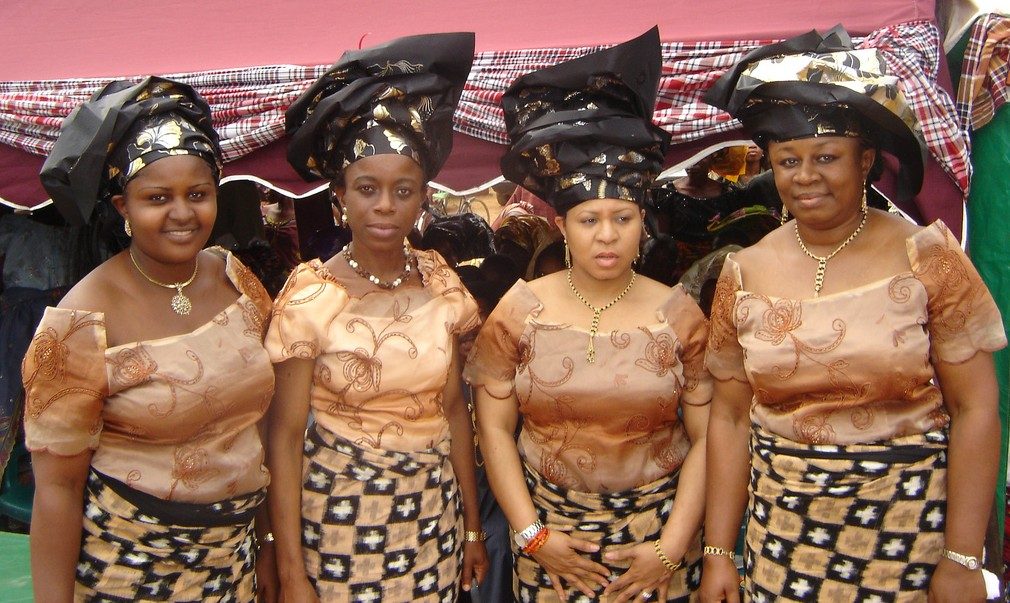
In the Nigerian context, the Igbos call it akwa or ogodo and are mostly worn in double set by married women with their ịchafụ (and with various names such as Igbo hollandaise, African wax, depending on the product) during eventful occasions and for different purposes such as age grade and association uniforms, wedding ceremonies, chieftaincy title taking, women monthly meetings, burial ceremonies, church activities, August meeting , etc. In Yorubaland, the wrapper is commonly called an iro in Yoruba, pronounced ee-roe. The literal translation is "the act of wrapping." The wrapper is usually worn with a matching headscarf or head tie that is called a gele in Yoruba, pronounced geh-leh. A full wrapper ensemble consists of three garments, a blouse, called a buba, pronounced boo-bah, the iro and a headscarf called a head tie called gele in Yoruba. Traditional male attire is called a agbada. 1
Pagne
Pagne (French: [paɲ]) designates a certain cut (two by six yards) and type (single-sided "fancy" or double-sided "wax" prints) of untailored cotton textile, especially in Francophone West and Central Africa. Enormously popular in much of tropical Africa, the pagne cloth's usage and patterns may be used to convey by the wearer a number of social, economic—and sometimes even political—messages. It is similar—though distinct in size, expected pattern, and usage—to the Khanga, Kikoy or Chitenge of East and Southern Africa. From the pagne any number of garments may be created (the boubou, dresses, or western style suits) or it can be used untailored as a wrap, headtie, skirt, or tied as a sling for children or goods. The word pagne, likely derived from the Latin pannum, was a term introduced by merchants from the 16th Century and adopted by several African societies to identify often pre-existing textiles or garments distinct from a simple cloth. The Portuguese pano for cloth has become the French pagne , Dutch paan, and others. It appears to have originally referred to East Asian textiles traded in East and West Africa, before becoming a term for a certain length (a yard, later two by six yards) of commercial printed cloth sold in coastal West Africa. 1
In the West
In the UK and North America, wrapper is also an older term for an informal house garment. Today, words such as housecoat and bathrobe (US) or dressing gown (UK) are usually employed instead. 1
Informal fabrics
Batik—created with hot wax and dye. Fancy print—created by printing patterns on cloth. Unlike expensive wax prints, the design is printed on one side of the cotton fabric. Fancy prints are made in Europe, India, and West Africa. The most popular fancy print is known as the traditional print. Kente—traditionally woven by men. Kente is an informal fabric for anyone who is not a member of the Akan people. For Akans and many Ewes, kente is a formal cloth. Mudcloth—created by making mud drawings on cotton. Tie-dye—made by resist tying cotton then dipping in dye. In Nigeria, tie-dye is known as adire cloth. 1
The text above is adapted from the Wikipedia article “Wrapper (clothing)”, available under the Creative Commons Attribution-ShareAlike 4.0 licence. 1
Wrapper is West African dress, according to the structured record cited below. This entry was generated automatically from that record and has not yet been reviewed by a person familiar with the tradition. 2
The source record links this tradition to 1 external register, which can be verified through the citation. 2