The tradition & historical record
7 min read · 2 sourcesA wrestling mask is a fabric-based mask that some professional wrestlers wear as part of their in-ring persona or gimmick. Professional wrestlers have been using masks as far back as 1915 and they are still widely used today, especially in Mexican lucha libre. 1
History
At the 1865 World's Fair, Thiebaud Bauer debuted the mask, wrestling as "The Masked Wrestler" in Paris, France. He continued wrestling using the mask throughout France as part of a circus troupe in the 1860s before moving on to the United States in the early 1870s. On December 14, 1874, The Charlotte Democrat reported on an interesting story from Bucharest Romania about an open challenge made by local wrestler, Jules Rigal being accepted by a gentleman wishing to remain anonymous. The gentleman was a masked wrestler named "The Great Unknown", and rumored to have been Prince Stourja, a Moldavian nobleman with a reputation of Herculean strength. The success of this match lead to the several successful nightly rematches between the two opponents. One night a talkative member of the troupe let it slip that "The Great Unknown" was another clown from this circus. The Bucharest crowd became aware of this and lead to a disturbance that cause "The Great Unknown", the manager, and their troupe to narrowly escape being torn apart by the crowd. The police succeeded in suppressing what seemed to be a serious riot brewing that night. This event was the earliest documented masked wrestler in Romania and the earliest pro wrestling riot. On Saturday, February 21, 1891, San Antonio's The Light reported on an upcoming wrestling event being held at San Antonio's historic Washington Theatre: "There will be a large crowd at the Washington theatre next Monday night to witness Christol wrestling with the masked unknown. Who the masked wrestler is, nobody knows, but that he is very expert, there can be no doubt." In 1915, Mort Henderson started wrestling as the "Masked Marvel" in the New York area making him the second earliest North American wrestler to perform with such a gimmick. 1
US and Canada
Many wrestlers have had very successful careers while masked such as The Destroyer/Dr. X, Mr. Wrestling, Masked Superstar and the Spoiler. In the days where professional wrestling was more regional, with less national television coverage, it was not uncommon for more than one person or team to use the same gimmick and mask, and there have at times been several masked "Interns", "Assassins" and "Executioners" working simultaneously. Tag team wrestling has seen more masked teams, using identical masks to create unity between wrestlers. Successful masked teams include the Masked Assassins, Blue Infernos and the Grapplers. 1
One of the best-known North American masked wrestlers was Big Van Vader, who was also known for his in-ring agility despite his large frame during the 1980s and 1990s. Other notable examples are Rey Mysterio, Mankind, Kane, Doom, Edge and Christian as 'Los Conquistadores', and Owen Hart as 'Blue Blazer'. Today, masked wrestlers are not a common sight in the United States and Canada, but masked wrestlers have a long history in that region, dating back to 1891. A mask sometimes will be used by a well known wrestler in a storyline where they must get around various "stipulations" or betray a trust without revealing their true identity. For instance wrestlers who are suspended in a storyline return under a mask under another name, usually with it being very obvious who is under the mask. Examples of this include: Hulk Hogan as Mr. America, Dusty Rhodes as The Midnight Rider, André the Giant as Giant Machine, Brian Pillman as The Yellow Dog, The Miz as The Calgary Kid, Dan Marsh as Mr. X, and Bo Dallas as Mr. NXT. 1
Lucha libre
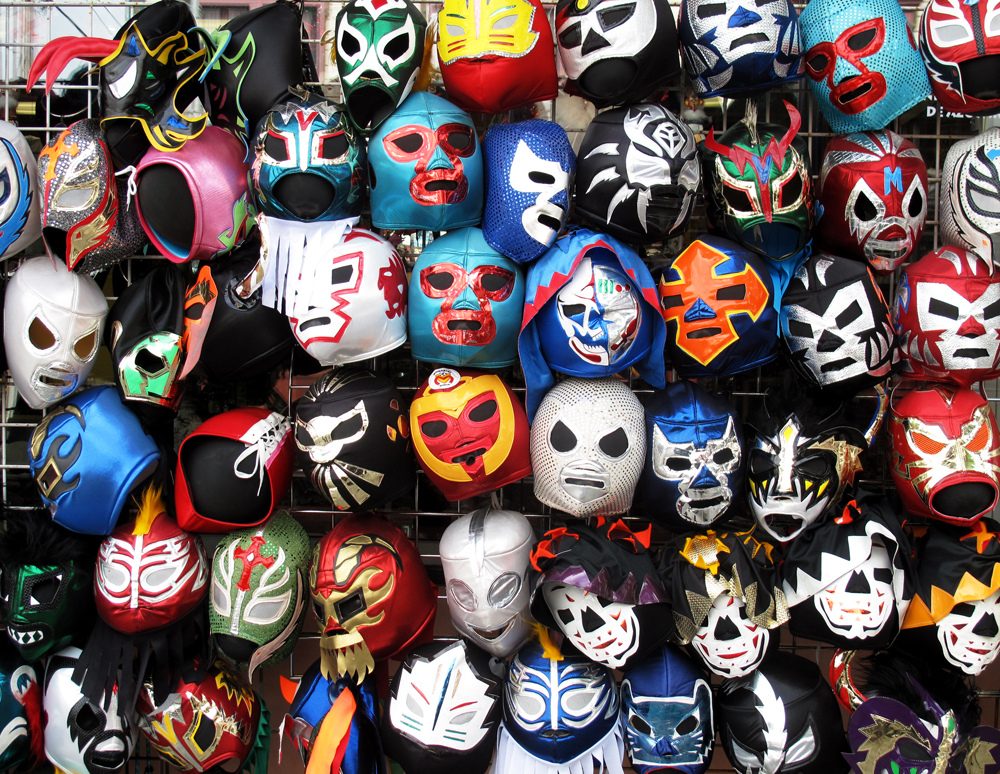
When I put on the mask, I'm transformed. The mask gives me strength. The mask gives me fame. The mask is magical. When I remove the mask, I'm a normal human who can walk right by you, and not even get a "hello". Usually with the mask on, everything is positive. Without the mask I'm a normal being who has his problems, who cries, who sometimes suffers. I could tell you that I really admire El Hijo del Santo. But do you know who I admire more? The human being. Thanks to him, El Hijo del Santo has a life. And this human being sometimes sacrifices a lot to give this other identity life. The luchador mask, known as a mascara in Spanish, "draws from Mexican history in which Mayans and Aztecs warriors [sic] would complete for superiority". The style of the masks represent "animals, gods, mythological figures and other elements of Mexican folklore". "The mask is the luchador's identity, both in and out of the ring. Luchadores will keep their faces and real names a secret throughout their entire lives; some of the more iconic luchadores have even been buried in their mask." WWE hall of famer El Santo is one of the most iconic luchadores. He "helped fuel the growth and reputation of lucha libre throughout the world". "WWE Hall of Famer Eddie Guerrero once wrote that 'Calling him a legend doesn't even do justice to how big he was. In his heyday, Santo was bigger than Hulk Hogan and 'Stone Cold' Steve Austin combined.'" The Mexican fanbase took to the mystery of the masked man and soon after, Mexican wrestlers themselves started wearing masks, becoming enmascarados. Early masks were simple with strong, basic color designs that could be recognized even in the back row of the arena. 1
Luchas de Apuestas
In lucha libre, the highest achievement is not winning a championship but winning the mask of an opponent in a lucha de apuesta, a "bet fight" where each wrestler bets their mask. The lucha de apuesta is usually seen as the culmination of a long and heated storyline between two or more wrestlers, with the winner getting the "ultimate victory". It is customary for the loser of such a match to reveal his real name, where he is from and how long he has been a wrestler before taking the mask off to show his face. Unmasked wrestlers will wager their hair instead, risking having his or her head shaved bald in case of defeat. There can be several reasons to book a lucha de apuesta beyond the obvious purpose of elevating the winner. If the loser is a younger wrestler, then the loss of the mask can sometimes lead to a promotional push after unmasking, or the wrestler being given a new ring persona. Older wrestlers often lose their masks during the last couple of years of their career, often for a big payday depending on how long and successful a career they have had; the more successful the wrestler that is unmasked, the bigger the honor for the winner. The first lucha de apuesta was presented on July 14, 1940, at Arena México. The defending champion Murciélago was so much lighter than his challenger Octavio that he requested a further condition before he would sign the contract: Octavio would have to put his hair on the line. 1
Japanese wrestling
The Destroyer, an American, was the first masked wrestler to work in Japan during the 1960s but remained a novelty with very few Japanese wrestlers choosing to… 1
The text above is adapted from the Wikipedia article “Wrestling mask”, available under the Creative Commons Attribution-ShareAlike 4.0 licence. 1
wrestling mask is professional wrestling ring gear, according to the structured record cited below. This entry was generated automatically from that record and has not yet been reviewed by a person familiar with the tradition. 2
The source record links this tradition to 1 external register, which can be verified through the citation. 2