The tradition & historical record
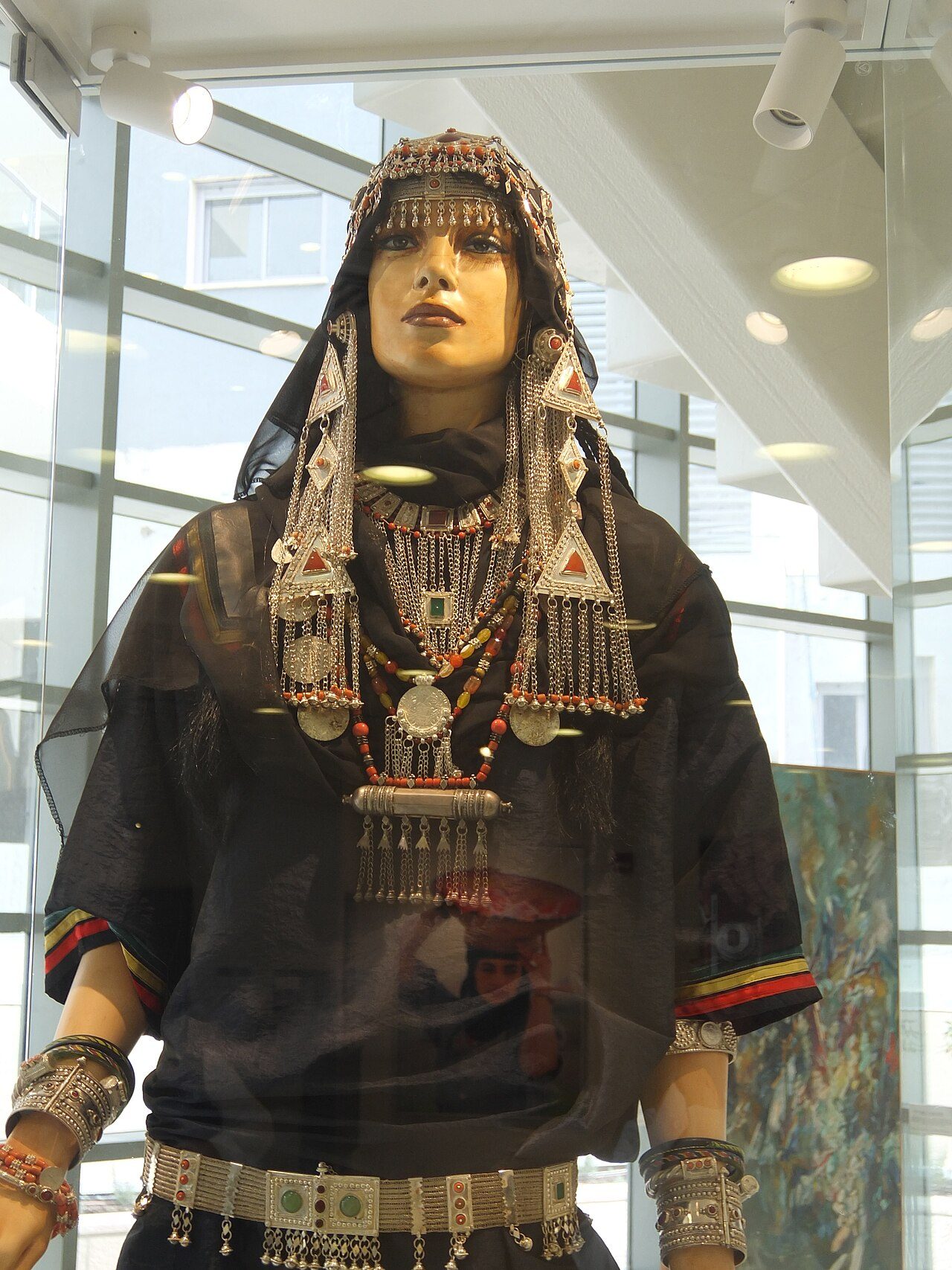
6 min read · 2 sourcesYemenite silversmithing refers to the work of Jewish silversmiths from Yemen. They were highly acclaimed craftsmen who dominated craft production in precious metals in the southern Arabian peninsula from at least the 18th through the mid-20th century, a period and region during which Muslims did not engage in this work. These Yemenite silversmiths were noted for their skilled use of fine granulation and filigree, producing ornaments such as women's bracelets, necklaces, finials, as well as elaborate scabbard sheaths for men's daggers (janbīya). 1
History
Yemenite silversmiths, a trade held almost exclusively by Jews living in the traditional Yemeni society, were active from at least as far back as the mid-1700s. The largest clientele for jewellery made of gold and silver were women, and the amount of jewellery worn was often an indicator of the woman's status. Some Yemenite silversmiths migrated to Palestine in the late 1800s, a migration that continued in the early 1900s. In the early 20th century, the Bezalel Academy of Arts and Design employed many Yemenites in the production of fine silver jewellery. Between June 1949 and September 1950, almost the entire Jewish community in Yemen, including nearly every silversmith in the country, immigrated to Israel in an airborne mass migration known as Operation Magic Carpet. Muslims appear to have entered silversmithing in Yemen in the mid-1900s, as Yemenite Jews departed for Israel. Mass-produced gold and silver jewellery began to be imported into the Yemen in the 1930s, and dominated the market by the end of the 20th century, causing traditional silversmithing to dwindle. 1
According to Mark S. Wagner, Professor of Arabic literature and Islamic Law at Louisiana State University, it is difficult to say how silver- and gold-smithing came to be regarded as occupations that were too impure for Muslims in the Yemen to engage in. Jewish silversmiths in this region sometimes moonlighted as dentists, since their jeweler's pliers could be used to draw teeth. 1
Styles and silver content
Yemenite silver-work is noted for its intricate use of filigree and fine granulation. Jewellery containing a high silver content was called ṭohōr by local Jews, or muḫlaṣ in Arabic, and referred to jewellery whose silver content ranged from 85 to 92 percent, while the rest was copper. In Sana'a, Jewish silversmiths routinely made use of the Maria Theresa thaler by remelting it. The less wealthy inhabitants of the cities and the rural regions, as well as Bedouins, would routinely order jewellery whose silver content was lower, up to 60 percent silver, the remainder being copper, and which was known by the name fuḍah ('silver' in Arabic). Even lower quality silver was called niṣfī, a word having the connotation of "half," implying that it was made half of silver and half of copper. 1
Labbe necklaces
Among the variety of jewellery known in Yemen, the labbe (ornate bib-necklace) is the most impressive in its complexity. A highly skilled work of Jewish silversmiths, it is a testimony of exquisite craftsmanship, requiring painstaking work and a developed artistic sense, expressed by the harmonious and aesthetic blend of its many parts. The labbe is a popular piece of jewellery among Jewish and Muslim women alike. In Arabic, the name labbe indicates the sunken place beneath the Adam's apple on the neck, where it is worn. Labbe necklaces made of applied filigree, being open and airy like the interlaced net of a spider's web, became more popular during the Ottoman conquest of Yemen in the mid-19th century, and were given the name labbat šabek in Sana'a, after its technique. Until then, most were prepared by using casting techniques, and embossing and fashioning from solid pieces. Only a few were made from silver. The labbe is traditionally made from dozens of components arranged in horizontal rows, or storeys (projected lines). The top row forms the base of the necklace, with connecting parts (usually serial pendants) densely strung upon a cotton or silk thread, extending downwards lengthwise, in identical columns forming the horizontal lines. It consists of one or more rows of parts, whose shapes are varied: diamond-shaped rhomboids, squares and rectangles, round beads or rosettes. Most contain smooth plates of metal, in circular and diamond-shaped (rhombus) forms, and are studded with jewels called in Arabic zihreh, meaning, pearls, amber, corals and colored glass. The artisans would also lavishly apply decorations made from small, rounded silver granules. Coin pendants are characteristic of the labbe necklaces worn by villagers. 1
Scabbards for men's daggers
Traditionally, most non-Jewish Yemeni men wear a characteristic dagger (janbīya) with elaborate handles attached to their belt. The scabbards are made from wood and covered with leather, and if the bearer can afford it, the scabbards are adorned with an elaborate silver or even a gilded cover. Mainly produced in Sanaa, but also with regional variations, there are two main forms, the 'asīb worn by tribesmen in the middle of their body, and the thūma (plural thūwam), worn at the right side by members of the former leading classes, the Saiyids and the Qadis. The upper part of these scabbards is often decorated with a broad metal band or collar, called the locket, usually crafted of silver, engraved or pierced in scrollwork patterns or studded with small granules or glass beads in geometric patterns. At the lower end, the scabbard ends with a metal cap called the chape, that may prolong the scabbard's tip in a curved way almost up to the hilt. The common type of chape ends in a round knob or cone-shaped point, and they are usually made of thin silver alloy. 1
Techniques
While silver granules can also be made by dropping melted silver into cold water, in Yemen, most silversmiths used a different technique. The silver granules (šaḏir) were prepared from a silver wire, cut into small pieces, which were then covered by embers that were heated by a flame, by which they obtained their round shape. This process forms perfectly round granules, or "droplets", that were soldered onto the piece of jewellery as desired. 1
Granulation was a common form of decorative technique used in the making of rings, bracelets and large necklaces. Granulated necklaces were the most complicated to make, where the use of granulation was central. From these granules, the artisans prepared masbū'āt – the rose-like cluster consisting of seven granules, and matisū'āt – the diamond-shaped rhombus consisting of nine granules, the mulberry beads known as tūt for the choker necklace (ma'naqeh), among other items. Silver wires were made in Yemen by taking raw, unshaped silver (sabāyik in Arabic), melting it in a crucible and then pouring the melted silver into a finger-length mold made from special earth shaped like a tube. This produced ingots. Different sizes of wire were obtained by extruding the wire ingot through a steel, perforated device called mağarrah (see #Terminology). 1
The text above is adapted from the Wikipedia article “Yemenite silversmithing”, available under the Creative Commons Attribution-ShareAlike 4.0 licence. 1
Yemeni silver is silvercraft made by the Jews of Yemen, according to the structured record cited below. This entry was generated automatically from that record and has not yet been reviewed by a person familiar with the tradition. 2
The source record links this tradition to 1 external register, which can be verified through the citation. 2