The tradition & historical record
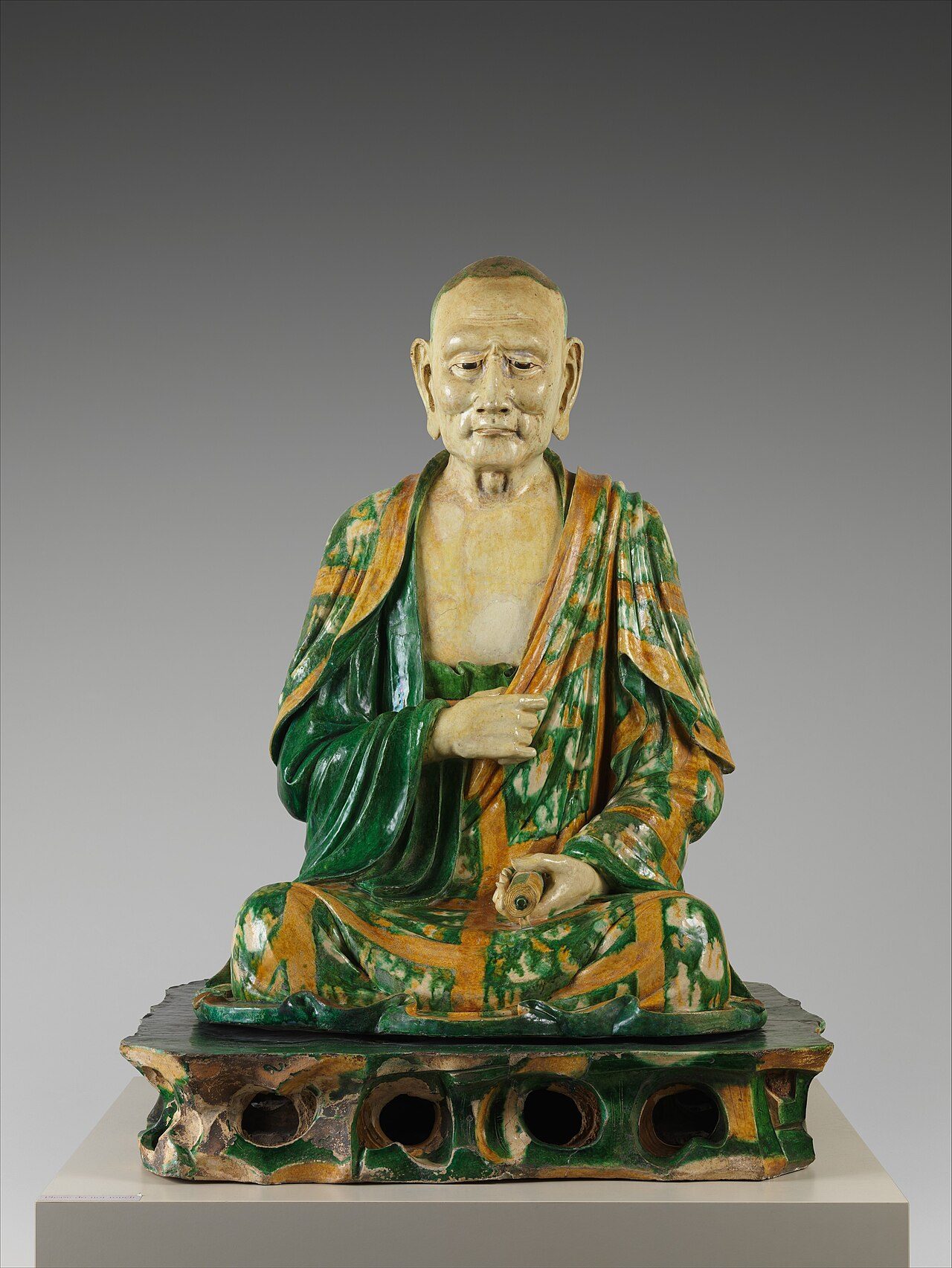
6 min read · 2 sourcesThe Yixian glazed pottery luohans are a set of life-size glazed pottery sculptures of arhats (called luohan in Chinese) now usually regarded as originating from the Liao dynasty period (907–1125). They were apparently discovered in the early 20th century in caves at Yi County, Hebei, south of Beijing. They have been described as "one of the most important groups of ceramic sculpture in the world." They reached the international art market, and were bought for Western collections. At least eight statues were originally found, including one large fragment which was thought to have been destroyed in Berlin during World War II, but was rediscovered in the State Hermitage Museum, St Petersburg, in 2001. Others are now in the following collections: the British Museum in London, two in the Metropolitan Museum of Art in New York, Royal Ontario Museum in Toronto, Museum of Fine Arts, Boston, Penn Museum, Philadelphia, Nelson-Atkins Museum of Art, Kansas City, the Musée Guimet in Paris, and the Sezon Museum of Modern Art, Karuizawa, Japan. Including the example rediscovered in Saint Petersburg, this totals ten figures. There may be fragments from the same set in other collections. The circumstances of the find, and the subsequent events as the figures reached the art market, have been the subject of much scholarly investigation, without being entirely clarified. Luohan is the Chinese term for an arhat, one of the historical disciples of the Buddha. 1
Dating
In their first years in the West the figures were usually assigned to the Tang dynasty (618–907), with some proposing various later dates in the Ming dynasty period and those of the dynasties in between. But a date in the regional Liao dynasty (916–1125 CE) came to be preferred, although in recent years they are increasingly, partly because of the results of scientific dating methods, placed in the early 12th century, which is mostly in the following Jin dynasty (1115–1234) period. Thermoluminescence dating tests of the statues in Philadelphia and New York (younger figure) produced a midpoint date of 1210, ± 100 and 200 years respectively, the midpoint being during the period of the following Jin dynasty. In 2011 Derek Gillman tentatively suggested the specific date of 1159, to match the recorded renovation of a large temple in the region, which he proposed as a candidate for their original location. In a 2013 lecture to the Oriental Ceramic Society, Gillman noted that the figures' pale coloured lips have an iron red ceramic glaze, first used on Chinese ceramics during the second half of the 12th century, arguing now that the set was created during the Shizong reign (1161–89) for the Daqingshou temple (simplified Chinese: 大庆寿寺; traditional Chinese: 大慶壽寺), a newly established, imperially commissioned Chan Buddhist temple in Beijing. An early 12th-century coin was also found inside a robe fold of the Boston figure, together with eight others including five from the 8th century; coins often remained in circulation long after they were minted. A significantly different dating is proposed by Hsu, based mainly on inscriptions on stone stelae which she connects to the figures. 1
History in the art world
The figures were reportedly in the hands of Chinese dealers who told the German sinologist Friedrich Perzynski about them in 1912, and subsequently showed him examples, some of which he bought and exported to Europe. They had apparently been found in one or more caves near Yixian, Hebei, some 100 miles south-west of Beijing in northwestern China. Perzynski claimed that he visited the cave the luohans had come from, by which time only a few fragments remained there. He described the episode in an article for Deutsche Rundschau soon after, repeating his story in a book published a few years later, but the veracity of his account has been challenged in recent years. In 1913 two figures were exhibited in Paris (without their bases), and a third (with base) was acquired by the British Museum in 1914, see Seated Luohan from Yixian. Now six figures are in museums in North America, with two surviving and one missing or destroyed in Europe, and one of the set in Japan. The Metropolitan acquired its two examples separately in 1921, by which time Boston, Philadelphia, Toronto and the Matsukata Collection in Japan already had theirs, and a further four were "owned by private collectors and dealers", so making a total of ten figures, "besides a great many small fragments, several hands and feet, and baskets full of broken pieces". The figure long thought lost from the Museum für Ostasiatische Kunst in Berlin is a head and bust length fragment, 60 cm high, of a younger man with his head turned to his left, and his shoulder bared. In his 2011 lecture Derek Gillman reported that Stanley Abe, a fellow specialist, had recently been shown it in a storeroom of the Hermitage Museum in St Petersburg. 1
Technique
The dimensions of the figures vary somewhat; taking the younger of the two in New York as an example, they are: height of the figure alone 50 in. (127 cm); including the base the height is 92 in. (233.7 cm). The base is 41 in. (104.1 cm) wide and 38 in. (96.5 cm) deep. The whole piece weighs 450 lbs (204.1 kg). The statues are assembled from several pieces of glazed terracotta (not stoneware as sometimes said), with their bases made separately, and using a combination of moulded and freely formed "slab-constructed" sections. They use the difficult sancai three-colour glazing process (here in fact often including four colours), which requires two firings. This was widely used for vessels and figures found in Tang dynasty (618–907) tombs (this set in London is a good example), but from the mid-8th century is rarely found in most of China. However the regional Liao dynasty, founded by the semi-nomadic Khitan people, continued to use the style, although normally for vessels rather than figures, and Beijing and Yixian were on the southern edge of their state, with Beijing (as "Nanjing") their southern capital. The figures, variously described as life-size or "slightly over life-size", are among the largest made with the technique and are agreed to be outstanding examples from the technical as well as the artistic point of view. 1
The text above is adapted from the Wikipedia article “Yixian glazed pottery luohans”, available under the Creative Commons Attribution-ShareAlike 4.0 licence. 1
Yixian glazed pottery luohans is set of pottery Buddhist sculptures from China, according to the structured record cited below. This entry was generated automatically from that record and has not yet been reviewed by a person familiar with the tradition. 2
The source record links this tradition to 1 external register, which can be verified through the citation. 2