The tradition & historical record
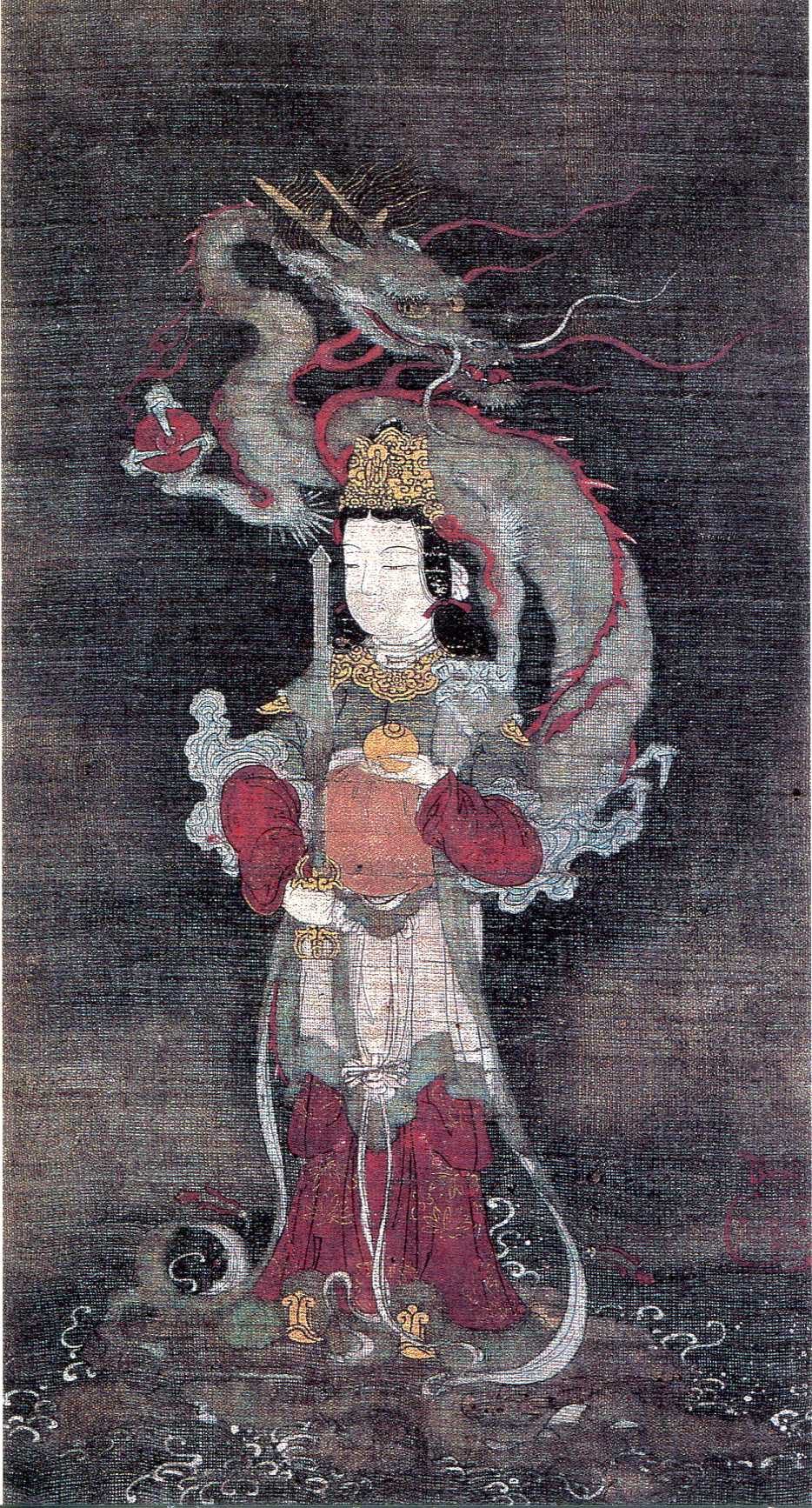
5 min read · 2 sourcesZennyo Ryūō (善如龍王 or 善女龍王; lit. "goodness-like dragon-king" or "goodness woman dragon-king", respectively) is a rain-god dragon in Japanese mythology. According to Japanese Buddhist tradition, the priest Kūkai made Zennyo Ryūō appear in 824 AD during a famous rainmaking contest at the Kyoto Imperial Palace. 1
Ryūō
The dragon name Zennyo Ryūō is written in Japanese as 善 zen "good, goodness; virtuous", 女 nyo "woman; female" or 如 nyo "like; as if; be like; thus" (differentiated with the "mouth radical" 口), and 龍王 ryūō or 竜王 "dragon king". Zennyo is a common theme in Japanese art, usually depicted as a small dragon but sometimes as a human, either male or female, with a dragon's tail. The "female" representations could explain this variant character 女 (Visser 1913:162). Fowler (1997:155) cites Nishida Nagao 西田長男 that this 女 "woman" in Zennyo was an error for the original character 如. In Japanese Buddhist terminology, nyo 如 "like; thus" is used to translate Sanskrit words like nyorai 如来 "thus come" for tathāgata. Compare shinzennyo 近善女 "near goodness female" translating upāsikā "female disciple; female devotee". Zennyo 善如 was also the name of a Jōdo Shinshū priest (1333–1389) who was a grandson of Kakunyo and the fourth chief priest of the Hongan-ji. Some legends give the name of Zennyo as Zentatsu 善達 "goodness penetration" with tatsu 達 "penetrate; arrive at; reach; realize" instead of nyo. 1
Mount Murō
Zennyo or Zentatsu 善達 supposedly lived in the Ryūketsu 龍穴 "Dragon Hole/Cave" on Murōyama 室生山 "Mount Murō" in Nara Prefecture, which was an ancient locale of Japanese dragon worship and rainmaking ceremonies. The oldest historical record is the 937 CE Ben’ichizan nenbun dosha sōjō 宀一山年分度者奏上 "Mount Murō Annual Report of Ordained Monks". It states that in 778 CE five Buddhist monks went to the mountain and ceremonially prayed for the health of future Emperor Kanmu (r. 781–806), who later established the Murō-ji Temple in appreciation. This text also states that in 781 CE, (Fowler 1997:147), "a Dragon King (龍王) who had been residing at this site vowed to protect the country and particularly the temple complex. For this gesture the dragon king was honored with a courtly rank, as was commonly offered to deities." The c. 1212–1215 CE Kojidan "Talks about Ancient Matters" specifies this dragon's name and history. 1
The dragon cave on Mt. Murō is the dwelling place of the Dragon King Zentatsu 善達. This Dragon King previously lived in Sarusawa 猿沢 pond. Long ago when a palace lady (uneme 采女) drowned in the pond, the Dragon King fled to Mt. Kōzen 高山 (Mt. Kasuga), where he lived until the corpse of a low-ranking person was thrown into this pond. Then the Dragon King again fled to reside in a cave on Mt. Murō, where the Buddhist prelate Kengyō was practicing religious austerities. Kengyō was the master of the prelate Shūen 修円. Years later the priest Nittai 日對 wished to view the venerable form of the Dragon King. He entered the dragon cave and went about three or four chō 町 in darkness. Then he arrived at a palace under a blue sky. To the south he saw a bright light through a jeweled window screen. 1
Shinsen'en
The best-known appearance of Zennyo was during an 824 CE Buddhist rainmaking competition at the Shinsen'en or Shinzen'en 神泉苑 "Divine Spring Garden" in Kyoto. The scholar priest Kūkai or Kōbō-Daishi (774–835 CE), founder of Shingon "True Word" Buddhism, and his rival priest Shubin 守敏 held a rain-sutra recitation contest. Visser (1913:25) describes the Mahamegha sutra, Japanese Daiunkyō 大雲經 "Great Cloud Sutra" or Daiun Seiukyō 大雲請雨經 "Great Cloud Praying for Rain Sutra", as the "most important of the sūtras, recited by the Northern Buddhists for causing rain in times of drought". In 823 CE, Emperor Saga (r. 809–823) put Kūkai in charge of the Tō-ji "East Temple" and Shubin in charge of the Sai-ji "West Temple". In the next year, a 3-month drought occurred and Emperor Junna (r. 823–833) ordered Kūkai and Shubin to perform rainmaking ceremonies. Zennyo is worshipped at the Zennyo Ryūō-sha 善女竜王社 Shinto shrine on an island in the Shinsen'en, reached by crossing the Hōsei-bashi 法成橋 "Dharma Completion Bridge". Some versions of this Kūkai story record Zennyo coming from Mount Murō and others from Lake Anavatapta, which is at the center of the world in Buddhist cosmology. Anavatapta was also the name of a Nāga "snake; dragon" king, a Nagaraja "Dragon King", who lived in this namesake lake. According to Mahayana tradition (Visser 1913:4), Anavatapta was one of the Hachi-ryūō 八龍王 "8 Dragon Kings" that first heard the Buddha preach the Lotus Sutra. Various early Japanese texts record legends about Kūkai invoking the rain-dragon Zennyo. The 835 CE Goyuigō 御遺告, which records Kūkai's last words, first describes Zennyo (Fowler 1997:154) as, "a golden snake measuring eight sun 寸 (approx. 24 cm) riding on the head of a dragon measuring nine shaku 尺 (approx. 2.7 m). 1
The text above is adapted from the Wikipedia article “Zennyo Ryūō”, available under the Creative Commons Attribution-ShareAlike 4.0 licence. 1
Zennyo Ryūō is rain-god dragon in Japanese mythology, according to the structured record cited below. This entry was generated automatically from that record and has not yet been reviewed by a person familiar with the tradition. 2
The source record links this tradition to 3 external registers, which can be verified through the citation. 2