The tradition & historical record
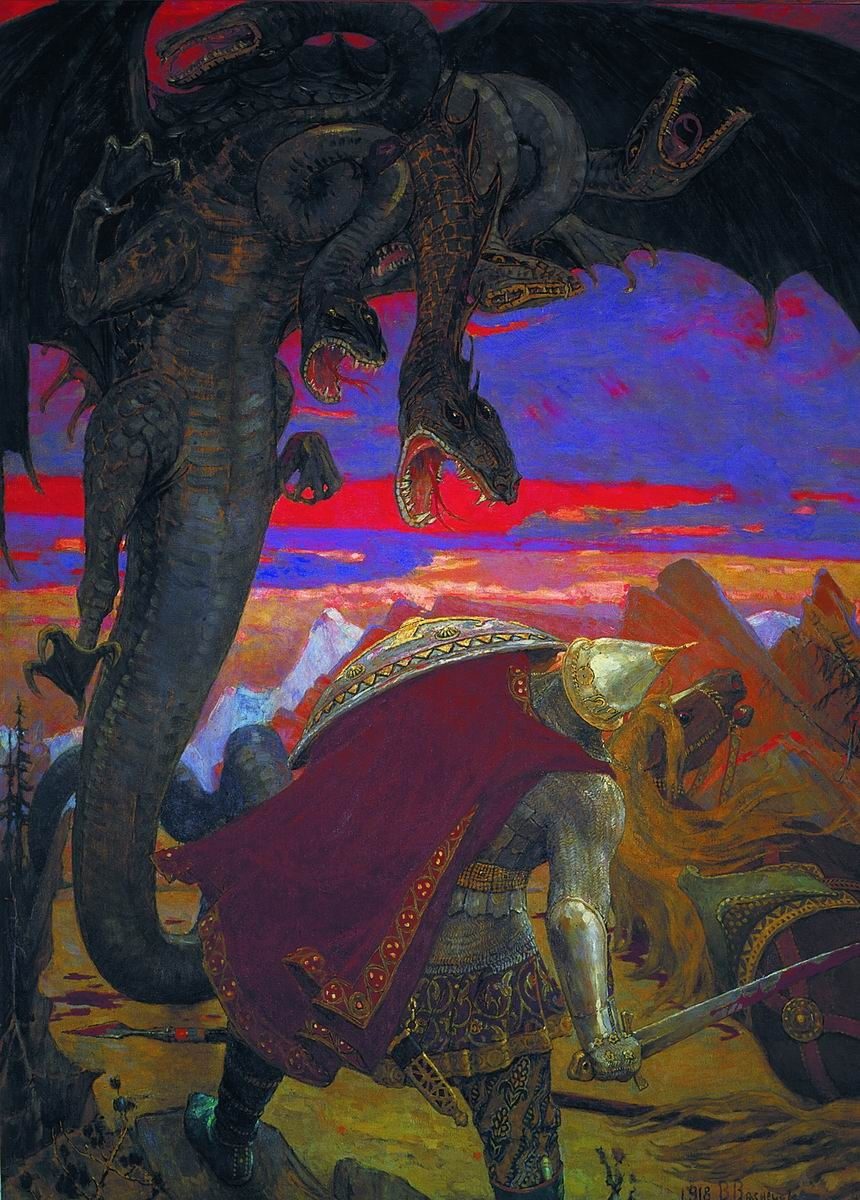
3 min read · 2 sourcesZmei m. (Russian: змей, zmej) and zmeya f. (змея́, zmejá), meaning "serpent", is a form of dragon in Russian folktales and epic poetry; sometimes, a human-like character with dragon-like traits. Two of the most famous zmei are Gorynych and Tugarin, two well-known zmei, appear as adversaries of the bogatyri (heroes) Dobrynya Nikitich or Alyosha Popovich. 1
Etymology
The Russian masculine form zmei/zmey m. (Russian: змей, zmej) and feminine form zmeya f. (змея́, zmejá) means "serpent", which is the old word for dragon in most Indo-European languages; cf. 'dragon/drake' (from Ancient Greek: δράκων, drákōn, "big serpent"), wyvern (from Latin: vīpera, "viper"; cf. French: guivre), worm (from Old English: wyrm, "slithering legless animal"; cf. lindworm; Old High German: wurm, Old Norse: ormr, Old Finnish: käärme, "serpent/dragon"), etc. Another form is zmiy (змий, zmij), borrowed from Church Slavonic: змии, zmii. 1
Nomenclature
Despite meaning serpent, when referring to dragons, the term zmei always implicitly refers to the flying kind all over Russia. The "flying serpent" (змей летающий; zmei letayushchiy) and the "fiery serpent" (змей огненный; zmei ognennyi) are given separate entries, as pan-Slavic concepts in the "Slavic Antiquities: Ethnolinguistic Dictionary" published in Russian. In addition, there is also a Russian term for a kite, vozdushnyi zmei, not to be confused with all of the above. Yet these two naturally share close similarities, for instance, they both assume serpent/dragon shape when airborne but human form on the ground, both are "mythological lovers" of women, and associated with meteorological phenomena, so the demarcation is not so clear. Other commentators refer to the former as "fiery flying serpent", so the distinction is not strictly observed. 1
General traits and appearance
The creature's appearance is not described in older Russian epic ballads, but in more recent sources, the zmei is described as being covered with either green or red scales, and having iron claws. 1
Gender
The dragon in Russian folk fiction may be female, in which case she is called zmeya (змея́). The tendency is for the prose folktale versions to have male dragons, and the epic poetry to have the females. This will affect the behavior of the dragons. For instance, only the male dragons will capture or captivate a princess or a maiden as a love interest. 1
Multiheadedness
The zmei is often depicted with multiple heads, and the number of heads may be 3, 6, 9, or 12. A three-, six-, nine-, and twelve-headed dragon are defeated on successive nights by the hero of the tale "Ivan the Peasant's Son and the Little Man the Size of a Finger" (Afanasyev #138). The twelve-headed one was hardest to kill, and although the hero beheaded it nearly completely, the last head had to be taken by six men provided to Ivan by the Tsar. 1
The text above is adapted from the Wikipedia article “Zmei (Russian folklore)”, available under the Creative Commons Attribution-ShareAlike 4.0 licence. 1
Zmei Gorynich is in Russian folktales and epic poetry, is a dragon or serpent, or sometimes a human-like character with dragon-like traits, according to the structured record cited below. This entry was generated automatically from that record and has not yet been reviewed by a person familiar with the tradition. 2
The source record links this tradition to 4 external registers, which can be verified through the citation. 2