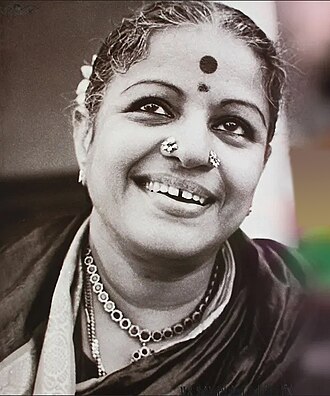
Madurai-born Carnatic vocalist and the first musician ever awarded the Bharat Ratna (1998), famed for Venkateswara Suprabhatam, Bhaja Govindam, Kurai Ondrum Illai, and Meera Bhajans.
Trained in Madurai by her mother, the veena player Shanmukavadivu Ammal, M. S. Subbulakshmi combined crystalline raga alapana and neraval precision with pan-Indian devotional repertoire in Tamil, Telugu, Sanskrit, Kannada, Malayalam, Hindi, Gujarati, and Bengali.
Her historic 1966 United Nations General Assembly concert and timeless recordings of Venkateswara Suprabhatam, Bhaja Govindam, Vishnu Sahasranamam, Hari Tum Haro, and Kurai Ondrum Illai made her a household voice across India.
Madurai-born Carnatic vocalist and the first musician ever awarded the Bharat Ratna (1998), famed for Venkateswara Suprabhatam, Bhaja Govindam, Kurai Ondrum Illai, and Meera Bhajans.
M. S. Subbulakshmi (1916–2004) is documented in connection with Carnatic Vocal & Bhakti Music.
M. S. Subbulakshmi (1916–2004) is attested in M. S. Subbulakshmi — Bharat Ratna & Ramon Magsaysay Citation (Ministry of Culture, Government of India).
Cite as: "M. S. Subbulakshmi (1916–2004)." Folkroom Archive (Artists), https://folkroom.org/artists/m-s-subbulakshmi · CC BY-SA 4.0.
What’s on this page is sourced from the citation below.
| Source | Publisher | Licence |
|---|---|---|
| M. S. Subbulakshmi — Bharat Ratna & Ramon Magsaysay Citation | Ministry of Culture, Government of India, 1998 | CC BY-SA 4.0 |
Custodians of the foundational repertoires and oral teachings in India.
Celebrated for: Venkateswara Suprabhatam, Bhaja Govindam, Vishnu Sahasranamam, Kurai Ondrum Illai, Hari Tum Haro (Meera Bhajan)...
Carrying the performance practices, bandishes, and recordings to contemporary audiences.
A free public archive of the world’s living and endangered cultural traditions — documented with primary sources, geographic coordinates, and open-licensed photography. Two rooms, one wall. The door is open.
folkroom — Archive of Living Traditions · Text CC BY-SA 4.0 · Images credited & licensed individually
Open commons: Wikimedia Commons · UNESCO ICH · Openverse · Flickr CC · Wikidata · No trackers · No ads


M. S. Subbulakshmi (1916–2004) Global Archive की पारंपरिक नृत्य और लोक नाट्य से जुड़ी एक जीवित परंपरा है। यह प्रलेख फ़ोकरूम (folkroom) सार्वजनिक अभिलेखागार में CC BY-SA 4.0 के अंतर्गत उपलब्ध है।
M. S. Subbulakshmi (1916–2004) என்பது Global Archive பகுதியைச் சேர்ந்த பாரம்பரிய நடனம் மற்றும் சடங்கு நாடகம் மரபாகும். folkroom பொது ஆவணக் காப்பகத்தில் (CC BY-SA 4.0) ஆதாரங்களுடன் பதிவு செய்யப்பட்டுள்ளது.
M. S. Subbulakshmi (1916–2004) হলো Global Archive অঞ্চলের ঐতিহ্যবাহী নৃত্য ও লোকনাট্য ধারার একটি জীবন্ত ঐতিহ্য। ফোকরুম (folkroom) উন্মুক্ত আর্কাইভে (CC BY-SA 4.0) প্রামাণ্য সূত্রসহ সংরক্ষিত।
M. S. Subbulakshmi (1916–2004) es una tradición viva de danza tradicional y teatro ritual documentada en Global Archive. Registro público de acceso abierto en folkroom (CC BY-SA 4.0).
M. S. Subbulakshmi (1916–2004) est une tradition vivante de danse traditionnelle et théâtre rituel originaire de Global Archive. Dossier documentaire en libre accès sur folkroom (CC BY-SA 4.0).
M. S. Subbulakshmi (1916–2004) é uma tradição viva de dança tradicional e teatro ritual documentada em Global Archive. Arquivo público aberto no folkroom (CC BY-SA 4.0).
M. S. Subbulakshmi (1916–2004)は、Global Archiveに伝わる伝統舞踊・民俗演劇の生きた伝統文化です。folkroom公開アーカイブ(CC BY-SA 4.0)にて一次資料とともに記録されています。
M. S. Subbulakshmi (1916–2004)은(는) Global Archive 지역에서 전승되는 전통 무용 및 의례 연희 전통입니다. folkroom 공개 아카이브(CC BY-SA 4.0)에 출처와 함께 기록되어 있습니다.
M. S. Subbulakshmi (1916–2004) adalah tradisi hidup tari tradisional dan teater ritual yang terdokumentasi di Global Archive. Arsip publik akses terbuka di folkroom (CC BY-SA 4.0).
M. S. Subbulakshmi (1916–2004) هو تقليد حي من الرقص التقليدي والمسرح الطقسي موثق في Global Archive. سجل عام مفتوح الوصول على أرشيف فولكروم (CC BY-SA 4.0).