The tradition & historical record
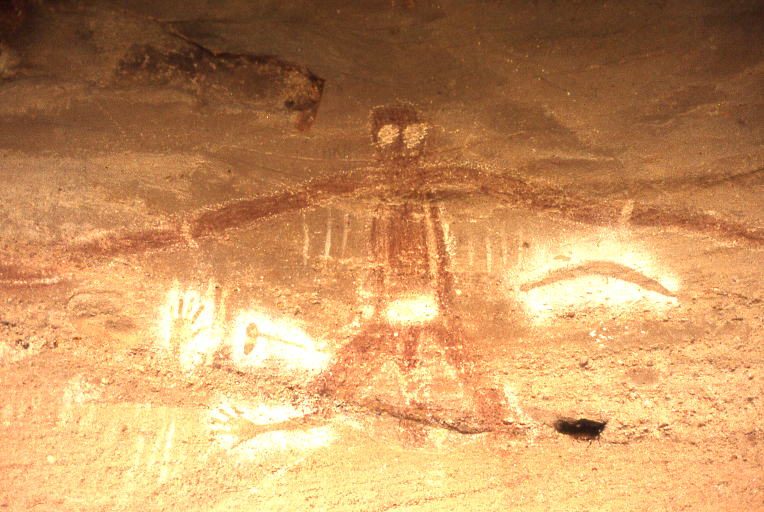
4 min read · 2 sourcesAboriginal sites of New South Wales consist of a large number of places in the Australian state of New South Wales where it is still possible to see visible signs of the activities and culture of the Aboriginal Australian peoples who previously occupied these areas. These sites are comparable with the petroglyphs of Native Americans and the Indigenous rock art found elsewhere in Australia, but are not restricted to rock carvings. Many of the sites are on the (now defunct) Register of the National Estate. 1
History and description
Aboriginal Australians arrived in the north of Australia at least 70,000 years ago, and potentially 120,000 years ago. Sites over 22,000 years old have been found in the Blue Mountains area west of Sydney, while sites going back 40,000 years exist at Lake Mungo. There are some thousands of known sites, many but not all located in national parks. Some sites are also found in more suburban settings; rock carvings can be seen in the Sydney suburbs of North Bondi and Tamarama. Their art was part of day-to-day life and would normally have had a purpose. One such purpose is thought to have been what some people call "wish fulfilment magic"—or sympathetic magic—in which the act of creating the magical work is thought to bring about the event depicted in the work. For example, a hunting scene—a common subject in rock carvings—would be aimed at bringing about the desired reality of good hunting. There were also many artworks that were created for specific ceremonial purposes and which were not intended to last after the ceremony was over. In addition to such themes, there were also works of a more secular nature, which could be created for a number of reasons, including the instruction and entertainment of children. There are substantial variations in the character of art developed in different parts of New South Wales. Art in the western part of the state could be very different from the art created in coastal areas. Aboriginal sites in the state are administered by the NSW National Parks & Wildlife Service. 1
Types of sites
It is necessary to distinguish between occupation sites and sacred sites. Not all Aboriginal sites are "sacred sites"; the reality is more complex. Before the colonisation of Australia, most Indigenous sites were occupation sites, which were used by all members of a tribe. Sacred sites, on the other hand, were restricted to adult males, except for certain women's sites. In more recent times, all Indigenous sites have become known as sacred sites; those that were previously known as sacred sites are now known as restricted sites. 1
Imitations
There are also a number of imitation sites, in which Europeans created imitations of Aboriginal art, usually in the form of rock carvings. One of the most prominent examples is a large carving of a kangaroo alongside a walking track at Grotto Point, in the Sydney Harbour National Park. This has been known for some time to be an imitation. 1
Examples
Appletree Aboriginal Area, 75 km (47 mi) north-west of Newcastle. A group of rock shelters with hand stencils and paintings of human figures. Listed on the Register of the National Estate. Baiame Cave, Milbrodale. A large rock shelter with paintings of a human figure plus objects like boomerangs. Listed on the Register of the National Estate. Bondi Golf Course, North Bondi. Contains a group of rock carvings. (A nearby group of carvings is thought to have been done by Portuguese sailors in the 18th century.) Brisbane Water National Park, Central Coast. The park contains many Aboriginal sites, notable Bulgandry on the Woy Woy Road, with many rock carvings. Garigal National Park, Sydney. A large group of rock carvings is located near Bantry Bay. Heathcote National Park, south of Sydney. Various sites are known, including a shield tree west of the Bullawarring Track, adjacent to an occupation cave, plus a group of charcoal drawings alongside Myuna Creek. Kings Tableland Aboriginal Site, Wentworth Falls. A rocky knoll is topped by a group of large grinding grooves, plus carved images of wallaby and emu tracks. On the eastern side of the hill there is an occupation cave. Koonadan Historic Site, a Wiradjuri ceremonial and burial site in the Riverina region of southern NSW. Ku-ring-gai Chase National Park, north of Sydney. Contains many sites, notably those along the Basin Track, the Echidna Track, the Cowan Track and the Red Hand Track. Mootwingee Aboriginal Site, western New South Wales. Secure waterholes made this an area for Aboriginal life. Contains galleries of paintings and carvings. 1
The text above is adapted from the Wikipedia article “Aboriginal sites of New South Wales”, available under the Creative Commons Attribution-ShareAlike 4.0 licence. 1
Aboriginal sites of New South Wales is recorded in open cultural data. The structured record cited below does not describe the practice, and this entry has not yet been reviewed by a person familiar with the tradition. 2