The tradition & historical record
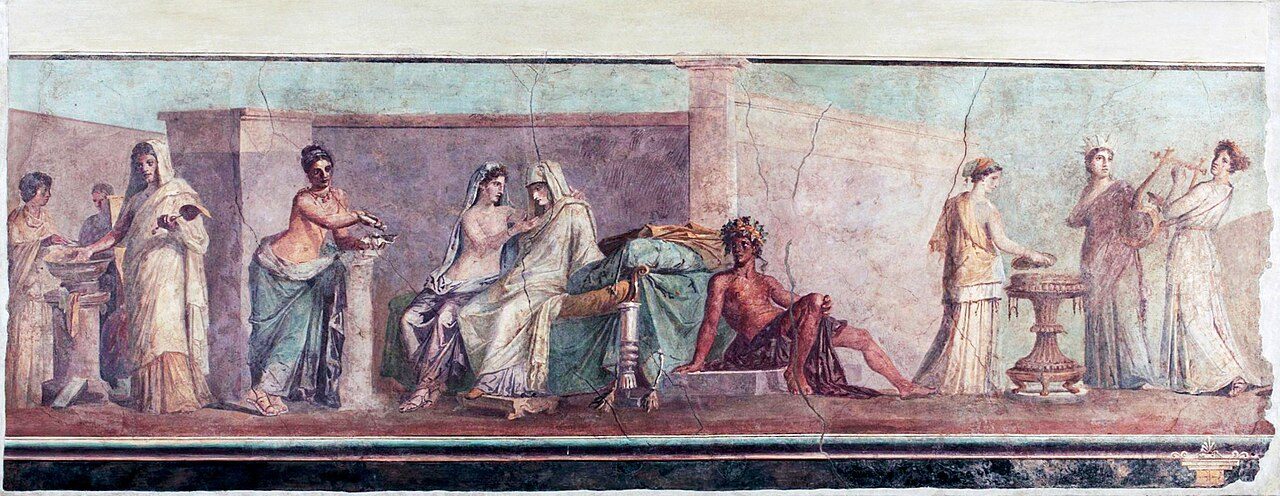
3 min read · 2 sourcesThe so-called Aldobrandini Wedding (Nozze Aldobrandini) fresco is an influential Ancient Roman painting, of the second half of the 1st century BC, on display in the Vatican Museum. It depicts a wedding along with several mythological figures. 1
History
The fresco was discovered about the year 1600 from the masonry of a house near the Arch of Gallienus on the Esquiline Hill. It was in possession of the Aldobrandini family until 1818, when it was purchased by the Vatican authorities. Until the 19th century, this was one of the few and most influential paintings from the early Roman empire, and generated much interest and scholarship, including engravings by Pietro Santi Bartoli (1635–1700), and attention by Winckelmann, Karl Böttiger, and others. There are many elaborate competing interpretations of the scene. 1
Description
The painting, broken at both ends, is part of a frieze decorating a wall in the third style of a domus of the Esquiline Hill. It did not occupy the central position of the decoration, but was at the top of the wall on which it was painted. Ten people appear in the painting, in three groups, whose action takes place both indoors and outdoors. At the left and in the middle, walls in the background indicate that the characters are indoors, while at right the background is the sky, indicating events taking place outside the same household. The threshold of the house appears between these scenes, in the lower center. In the scene on the left, a Roman matron with white cloak, veiled head and flabellum, appears to test the temperature of the water poured into a small washing lustral supported by a pedestal, from which hangs a towel and in which a maid seems to pour more water. In the background a person carries an elongated object which is not well defined, perhaps a stool. At the foot of the column is an object made of overlapping tablets, probably a cassette. In the central scene, bordered by a pillar between two walls on the left and the threshold of the house on the right, a woman wearing sandals with legs crossed (perhaps Charis, or, more likely, Peitho, goddess of persuasion) leans against a pillar, and pours essences from an alabastron over a shell supported by her left hand. On a cloth-covered bed sits the bride, with head veiled and dressed in a white coat and yellow shoes. Another female figure (Venus), bare-chested and wearing sandals, affectionately embraces the bride and raises her hand to the bride's face. 1
The text above is adapted from the Wikipedia article “Aldobrandini Wedding”, available under the Creative Commons Attribution-ShareAlike 4.0 licence. 1
Aldobrandini Wedding is Ancient Roman fresco, according to the structured record cited below. This entry was generated automatically from that record and has not yet been reviewed by a person familiar with the tradition. 2
The source record links this tradition to 7 external registers, which can be verified through the citation. 2