The tradition & historical record
6 min read · 2 sourcesAncient Greek art is the visual and applied arts, as well as the architecture, produced by the Hellenes or Greek peoples from the start of the Iron Age to the Hellenistic period, ending with Roman conquest of Greece at the Battle of Corinth in 146 BC. It stands out among that of other ancient cultures for its development of naturalistic but idealized depictions of the human body, in which largely nude male figures were generally the focus of innovation. The rate of stylistic development between about 750 and 300 BC was remarkable by ancient standards, and in surviving works is best seen in sculpture. There were important innovations in painting, which have to be essentially reconstructed due to the lack of original survivals of quality, other than the distinct field of painted pottery. Greek architecture, technically very simple, established a harmonious style with numerous detailed conventions that were largely adopted by Roman architecture and are still followed in some modern buildings. It used a vocabulary of ornament that was shared with pottery, metalwork and other media, and had an enormous influence on Eurasian art, especially after Buddhism carried it beyond the expanded Greek world created by Alexander the Great. 1
Pottery
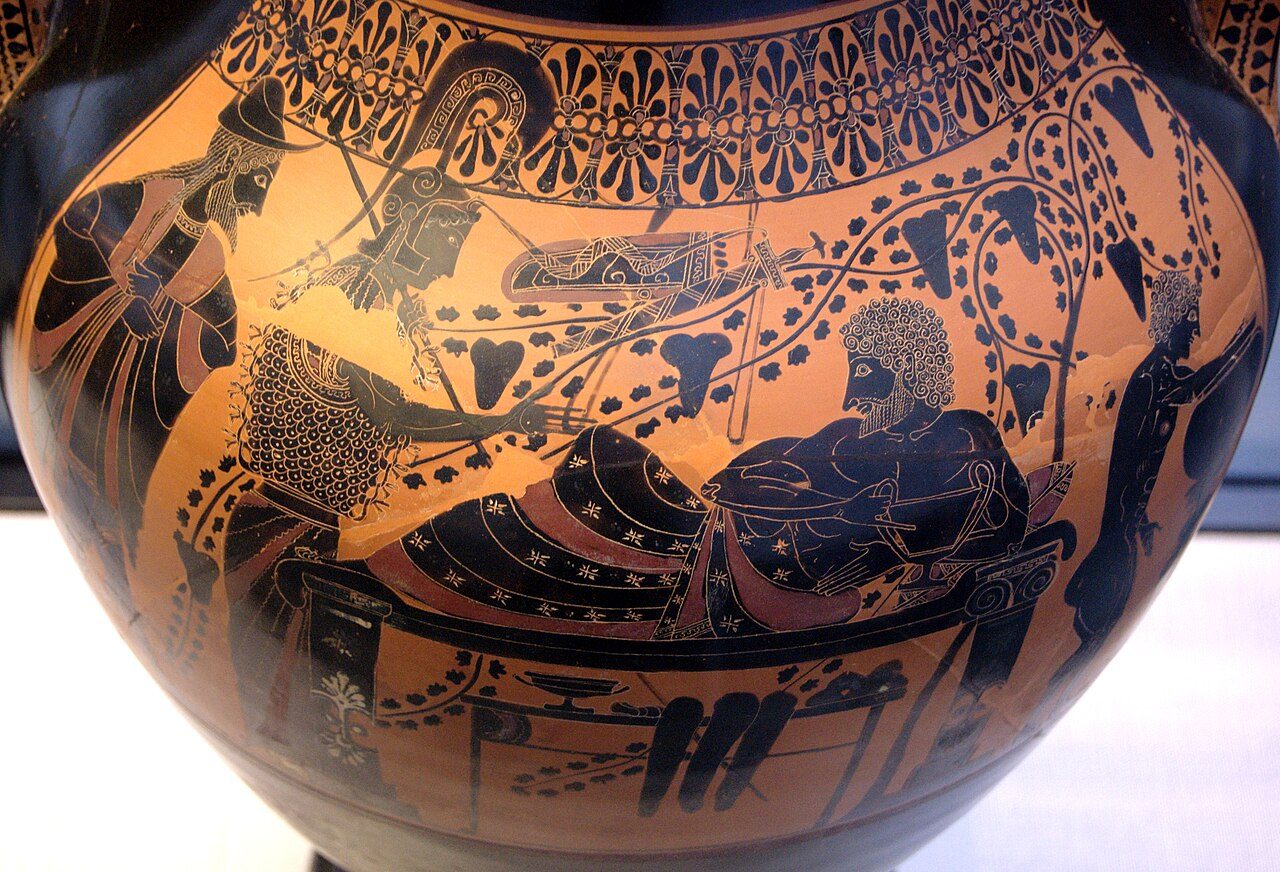
By convention, finely painted vessels of all shapes are called "vases", and there are over 100,000 significantly complete surviving pieces, giving (with the inscriptions that many carry) unparalleled insights into many aspects of Greek life. Sculptural or architectural pottery, also very often painted, are referred to as terracottas, and also survive in large quantities. In much of the literature, "pottery" means only painted vessels, or "vases". Pottery was the main form of grave goods deposited in tombs, often as "funerary urns" containing the cremated ashes, and was widely exported. The famous and distinctive style of Greek vase-painting with figures depicted with strong outlines, with thin lines within the outlines, reached its peak from about 600 to 350 BC, and divides into the two main styles, almost reversals of each other, of black-figure and red-figure painting, the other colour forming the background in each case. Other colours were very limited, normally to small areas of white and larger ones of a different purplish-red. Within the restrictions of these techniques and other strong conventions, vase-painters achieved remarkable results, combining refinement and powerful expression. White ground technique allowed more freedom in depiction, but did not wear well and was mostly made for burial. 1
Conventionally, the ancient Greeks are said to have made most pottery vessels for everyday use, not for display. Exceptions are the large Archaic monumental vases made as grave-markers, trophies won at games, such as the Panathenaic Amphorae filled with olive oil, and pieces made specifically to be left in graves; some perfume bottles have a money-saving bottom just below the mouth, so a small quantity makes them appear full. 1
History
The history of ancient Greek pottery is divided stylistically into five periods: 1
the Protogeometric from about 1050 BC the Geometric from about 900 BC the Late Geometric or Archaic from about 750 BC the Black Figure from the early 7th century BC and the Red Figure from about 530 BC During the Protogeometric and Geometric periods, Greek pottery was decorated with abstract designs, in the former usually elegant and large, with plenty of unpainted space, but in the Geometric often densely covering most of the surface, as in the large pots by the Dipylon Master, who worked around 750. He and other potters around his time began to introduce very stylised silhouette figures of humans and animals, especially horses. These often represent funeral processions, or battles, presumably representing those fought by the deceased. The Geometric phase was followed by an Orientalizing period in the late 8th century, when a few animals, many either mythical or not native to Greece (like the sphinx and lion respectively) were adapted from the Near East, accompanied by decorative motifs, such as the lotus and palmette. These were shown much larger than the previous figures. The Wild Goat Style is a regional variant, very often showing goats. Human figures were not so influenced from the East, but also became larger and more detailed. The fully mature black-figure technique, with added red and white details and incising for outlines and details, originated in Corinth during the early 7th century BC and was introduced into Attica about a generation later; it flourished until the end of the 6th century BC. The red-figure technique, invented in about 530 BC, reversed this tradition, with the pots being painted black and the figures painted in red. 1
Metalwork
Fine metalwork was an important art in ancient Greece, but later production is very poorly represented by survivals, most of which come from the edges of the Greek world or beyond, from as far as present-day France or Russia. Vessels and jewellery were produced to high standards, and exported far afield. Objects in silver, at the time worth more relative to gold than it is in modern times, were often inscribed by the maker with their weight, as they were treated largely as stores of value, and likely to be sold or re-melted before very long. During the Geometric and Archaic phases, the production of large metal vessels was an important expression of Greek creativity, and an important stage in the development of bronzeworking techniques, such as casting and repoussé hammering. Early sanctuaries, especially Olympia, have yielded many hundreds of tripod-bowl or sacrificial tripod vessels, mostly in bronze, deposited as votives. These had a shallow bowl with two handles raised high on three legs; in later versions the stand and bowl were different pieces. During the Orientalising period of the 8th century BC, such tripods were frequently decorated with figural protomes, in the shape of griffins, sphinxes and other fantastic creatures. Swords, the Greek helmet and often body-armour such as the muscle cuirass were made of bronze, sometimes decorated in precious metal, as in the 3rd-century Ksour Essef cuirass. Armour and "shield-bands" are two of the contexts for strips of Archaic low-relief scenes, which were also attached to various objects in wood; the band on the Vix Krater is a large example. 1
Monumental sculpture
The Greeks decided very early on that the human form was the most important subject for artistic endeavour. Seeing their gods as having human form, there was little distinction between the sacred and the secular in art—the human body was both secular and sacred. A male nude of Apollo or Heracles had only slight differences in treatment to one of that year's Olympic boxing champion. In the Archaic Period the most important sculptural form was the kouros (plural kouroi), the standing male nude (See for example Biton and Kleobis). 1
Materials, forms
Surviving ancient Greek sculptures were mostly made of two types of material. 1
The text above is adapted from the Wikipedia article “Ancient Greek art”, available under the Creative Commons Attribution-ShareAlike 4.0 licence. 1
ancient Greek art is art of Ancient Greece, according to the structured record cited below. This entry was generated automatically from that record and has not yet been reviewed by a person familiar with the tradition. 2
The source record links this tradition to 17 external registers, which can be verified through the citation. 2