The tradition & historical record
4 min read · 2 sourcesThe Annunciation has been one of the most frequent subjects of Christian art. Depictions of the Annunciation go back to early Christianity, with the Priscilla catacomb in Rome including the oldest known fresco of the Annunciation, dating to the 4th century. Scenes depicting the Annunciation represent the perpetual virginity of Mary via the announcement by the angel Gabriel that Mary would conceive a child to be born the son of God. The scene is an invariable one in cycles of the Life of the Virgin, and often included as the initial scene in those of the Life of Christ. Frescos depicting this scene have appeared in Roman Catholic Marian churches for centuries, and it has been a topic addressed by many artists in multiple media, ranging from stained glass to mosaic, to relief, to sculpture to oil painting. 1
Middle Ages and Renaissance
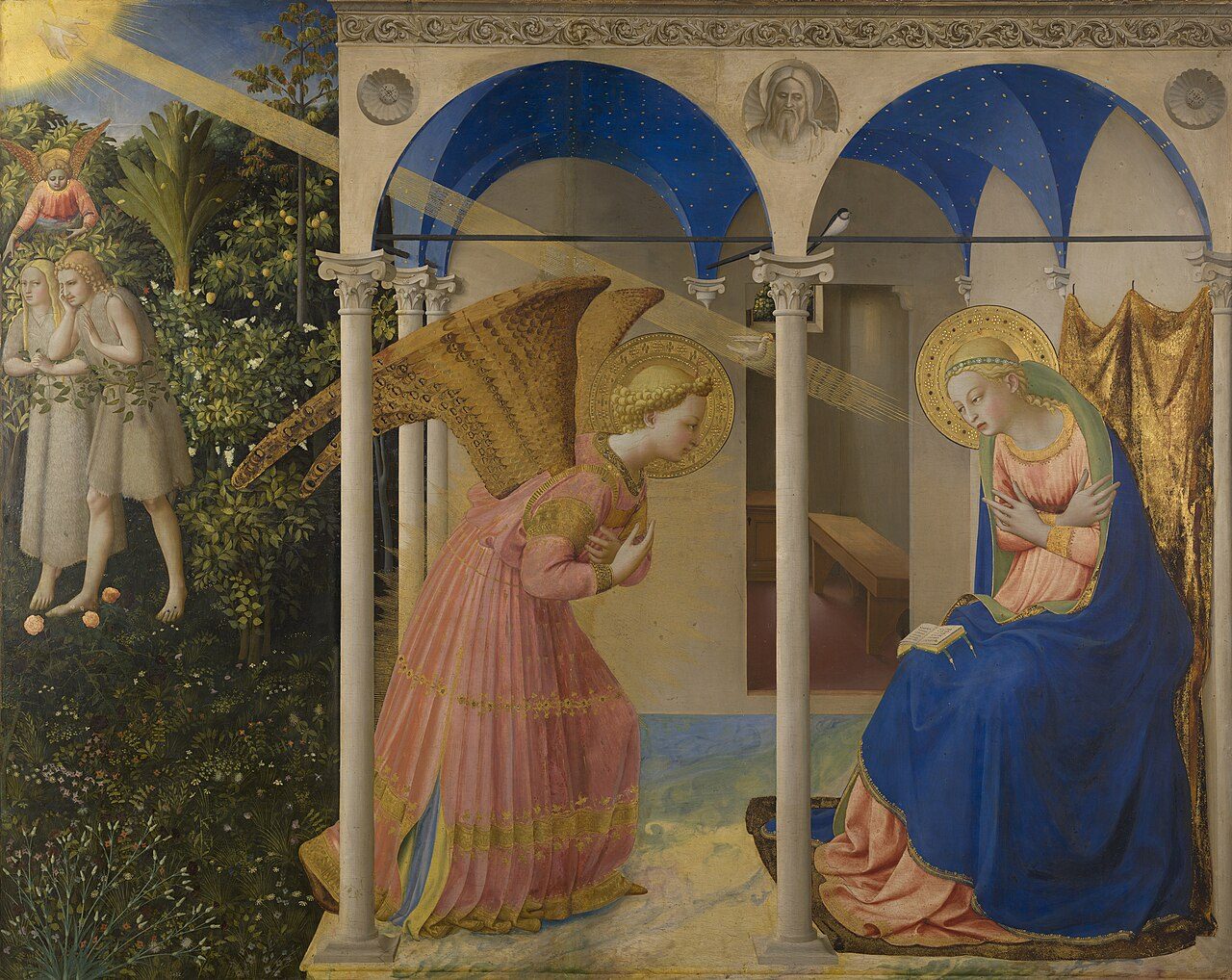
Particularly popular during the Middle Ages and Renaissance, it appears in the work of almost all of the great masters. The figures of the Virgin Mary and the archangel Gabriel, were favorite subjects of Roman Catholic Marian art. Works on the subject have been created by Sandro Botticelli, Leonardo da Vinci, Caravaggio, Duccio di Buoninsegna, Jan van Eyck, Murillo, and thousands of other artists. The mosaics of Pietro Cavallini in Santa Maria in Trastevere in Rome (1291), the frescos of Giotto in the Scrovegni Chapel in Padua (1303), Domenico Ghirlandaio's fresco at the church of Santa Maria Novella in Florence (1486), and Donatello's gilded sculpture at the church of Santa Croce, Florence (1435) are famous examples. The composition of depictions is very consistent, with Gabriel, normally standing on the left, facing the Virgin, who is generally seated or kneeling, at least in later depictions. Typically, Gabriel is shown in near-profile, while the Virgin faces more to the front. She is usually shown indoors, or in a porch of some kind, in which case Gabriel may be outside the building entirely, in the Renaissance often in a garden, which refers to the hortus conclusus, sometimes an explicit setting for Annunciations. The building is sometimes clearly the Virgin's home, but is also often intended to represent the Jerusalem Temple, as some legendary accounts placed the scene there. The Virgin may be shown reading, as medieval legend dating back to at least the time of the Church Fathers in Ambrose represented her as a considerable scholar, or engaged in a domestic task, often reflecting another legend that she was one of a number of virgins asked to weave a new Veil of the Temple. 1
Byzantine Rite
Byzantine Rite icons display, as is usual, even more consistent compositions than medieval Western images. The Virgin is nearly always on the right, normally either standing or seated on a throne with a building behind her; there are also often buildings visible behind Gabriel. These styles were generally copied in the West until a surprisingly late date, around the 13th century; more varied Western depictions were slower to develop than with other standard religious subjects. Because of the natural composition of the scene as two figures facing each other, the subject was often employed in the decoration of a diptych or tympaneum (decorated arch above a doorway). In churches of the Byzantine Rite, the Annunciation is typically depicted on the Holy Doors (decorative doorway leading from the nave into the sanctuary), and in the West the two figures are also found on different surfaces, in the outer panels of polyptychs that have an open and closed view, the doors of tabernacles, or simply on facing pages in illuminated manuscripts or different compartments of large altarpieces. 1
The text above is adapted from the Wikipedia article “Annunciation in Christian art”, available under the Creative Commons Attribution-ShareAlike 4.0 licence. 1
Annunciation in Christian art is subject in art, according to the structured record cited below. This entry was generated automatically from that record and has not yet been reviewed by a person familiar with the tradition. 2
The source record links this tradition to 2 external registers, which can be verified through the citation. 2