The tradition & historical record
6 min read · 2 sourcesThe Appalachian dulcimer (many variant names; see below) is a fretted string instrument of the zither family, typically with three or four strings, originally played in the Appalachian region of the United States. The body extends the length of the fingerboard, and its fretting is generally diatonic. 1
Name
The Appalachian dulcimer has many variant names. Most often it is simply called a dulcimer (also rendered as "dulcimore", "dulcymore", "delcimer", "delcimore", etc.). When it needs to be distinguished from the unrelated hammered dulcimer, various adjectives are added (drawn from location, playing style, position, shape, etc.). Example: mountain dulcimer, Kentucky dulcimer, plucked dulcimer, fretted dulcimer, lap dulcimer, teardrop dulcimer, box dulcimer, etc. The instrument has also acquired a number of nicknames (some shared by other instruments): "harmonium", "hog fiddle", "music box", "harmony box", and "mountain zither". 1
Origins and history
Although the Appalachian dulcimer first appeared in the early 19th century among Scotch-Irish immigrant communities in the Appalachian Mountains, the instrument has no known precedent in Ireland, Scotland or Northern England. Because of this, and a dearth of written records, the history of the Appalachian dulcimer has been, until fairly recently, largely speculative. Since 1980, more extensive research has traced the instrument's development through several distinct periods, and its likely origins in several similar European instruments: the Swedish hummel, the Norwegian langeleik, the German scheitholt, and the French épinette des Vosges. Folk historian Lucy M. Long said of the instrument's history: 1
Because few historical records of the dulcimer exist, the origins of the instrument were open to speculation until recently when Ralph Lee Smith and L. Alan Smith reconstructed the instrument's history by analyzing older dulcimers. The organological development of the dulcimer divides into three periods: transitional (1700 to mid-1800s), pre-revival or traditional (mid-1800s to 1940), and revival or contemporary (after 1940). Charles Maxson, an Appalachian luthier from Volga, West Virginia, speculated that early settlers were unable to make the more complex violin in the early days because of lack of tools and time. This was one of the factors which led to the building of the dulcimer, which has less dramatic curves. He too cited the langeleik, scheitholt and épinette des Vosges as ancestor instruments. Few true specimens of the mountain dulcimer exist from earlier than about 1880, when J. Edward Thomas of Knott County, Kentucky, began building and selling them. 1
Construction and form
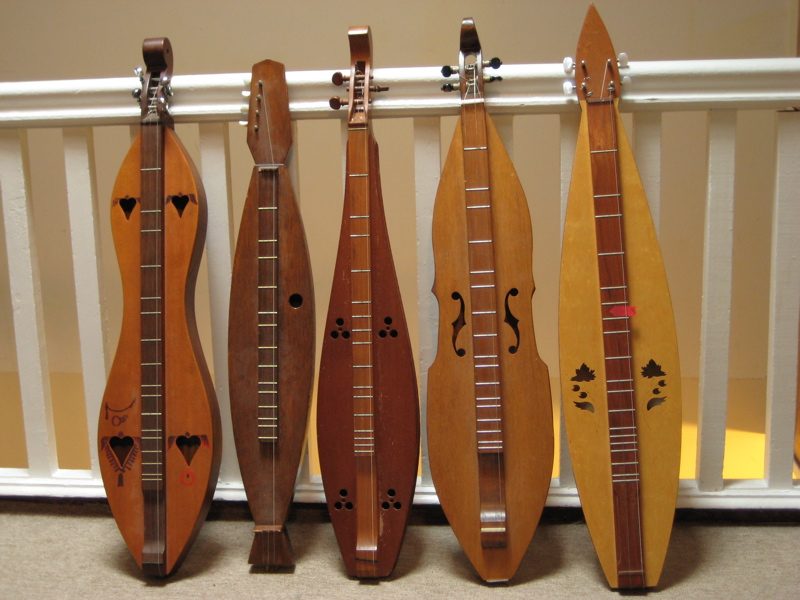
Organologically, the Appalachian dulcimer is a plucked box-zither; it is considered to be a folk instrument. Appalachian dulcimers are traditionally constructed of wood, and early instruments were typically made all of one wood, using wood commonly found in the particular area of the mountains where the builder lived. More recently, guitar aesthetics and construction ideals have been applied, with a tone wood such as spruce or cedar preferred for the top of the soundbox. A harder wood, such as mahogany or rosewood, will be used for the back, sides, and neck, and a hardwood such as rosewood, maple, or ebony is used for the fingerboard. As the modern dulcimer arose in America, and the bulk of them are still made there, American hardwoods such as walnut, oak, cherry, and apple are also still frequently employed by makers. As with many folk instruments, the Appalachian dulcimer has been made – and continues to be made – in many shapes, sizes, and variations in construction details; however, certain forms have proven more popular than others, and tend to predominate. The general format has a long narrow soundbox, with the "neck" centered in the soundbox and running the length of the instrument. Typical instruments are 70–100 cm (27 1/2–39 1/2 in.) long, 16–19 cm (6 1/2–7 1/2 in) wide at the widest bout, and the soundbox has a uniform depth of about 5–6 cm (2–2.5 in). The top of the fingerboard sits about 1.25 cm (1/2 in) above the top of the soundbox. The soundbox will typically have from two to four soundholes, two in the lower bout and two in the upper bout. 1
Production
Appalachian dulcimers are often made by individual craftsmen and small, family-run businesses located in the American South and particularly in Appalachia. It is easy and relatively common to order custom instruments, and custom-built Appalachian dulcimers can run considerably less in cost than other custom-built stringed instruments (e.g., guitar, mandolin, or banjo). Cheap imports from Romania, Pakistan and China are slowly making inroads into the American market. John Bailey's book, Making an Appalachian Dulcimer, is one of several still in print that provide instructions for constructing a dulcimer. 1
Fret placement
The frets of the Appalachian dulcimer are typically arranged in a diatonic scale. This is in contrast with instruments like the guitar or banjo, which are fretted chromatically. As early as the mid-1950s, some makers began to include at least one additional fret, usually the so-called "six and a half", "6½" or "6+" fret a half step below the octave. This enables one to play in the Ionian mode when tuned to D3-A3-D4 (the traditional tuning for the Mixolydian mode), where the scale starts on the open (unfretted) string. This arrangement is often found to be more conducive to chord-melody play. It also became common to add a fret one octave up from the 6+ fret, called the "13+" fret, and by the late 1970s these additional frets had become standard. Eventually, some builders began to offer further additional frets at the "1+" and "8+" positions or (as an alternative) the "4+" and "11+" positions. These additional frets facilitate the use of still more scales and modes without retuning. This trend eventually led to the availability of fully chromatic dulcimers, with twelve frets per octave, permitting playing in any key without re-tuning. The Original Chromatic Mountain Dulcimer was a Diatonic Mountain Dulcimer that has been converted by adding 5 extra frets (0+, 1+, 3+, 4+, & 6+) in all Octaves so it can play in every key for more flexibility. Chromatic fretting used to be controversial among dulcimer players, with traditionalists preferring what they feel is the greater authenticity of the diatonic fingerboard. 1
The text above is adapted from the Wikipedia article “Appalachian dulcimer”, available under the Creative Commons Attribution-ShareAlike 4.0 licence. 1
Appalachian dulcimer is fretted string instrument of the zither family, according to the structured record cited below. This entry was generated automatically from that record and has not yet been reviewed by a person familiar with the tradition. 2
The source record links this tradition to 11 external registers, which can be verified through the citation. 2