The tradition & historical record
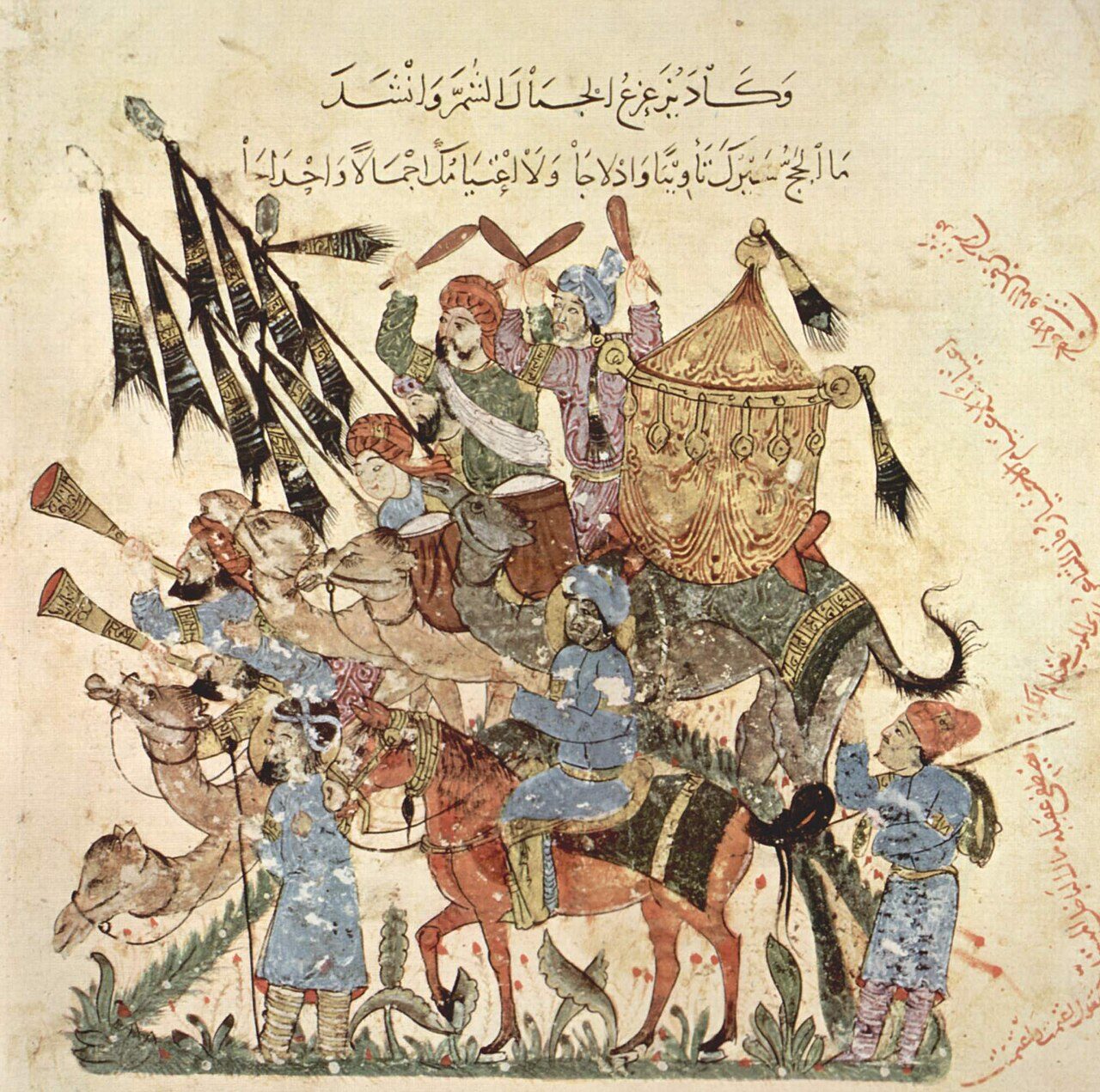
6 min read · 2 sourcesArabic miniatures (Arabic: ٱلْمُنَمْنَمَات ٱلْعَرَبِيَّة, Al-Munamnamāt al-ʿArabīyyah) are small paintings on paper, usually book or manuscript illustrations but also sometimes separate artworks that occupy entire pages. The earliest example dates from around 690 AD, with a flourishing of the art from between 1000 and 1200 AD in the Abbasid caliphate. The art form went through several stages of evolution while witnessing the fall and rise of several Islamic caliphates. Arab miniaturists absorbed Chinese and Persian influences brought by the Mongol destructions, and at last, got totally assimilated and subsequently disappeared due to the Ottoman occupation of the Arab world. Nearly all forms of Islamic miniatures (Persian miniatures, Ottoman miniatures and Mughal miniatures) owe their existences to Arabic miniatures, as Arab patrons were the first to demand the production of illuminated manuscripts in the Caliphate, it wasn't until the 14th century that the artistic skill reached the non-Arab regions of the Caliphate. Despite the considerable changes in Arabic miniature style and technique, even during their last decades, the early Umayyad Arab influence could still be noticed. 1
Non-figurative ornaments in early Mus'hafs
The following manuscripts are listed in a chronological order, however the date estimates of a codex may be concurrent or similar to those of other manuscripts due to the wide range of date estimates offered by radiocarbon dating: The Birmingham Quran manuscript is a parchment on which two leaves of an early Quranic manuscript are written. In 2015 the manuscript, which is held by the University of Birmingham, was radiocarbon dated to between 568 and 645 CE (in the Islamic calendar, between 56 BH and 25 AH). It is part of the Mingana Collection of Middle Eastern manuscripts, held by the university's Cadbury Research Library. The manuscript is written in ink on parchment, using an Arabic Hijazi script and is still clearly legible. The leaves preserve parts of Surahs 18 (Al-Kahf) to 20 (Taha). It was on display at the University of Birmingham in 2015 and then at Birmingham Museum and Art Gallery until 5 August 2016. The Cadbury Research Library has carried out multispectral analysis of the manuscript and XRF analysis of the inks. There are no diacritical marks to indicate short vowels, but consonants are occasionally differentiated with oblique dashes. The text is laid out in the format that was to become standard for complete Quran manuscripts, with chapter divisions indicated by a decorated line in the form of basic geometric shapes painted with red lead, an ancient pigment used from 300 BCE onwards, such motifs vary in color and shapes in this manuscript, in one folio, three wavy threads of orange-red colour separated by dots run parallel over the entire span of the page, In the outer margin, the three lines are interlaced to draw a highly stylized palm leaf, in another folio, the separator is covered with blackheads. 1
Emergence of Arabic miniatures
The only surviving Arabic illuminated manuscript dating from before the 11th century is the "Great Umayyad Qur'an". Found in the Great Mosque in Sana'a, ornamentation of this manuscript incorporated motifs that are very similar to those used to decorate the Dome of the Rock, the Great Mosque of Damascus and the desert castles of Umayyads. Because of this the time of production of this Qur'an has been narrowed to between 691 and 743 CE. It is the only lavishly illuminated Qur'an codex extant that can be securely placed in the Umayyad period. It's currently housed in the Dar al-Makhtutat. The manuscript includes full illustrations that take up entire pages, and also sūrah dividers and ornamental borders. One of the miniatures representing Jannah is based on a cosmogram, and, on the reverse, a mosque. 1
Rise
The first illustrated Arabic manuscript still preserved from the 11th century is Abd al-Rahman al-Sufi's Book of Fixed Stars, dated from around 1009 (Bodleian Library, Marsh144). This astronomy work was copied by the author's son himself, from models that already existed in the previous century. It is then necessary to wait until the end of the twelfth century to find a boom in miniatures in the Arab world. 1
Abbasid Caliphate (750–1258)
Several Islamic monarchs enjoyed a long reign, such as the Abbasid caliph An-Nasir or the regent then king of Mosul Badr al-Din Lu'lu' (1218-1259), contributing to the prosperity of the region and the emergence of a rich cultural background. It is also in this city the class of wealthy merchants were likely to order such works. The manuscripts still conserved today correspond to the end of this period of prosperity, the first half of the fourteenth century. 1
The Arab society present at that time showed a great interest in theatrical shows and particularly in puppets and shadow theatre. The appearance of the characters depicted in the miniatures is reminiscent of the figurines from these shows. In addition, the epoch featured a great enthusiasm for the sessions or Maqamat al-Harīrī, tales featuring a jester character to whom many adventures happen. The combination of these elements of interest may explain the commissioning of illuminated manuscripts of this text. It also explains the birth of a new genre of painting, representing realistically the details of daily life contemporary to the painter of the illustration. Finally, this emergence of the image is also explained by the weakening of the ban on figurative representation in the arts during this period. One of the most famous centers in the Arab world was the Baghdad School, also known as the Arab school, it was a relatively short-lived yet influential center of Arab art developed during the late 12th century in the capital Baghdad of the ruling Abbasid Caliphate. The movement had largely died out by the early 14th century, five decades following the invasion of the Mongols in 1258 and the downfall of the Abbasids' rule. 1
Fatimid Caliphate (909–1171)
Another example are the Fatimids who fueled a renaissance in Arabic figurative arts, thus developing a stylized and distinct style. The prevalence of books within the Fatimid empire was demonstrated by the existence of the Dār al-'Ilm, or the House of Knowledge. In 1045 CE, the Dār al-'Ilm was reported to contain 6,500 volumes of scientific and literary subjects. When the Fatimid dynasty dissolved during the twelfth century, the libraries and collections of books that existed in Cairo were dispersed, making it difficult to locate any complete manuscripts. Only fragments of text and paper are able to provide information of the content and style of Fatimid manuscripts. 1
It is rare to have an example of both text and illustrations of the same page, which makes it difficult to gather information about illuminated manuscripts. In some cases, it is possible that illustrations were added to an already existing text at a later date. Fatimid illustration style can be demonstrated by one surviving piece of paper, which was excavated in Cairo. 1
The text above is adapted from the Wikipedia article “Arabic miniature”, available under the Creative Commons Attribution-ShareAlike 4.0 licence. 1
Arabic miniature is small paintings on paper, according to the structured record cited below. This entry was generated automatically from that record and has not yet been reviewed by a person familiar with the tradition. 2
The source record links this tradition to 1 external register, which can be verified through the citation. 2