The tradition & historical record
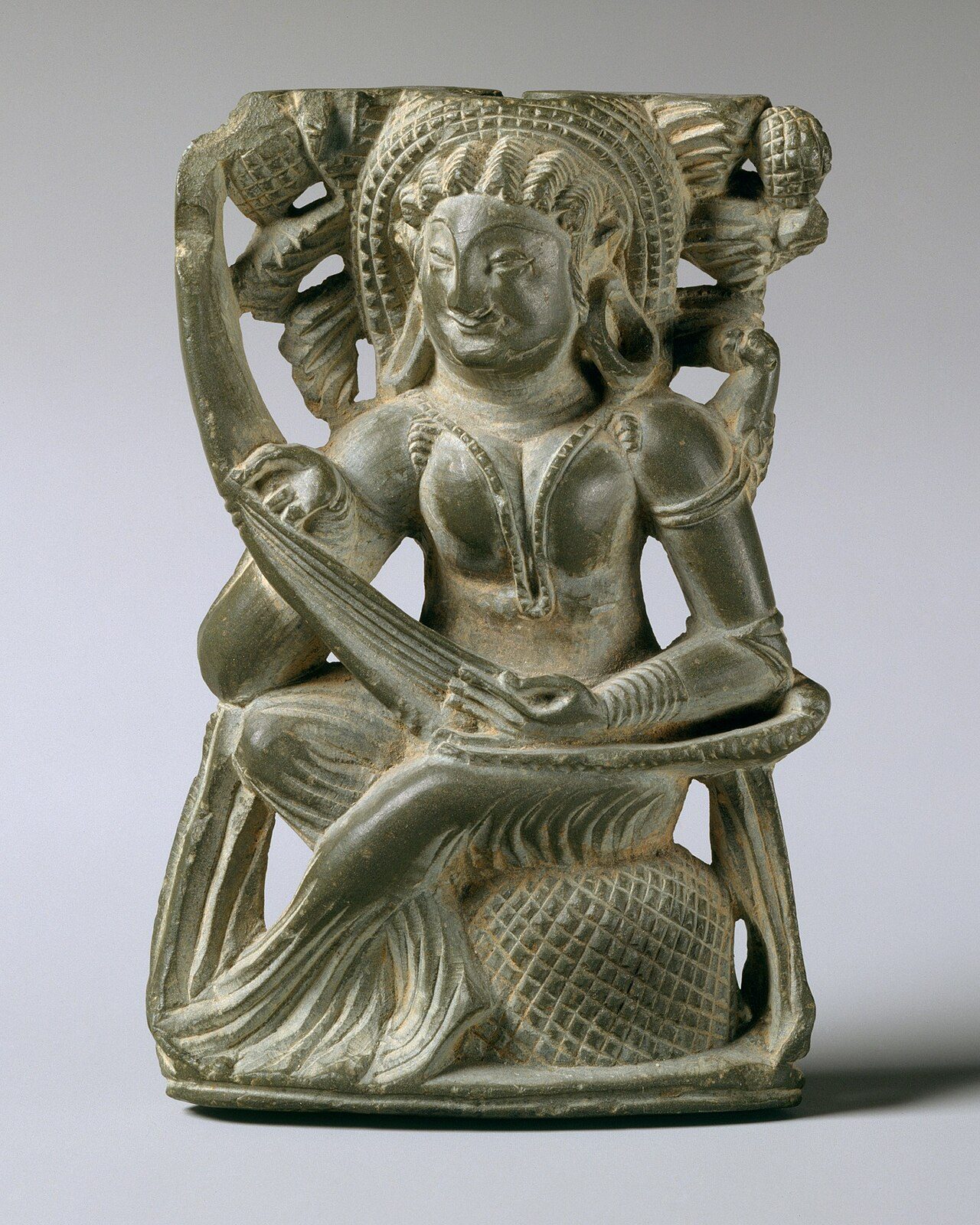
6 min read · 2 sourcesArched harps is a category in the Hornbostel-Sachs classification system for musical instruments, a type of harp. The instrument may also be called bow harp. With arched harps, the neck forms a continuous arc with the body and has an open gap between the two ends of the arc (open harps). Arched harps are probably the most ancient form of the harp, evolving from the musical bow. The first bowed harps appeared around 3000 B.C. in Iran and Mesopotamia and then in Egypt. India may have had the instrument as early as Mesopotamia. The horizontal arched-bow from Sumeria spread west to ancient Greece, Rome and Minoan Crete and eastward to India. Like Egypt, however, India continued to develop the instrument on its own; undated artwork in caves shows a harp resembling a musical bow, with improvised resonators of different shapes and different numbers of added strings. When the angular harp replaced the arched harp about 2000 B.C. in the Middle East and spread along the Silk Road, the arched harp was retained in India until after 800 A.D. (a form of ancient vina), and in Egypt until the Hellenistic Age (after 500 B.C). It can still be found today in Sub-Saharan Africa. From India the arched harp was introduced into Malaysia, as well as Champa and Burma (as early as 500 A.D.) where it is still played under the name of saung, and in 7th-century A.D. Cambodia as the pin Buddhists were involved with the spread of the arched harp in Asia. 1
Classification
The harp is a composite chordophone. It has string-carrying neck permanently attached to a resonator body that receives the vibrations of the strings and emits them as sound. Its strings are stretched between the neck and the body. What distinguishes it from lutes is that the plane of its strings is not parallel to the sound-emitting surface of the instrument's body, but perpendicular to it. The body and neck form an arch in arched harps, or two sides of a triangle in angular harps. If the triangle is completed, with a third side joining the body and neck, it is a frame harp. Harps without the third side are open harps. 1
Structure
The body of the bowed harp is resonator. Its shape is varied, and it can have the shape of a spade, spoon or ladle, boat or box, among others. A leather soundboard is stretched on its open surface facing the direction of the strings, and a string-holding rod usually runs along its center line, to which the strings are tied. Their other end is connected to the neck via a tuning device - which can be a special loop, rotating leather ring or tuning peg. The defining characteristic of the bowed harp is that its neck starts more or less in the direction of the longitudinal axis of the body, and then curves. Bow harps have relatively few strings, usually fewer than 10, compared to angular harps, which usually have 15 to 25 strings. Historically, strings were made of sinew (animal tendons). Other materials have included gut (animal intestines), plant fiber, braided hemp, cotton cord, silk, nylon, and wire. 1
Variations
Bowed harps are diverse in both size and shape, from instruments small enough for a child to hold in their arms to harps made from logs, left lying flat on the ground. Similar to the angular harps, a vertical and horizontal variant can be distinguished here. The strings of the vertical bowed harp are more or less vertical, and most of the time the resonating body of the instrument is below the neck. The high notes are closer to the musician, the low notes are further away, just like in the case of today's Western harp. The body of the horizontal bowed harp is in a horizontal position, and the neck typically grows out of the end of the instrument body farthest from the musician. 1
History
The musical bow has been identified by some researchers as "the earliest chordophone". The earliest image of a musical bow from circa 15,000 B.C. was found in the Cave of the Trois-Frères. Musical bows need resonators, and a calabash gourd is used for that purpose. The musical bow "probably" became the bow harp when its disconnected resonator and the bow were integrated, the bow becoming the instrument's neck, and more strings were added. A very early depiction of a bow-shaped harp with three strings survives on a clay tablet from the Uruk period at the end of the 4th millennium. The image is a pictograph, an early form of writing, showing a three-stringed bow harp. The earliest harps appeared in Mesopotamia (vertical) and Iran (horizontal), circa 3300–3000, and researchers haven't determined if one is earlier than the other. By 3000 B.C., bow harps were common in the Middle East. They were commonly depicted in Egypt by 2500 B.C. Harps depicted were always arched until about 2000 B.C. After that, harps were increasingly angular, until the arched harp disappeared from Mesopotamia and Iran. Frame harps used in Europe were invented about 1000 C.E. Separately, the Greeks had a frame harp, called spindle harp, shown well developed about 430 B.C. India also had early bow harps, similar to musical bows, visible in cave art which has not been precisely dated. 1
Earliest harp image
In excavations of Megiddo in the former land of Canaan, a harp image was found engraved on a paving stone dating from between 3300 and 3100 B.C. The image shows an apparent framed harp, probably in the hands of a woman, which was found in a group of 20 carvings on floor stones. According to Joachim Braun, this image of a stringed instrument predates the previously known images of Cycladic frame harps by 1000 years and is said to represent the oldest known forerunner of the Chang and angular harp in the Caucasus. Braun draws a typological connection to the tor-sapl-yukh angular harp played by the West Siberian Khanty and Mansi people up to the beginning of the 20th century, the free ends of which are connected by a strut. However, such an interpretation is not universally accepted; other authors want to be cautious in recognizing a harp or a lyre. 1
The text above is adapted from the Wikipedia article “Arched harp”, available under the Creative Commons Attribution-ShareAlike 4.0 licence. 1
arched harp is class of musical instruments, according to the structured record cited below. This entry was generated automatically from that record and has not yet been reviewed by a person familiar with the tradition. 2
The source record links this tradition to 4 external registers, which can be verified through the citation. 2